Social Movements
Madhya Pradesh Board · Class 12 · Sociology
Flashcards for Social Movements — Madhya Pradesh Board Class 12 Sociology. Quick Q&A cards covering key concepts, definitions, and formulas.
Interactive on Super Tutor
Studying Social Movements? Get the full interactive chapter.
Quizzes, flashcards, AI doubt-solver and a step-by-step study plan — built for flashcards and more.
1,000+ Class 12 students started this chapter today
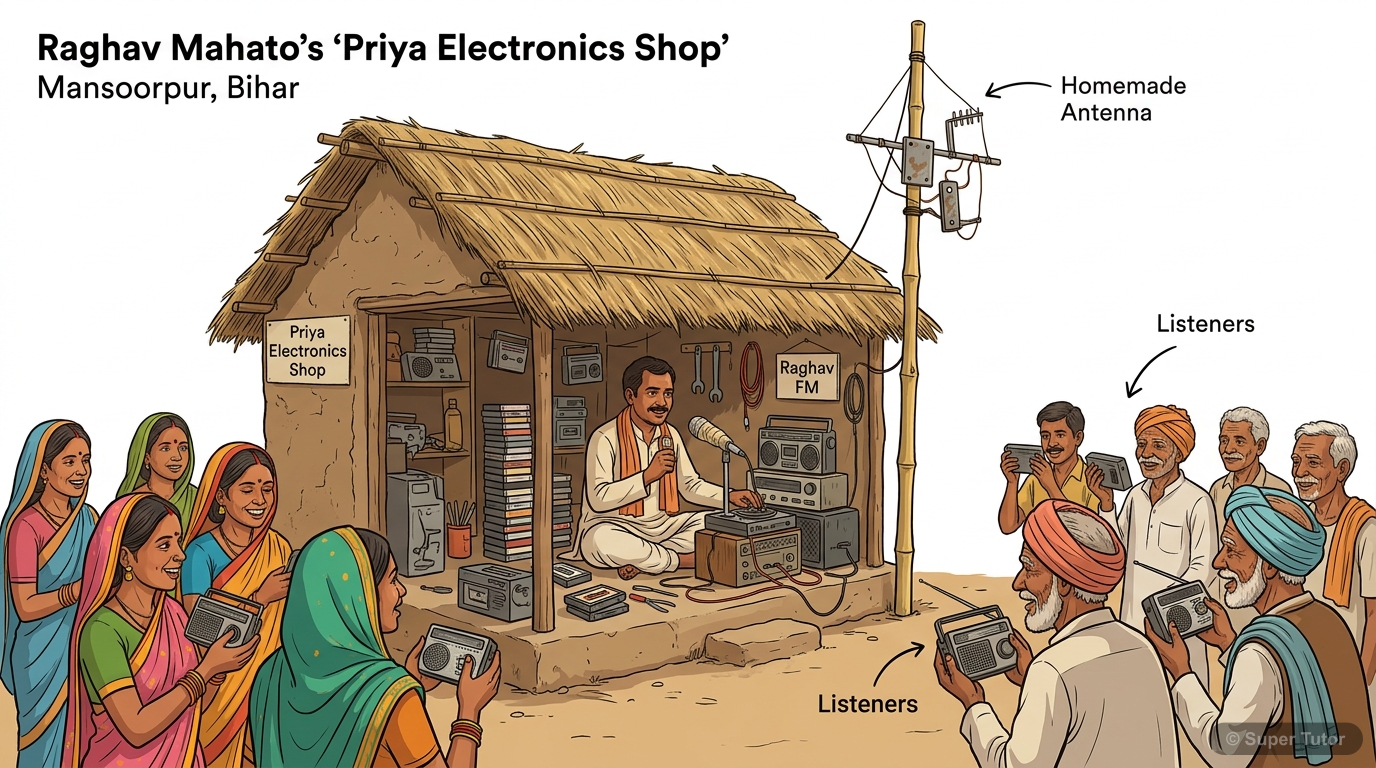
Learn better with visuals Super Tutor has hundreds of illustrations like this across every chapter — all free to try.
Get startedWhat is a social movement? Define its key characteristics.
Answer
A social movement is sustained collective action over time directed towards bringing about change in society. Key characteristics include: 1) Sustained collective action 2) Some degree of organization…
Distinguish between social change and social movements.
Answer
Social change is continuous and ongoing - the sum total of countless individual and collective actions over time and space. Social movements are directed towards specific goals and involve long, conti…
What are counter movements? Give examples from Indian history.
Answer
Counter movements arise in defence of status quo when social movements seek change. Examples: 1) Dharma Sabha formed to defend sati when Raja Rammohun Roy campaigned against it 2) Protests against gir…
Classify the three main types of social movements with examples.
Answer
1) Redemptive/Transformatory: Aims to change personal consciousness and actions (e.g., Narayana Guru leading Ezhava community in Kerala) 2) Reformist: Gradual change through incremental steps (e.g., l…
What is the significance of the Chartism movement in England?
Answer
Chartism was a social movement for parliamentary representation in England. In 1839, over 1.25 million people signed the People's Charter demanding universal male suffrage, voting by ballot, and right…
Explain the difference between 'old' and 'new' social movements.
Answer
Old movements: Class-based, focused on redistribution of power, led by political parties and trade unions, addressed economic inequality. New movements: Quality-of-life issues (environment), not neces…
What were the main causes and significance of the Chipko Movement?
Answer
Causes: Government contractors cutting oak and rhododendron forests; villagers dependent on forests for firewood, fodder, and necessities. Significance: 1) Economic issue - subsistence vs profit econo…
Describe the evolution of peasant movements in India from pre-independence to post-independence.
Answer
Pre-1947: Localised struggles (Bengal indigo revolt 1859-62, Deccan riots 1857), Gandhian movements (Bardoli Satyagraha 1928, Champaran 1917-18), organised movements (Bihar Kisan Sabha 1929, All India…
+14 more flashcards available
Practice AllFrequently Asked Questions
What are the important topics in Social Movements for Madhya Pradesh Board Class 12 Sociology?
How to score full marks in Social Movements — Madhya Pradesh Board Class 12 Sociology?
How many flashcards are available for Social Movements?
Sources & Official References
Content is aligned to the official syllabus. Refer to the board website for the latest curriculum.
More resources for Social Movements
Important Questions
Practice with board exam-style questions
Syllabus
What topics to cover
Revision Notes
Key points for last-minute revision
Study Plan
Step-by-step plan to ace this chapter
Formula Sheet
All formulas in one place
Chapter Summary
Understand the chapter at a glance
Practice Quiz
Test yourself with a quick quiz
Concept Maps
See how topics connect visually
For serious students
Get the full Social Movements chapter — for free.
Quizzes, flashcards, AI doubt-solver and a step-by-step study plan for Madhya Pradesh Board Class 12 Sociology.