Forest Society and Colonialism
Madhya Pradesh Board · Class 9 · Social Science
Summary of Forest Society and Colonialism for Madhya Pradesh Board Class 9 Social Science. Key concepts, important points, and chapter overview.
Interactive on Super Tutor
Studying Forest Society and Colonialism? Get the full interactive chapter.
Quizzes, flashcards, AI doubt-solver and a step-by-step study plan — built for chapter summary and more.
1,000+ Class 9 students started this chapter today
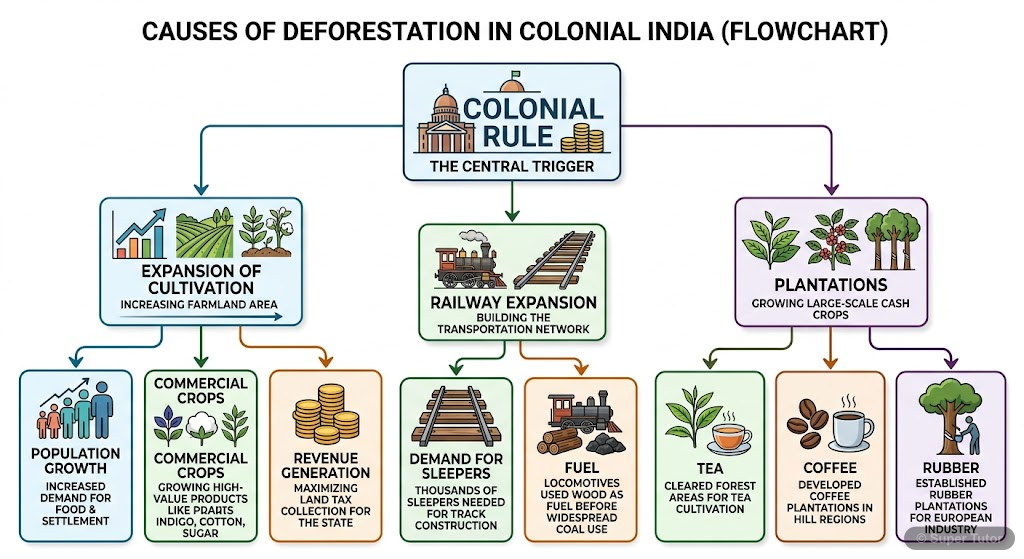
Super Tutor has 12+ illustrations like this for Forest Society and Colonialism alone — flashcards, concept maps, and step-by-step visuals.
See them allOverview
This chapter explores how colonial rule dramatically transformed India's forests and the lives of forest communities. It examines the causes of deforestation, the rise of commercial forestry, and the impact of colonial policies on traditional forest-dependent societies. The chapter also includes a c
Key Concepts
The large
The large-scale clearing of forests that accelerated during colonial rule. Between 1700-1995, 13.9 million sq km of forest was cleared globally. In In
A forest management system introduced by
A forest management system introduced by German expert Dietrich Brandis, involving cutting natural mixed forests and replacing them with single-specie
Colonial laws that classified forests into
Colonial laws that classified forests into Reserved (completely protected), Protected (limited access), and Village forests (community use allowed). T
Traditional farming practice where parts
Traditional farming practice where parts of forests are cut and burnt in rotation, crops grown for 2-3 years, then land left to regenerate for 12-18 y
A major uprising by the Gond
A major uprising by the Gond, Dhurwa, and other communities in Bastar against colonial forest policies. Led by figures like Gunda Dhur, the rebellion
Learning Objectives
- Understand the various causes of deforestation during colonial rule in India
- Analyze the concept of 'scientific forestry' introduced by the British and its impact
- Examine how colonial forest laws affected the lives of forest communities
- Study the Bastar rebellion of 1910 as an example of forest people's resistance
- Compare forest management policies in India and Java, Indonesia
Frequently Asked Questions
What are the important topics in Forest Society and Colonialism for Madhya Pradesh Board Class 9 Social Science?
How to score full marks in Forest Society and Colonialism — Madhya Pradesh Board Class 9 Social Science?
Sources & Official References
Content is aligned to the official syllabus. Refer to the board website for the latest curriculum.
More resources for Forest Society and Colonialism
Important Questions
Practice with board exam-style questions
Syllabus
What topics to cover
Revision Notes
Key points for last-minute revision
Study Plan
Step-by-step plan to ace this chapter
Flashcards
Quick-fire cards for active recall
Formula Sheet
All formulas in one place
Practice Quiz
Test yourself with a quick quiz
Concept Maps
See how topics connect visually
For serious students
Get the full Forest Society and Colonialism chapter — for free.
Quizzes, flashcards, AI doubt-solver and a step-by-step study plan for Madhya Pradesh Board Class 9 Social Science.