Natural Vegetation and Wildlife
Madhya Pradesh Board · Class 9 · Social Science
Summary of Natural Vegetation and Wildlife for Madhya Pradesh Board Class 9 Social Science. Key concepts, important points, and chapter overview.
Interactive on Super Tutor
Studying Natural Vegetation and Wildlife? Get the full interactive chapter.
Quizzes, flashcards, AI doubt-solver and a step-by-step study plan — built for chapter summary and more.
1,000+ Class 9 students started this chapter today
Super Tutor has 12+ illustrations like this for Natural Vegetation and Wildlife alone — flashcards, concept maps, and step-by-step visuals.
See them allOverview
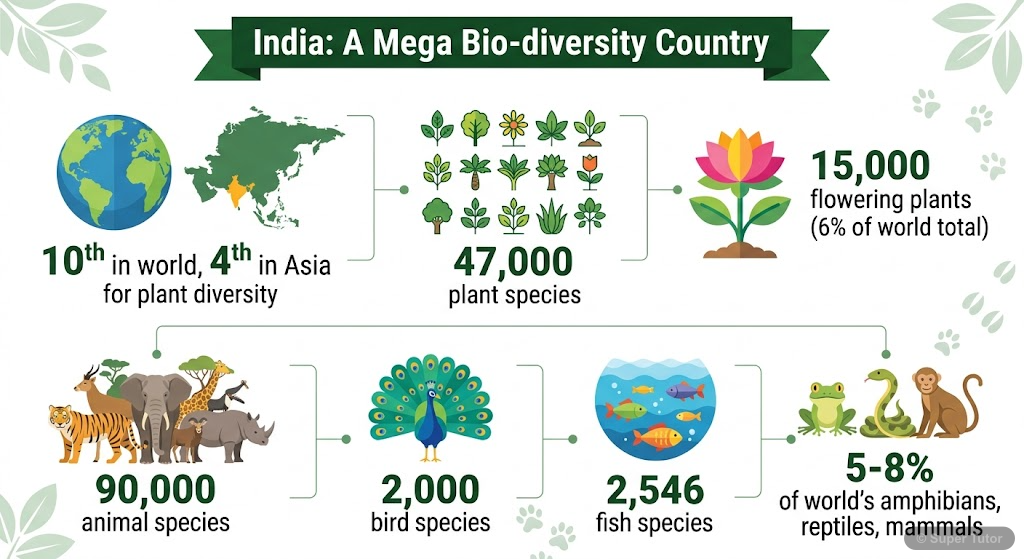
India is one of the 12 mega bio-diversity countries in the world, ranking 10th globally and 4th in Asia for plant diversity. With about 47,000 plant species and 90,000 animal species, India's natural vegetation and wildlife are incredibly diverse. Natural vegetation refers to plant communities that
Key Concepts
Natural vegetation (virgin vegetation) grows naturally
Natural vegetation (virgin vegetation) grows naturally without human aid and remains undisturbed, while cultivated crops and orchards are human-made.
Found in areas with over 200
Found in areas with over 200 cm rainfall, these forests remain green year-round. Trees reach 60+ meters height with multi-layered structure. Important
Most widespread forests in India
Most widespread forests in India, receiving 70-200 cm rainfall. Trees shed leaves for 6-8 weeks in dry summer. Divided into moist deciduous (100-200 c
Found in areas with less than
Found in areas with less than 70 cm rainfall, mainly in northwestern India. Plants have adaptations like long roots, succulent stems, and small thick
Mountain forests showing vegetation succession
Mountain forests showing vegetation succession with altitude. Wet temperate (1000-2000m), temperate coniferous (1500-3000m), and alpine vegetation (ab
Learning Objectives
- Understand the concept of natural vegetation and its difference from cultivated vegetation
- Identify and classify the five major types of vegetation found in India
- Analyze the relationship between climate, rainfall, and vegetation patterns
- Recognize the diverse wildlife species found in different vegetation zones
- Appreciate the importance of medicinal plants in Indian traditional medicine
Frequently Asked Questions
What are the important topics in Natural Vegetation and Wildlife for Madhya Pradesh Board Class 9 Social Science?
How to score full marks in Natural Vegetation and Wildlife — Madhya Pradesh Board Class 9 Social Science?
Sources & Official References
Content is aligned to the official syllabus. Refer to the board website for the latest curriculum.
More resources for Natural Vegetation and Wildlife
Important Questions
Practice with board exam-style questions
Syllabus
What topics to cover
Revision Notes
Key points for last-minute revision
Study Plan
Step-by-step plan to ace this chapter
Flashcards
Quick-fire cards for active recall
Formula Sheet
All formulas in one place
Practice Quiz
Test yourself with a quick quiz
Concept Maps
See how topics connect visually
For serious students
Get the full Natural Vegetation and Wildlife chapter — for free.
Quizzes, flashcards, AI doubt-solver and a step-by-step study plan for Madhya Pradesh Board Class 9 Social Science.