Physical Features of India
Madhya Pradesh Board · Class 9 · Social Science
Summary of Physical Features of India for Madhya Pradesh Board Class 9 Social Science. Key concepts, important points, and chapter overview.
Interactive on Super Tutor
Studying Physical Features of India? Get the full interactive chapter.
Quizzes, flashcards, AI doubt-solver and a step-by-step study plan — built for chapter summary and more.
1,000+ Class 9 students started this chapter today
Learn better with visuals Super Tutor has hundreds of illustrations like this across every chapter — all free to try.
Get startedOverview
India is a vast country with diverse landforms including mountains, plains, deserts, plateaus, and islands. The land displays great physical variation, from ancient stable landmasses like the Peninsular Plateau to the young, unstable Himalayan mountains. Understanding these physical features helps u
Key Concepts
India's physical features are grouped into
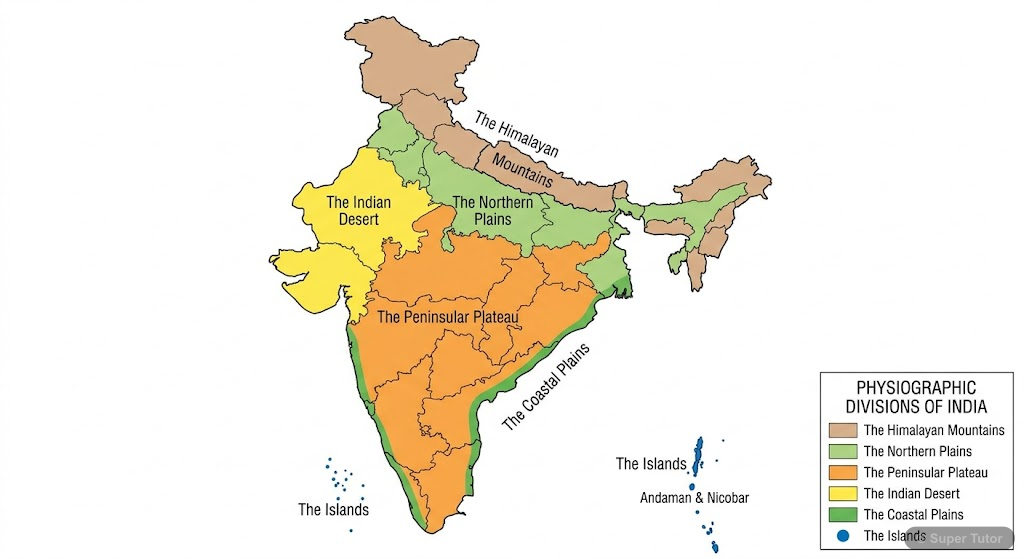
India's physical features are grouped into six main divisions: (1) The Himalayan Mountains, (2) The Northern Plains, (3) The Peninsular Plateau, (4) T
The Himalayas are geologically young fold
The Himalayas are geologically young fold mountains stretching 2,400 km from Indus to Brahmaputra. They consist of three parallel ranges: Himadri (Gre
Formed by alluvial deposits from Indus
Formed by alluvial deposits from Indus, Ganga, and Brahmaputra river systems over millions of years. The plain covers 7 lakh sq km and is divided into
A tableland of old crystalline
A tableland of old crystalline, igneous, and metamorphic rocks formed from Gondwana land. Divided into Central Highlands (north of Narmada) and Deccan
Western coast has narrow plains (Konkan
Western coast has narrow plains (Konkan, Kannad, Malabar) between Western Ghats and Arabian Sea. Eastern coast has wider plains (Northern Circar, Coro
Learning Objectives
- Identify and locate the six major physiographic divisions of India
- Understand the formation and characteristics of the Himalayan mountain system
- Explain the formation and features of the Northern Plains
- Describe the structure and divisions of the Peninsular Plateau
- Analyze the characteristics of India's coastal plains and desert regions
Frequently Asked Questions
What are the important topics in Physical Features of India for Madhya Pradesh Board Class 9 Social Science?
How to score full marks in Physical Features of India — Madhya Pradesh Board Class 9 Social Science?
Sources & Official References
Content is aligned to the official syllabus. Refer to the board website for the latest curriculum.
More resources for Physical Features of India
Important Questions
Practice with board exam-style questions
Syllabus
What topics to cover
Revision Notes
Key points for last-minute revision
Study Plan
Step-by-step plan to ace this chapter
Flashcards
Quick-fire cards for active recall
Formula Sheet
All formulas in one place
Practice Quiz
Test yourself with a quick quiz
Concept Maps
See how topics connect visually
For serious students
Get the full Physical Features of India chapter — for free.
Quizzes, flashcards, AI doubt-solver and a step-by-step study plan for Madhya Pradesh Board Class 9 Social Science.