Electricity
Rajasthan Board · Class 10 · Science
Flashcards for Electricity — Rajasthan Board Class 10 Science. Quick Q&A cards covering key concepts, definitions, and formulas.
Interactive on Super Tutor
Studying Electricity? Get the full interactive chapter.
Quizzes, flashcards, AI doubt-solver and a step-by-step study plan — built for flashcards and more.
1,000+ Class 10 students started this chapter today
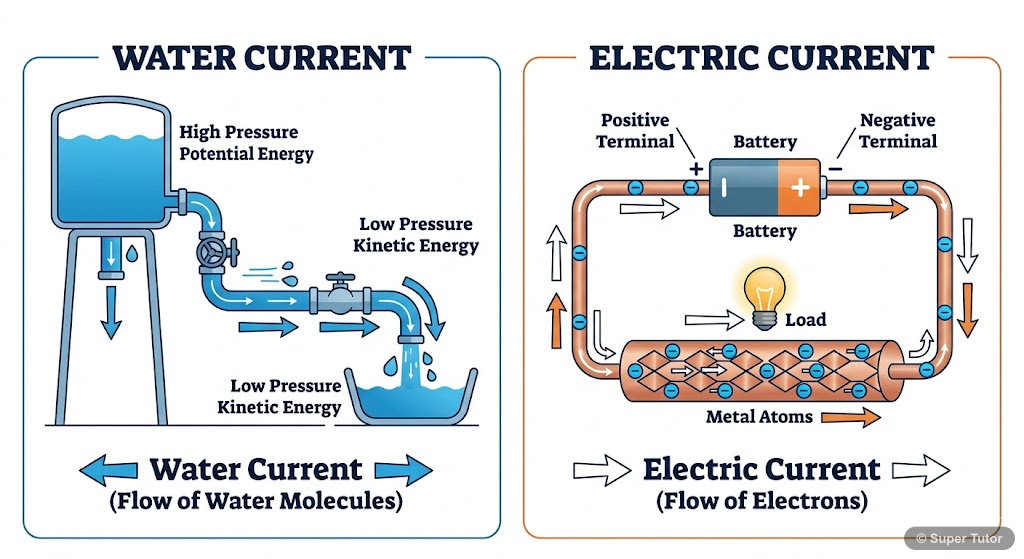
Super Tutor has 19+ illustrations like this for Electricity alone — flashcards, concept maps, and step-by-step visuals.
See them allA torch bulb glows when connected to a battery but stops glowing when the switch is turned off. Why does this happen?
Answer
The switch creates or breaks a conducting path between the battery and bulb. When the switch is ON, it completes the electric circuit allowing current to flow through the bulb, making it glow. When OF…
If 300 coulombs of charge flows through a wire in 10 minutes, calculate the electric current.
Answer
Given: Q = 300 C, t = 10 min = 600 s Using formula: I = Q/t I = 300 C ÷ 600 s = 0.5 A Therefore, the electric current is 0.5 amperes. This means 0.5 coulombs of charge flows through the wire every sec…
What is electric current and what causes it to flow?
Answer
Electric current is the flow of electric charges through a conductor. It's measured as the amount of charge flowing through a cross-section per unit time (I = Q/t). Current flows due to potential diff…
How much work is done when 4 coulombs of charge moves across a potential difference of 15 volts?
Answer
Given: Q = 4 C, V = 15 V Using formula: W = VQ W = 15 V × 4 C = 60 J Therefore, 60 joules of work is done. This energy is provided by the battery to move the charges through the circuit against resist…
Why do we measure potential difference in parallel and current in series in electric circuits?
Answer
Voltmeter measures potential difference between two points, so it's connected in parallel to compare the 'electrical pressure' at those points. Ammeter measures current flowing through a component, so…
A wire carrying 2A current has 24V across it. What is its resistance? What happens if voltage doubles?
Answer
Given: I = 2 A, V = 24 V Using Ohm's law: R = V/I = 24V ÷ 2A = 12 Ω If voltage doubles to 48V: I = V/R = 48V ÷ 12Ω = 4 A Resistance remains constant (property of conductor), but current doubles when v…
Why does a thicker wire have less resistance than a thinner wire of the same material and length?
Answer
Resistance is inversely proportional to cross-sectional area (R ∝ 1/A). A thicker wire has larger cross-sectional area, providing more space for electrons to flow. Like a wider road allows more traffi…
A nichrome wire of length 1m and area 0.01 mm² has resistivity 100×10⁻⁶ Ωm. Calculate its resistance.
Answer
Given: l = 1 m, A = 0.01 mm² = 0.01×10⁻⁶ m², ρ = 100×10⁻⁶ Ωm Using formula: R = ρl/A R = (100×10⁻⁶ × 1) ÷ (0.01×10⁻⁶) R = 100×10⁻⁶ ÷ 10⁻⁸ = 10 Ω The nichrome wire has resistance of 10 ohms, suitable f…
+12 more flashcards available
Practice AllFrequently Asked Questions
What are the important topics in Electricity for Rajasthan Board Class 10 Science?
How to score full marks in Electricity — Rajasthan Board Class 10 Science?
How many flashcards are available for Electricity?
Sources & Official References
Content is aligned to the official syllabus. Refer to the board website for the latest curriculum.
More resources for Electricity
Important Questions
Practice with board exam-style questions
Syllabus
What topics to cover
Revision Notes
Key points for last-minute revision
Study Plan
Step-by-step plan to ace this chapter
Formula Sheet
All formulas in one place
Chapter Summary
Understand the chapter at a glance
Practice Quiz
Test yourself with a quick quiz
Concept Maps
See how topics connect visually
For serious students
Get the full Electricity chapter — for free.
Quizzes, flashcards, AI doubt-solver and a step-by-step study plan for Rajasthan Board Class 10 Science.