Chemical Kinetics
Rajasthan Board · Class 12 · Chemistry
Summary of Chemical Kinetics for Rajasthan Board Class 12 Chemistry. Key concepts, important points, and chapter overview.
Interactive on Super Tutor
Studying Chemical Kinetics? Get the full interactive chapter.
Quizzes, flashcards, AI doubt-solver and a step-by-step study plan — built for chapter summary and more.
1,000+ Class 12 students started this chapter today
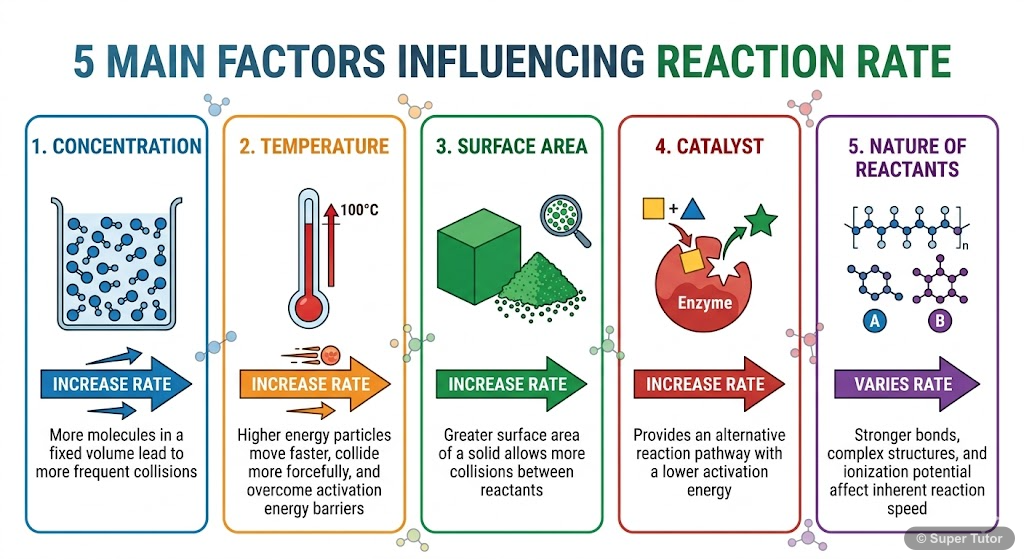
Learn better with visuals Super Tutor has hundreds of illustrations like this across every chapter — all free to try.
Get startedOverview
Chemical Kinetics is the branch of chemistry that studies the speed or rate of chemical reactions and the factors that influence these rates. Unlike thermodynamics which tells us whether a reaction is feasible, kinetics tells us how fast the reaction will proceed. This knowledge helps us understand
Key Concepts
The rate of a reaction
The rate of a reaction is defined as the change in concentration of reactants or products per unit time. It can be expressed as: Rate = -Δ[R]/Δt (for
Rate law expresses the relationship between
Rate law expresses the relationship between reaction rate and concentration of reactants: Rate = k[A]ˣ[B]ʸ, where k is the rate constant and x, y are
The order of a reaction
The order of a reaction is the sum of powers of concentration terms in the rate law (x + y in Rate = k[A]ˣ[B]ʸ). Individual orders (x, y) show sensiti
Molecularity is the number of molecules
Molecularity is the number of molecules that participate in an elementary reaction step. It can be 1 (unimolecular), 2 (bimolecular), or 3 (termolecul
These equations relate concentration to time
These equations relate concentration to time directly. For zero-order: [R] = [R]₀ - kt; For first-order: ln[R] = ln[R]₀ - kt or [R] = [R]₀e⁻ᵏᵗ. These
Learning Objectives
- Define average and instantaneous rate of reactions and express them mathematically
- Understand the relationship between reaction rate and concentration changes
- Distinguish between elementary and complex reactions
- Differentiate between molecularity and order of reactions
- Define and calculate rate constants for different order reactions
Frequently Asked Questions
What are the important topics in Chemical Kinetics for Rajasthan Board Class 12 Chemistry?
How to score full marks in Chemical Kinetics — Rajasthan Board Class 12 Chemistry?
Sources & Official References
Content is aligned to the official syllabus. Refer to the board website for the latest curriculum.
More resources for Chemical Kinetics
Important Questions
Practice with board exam-style questions
Syllabus
What topics to cover
Revision Notes
Key points for last-minute revision
Study Plan
Step-by-step plan to ace this chapter
Flashcards
Quick-fire cards for active recall
Formula Sheet
All formulas in one place
Practice Quiz
Test yourself with a quick quiz
Concept Maps
See how topics connect visually
For serious students
Get the full Chemical Kinetics chapter — for free.
Quizzes, flashcards, AI doubt-solver and a step-by-step study plan for Rajasthan Board Class 12 Chemistry.