Population : Distribution, Density, Growth and Composition
Rajasthan Board · Class 12 · Geography
Summary of Population : Distribution, Density, Growth and Composition for Rajasthan Board Class 12 Geography. Key concepts, important points, and chapter overview.
Interactive on Super Tutor
Studying Population : Distribution, Density, Growth and Composition? Get the full interactive chapter.
Quizzes, flashcards, AI doubt-solver and a step-by-step study plan — built for chapter summary and more.
1,000+ Class 12 students started this chapter today
This is just one of 8+ visuals inside Super Tutor's Population : Distribution, Density, Growth and Composition chapter
Explore the full setOverview
India is the second most populous country in the world with 1,210 million people (2011 Census). This chapter explores how India's population is distributed across the country, its density patterns, growth trends over time, and composition in terms of rural-urban distribution, language, religion, and
Key Concepts
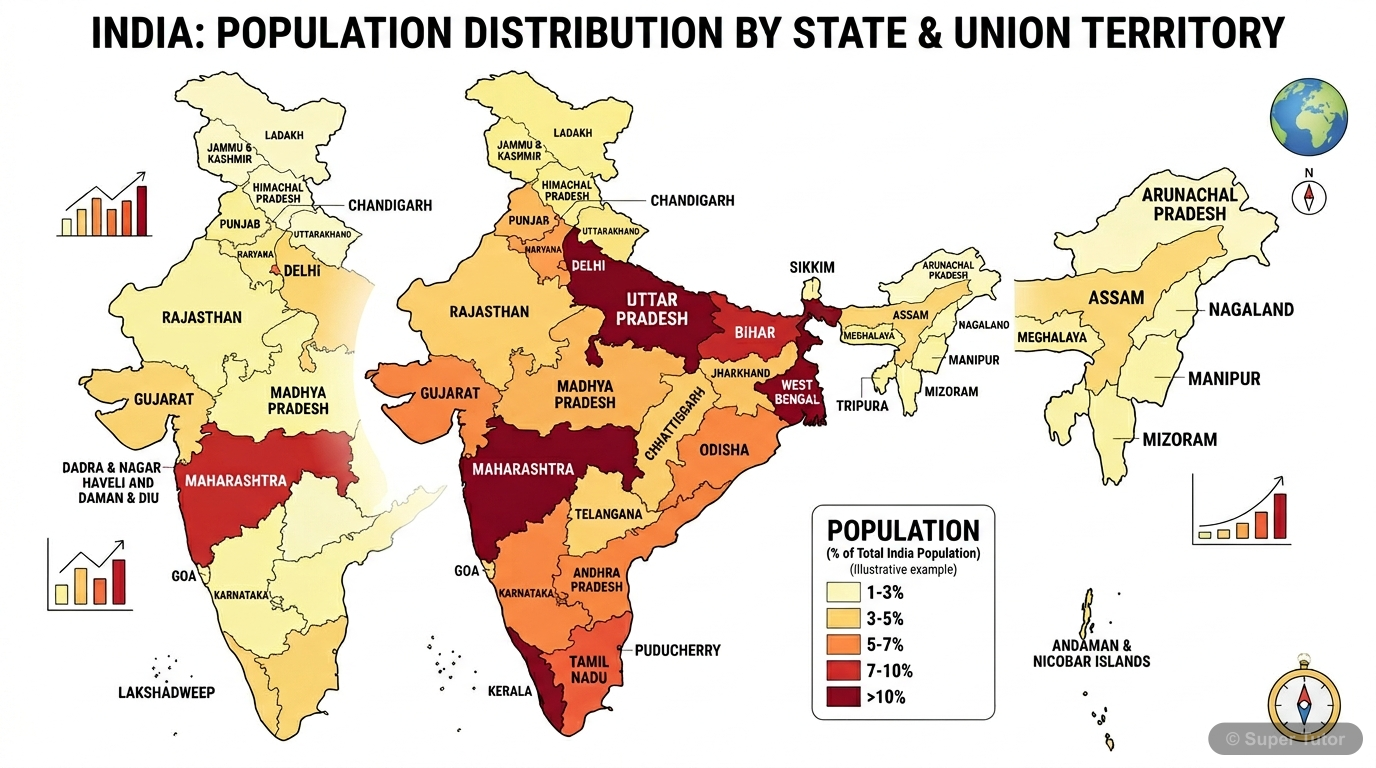
The uneven spread of population across
The uneven spread of population across India's territory. States like Uttar Pradesh, Maharashtra, Bihar, and West Bengal have the highest populations,
Number of persons per unit area
Number of persons per unit area. India's density is 382 persons per sq km (2011), ranging from 17 persons per sq km in Arunachal Pradesh to 11,297 in
Four distinct phases
Four distinct phases: Phase I (1901-1921) - Stagnant growth with high birth and death rates; Phase II (1921-1951) - Steady growth with declining death
68
68.8% of India's population lives in villages (640,867 villages with 597,608 inhabited). Urban population is 31.16% but growing rapidly due to economi
India has 22 scheduled languages
India has 22 scheduled languages and numerous dialects belonging to four language families: Indo-European (73%), Dravidian (20%), Sino-Tibetan (0.85%)
Learning Objectives
- Understand the patterns of spatial distribution of India's population
- Analyze population density and its variations across different regions
- Examine the growth phases of India's population from 1901-2011
- Study the composition of population by residence, language, religion, and occupation
- Evaluate the relationship between population patterns and physical, socio-economic factors
Frequently Asked Questions
What are the important topics in Population : Distribution, Density, Growth and Composition for Rajasthan Board Class 12 Geography?
How to score full marks in Population : Distribution, Density, Growth and Composition — Rajasthan Board Class 12 Geography?
Sources & Official References
Content is aligned to the official syllabus. Refer to the board website for the latest curriculum.
More resources for Population : Distribution, Density, Growth and Composition
Important Questions
Practice with board exam-style questions
Syllabus
What topics to cover
Revision Notes
Key points for last-minute revision
Study Plan
Step-by-step plan to ace this chapter
Flashcards
Quick-fire cards for active recall
Formula Sheet
All formulas in one place
Practice Quiz
Test yourself with a quick quiz
Concept Maps
See how topics connect visually
For serious students
Get the full Population : Distribution, Density, Growth and Composition chapter — for free.
Quizzes, flashcards, AI doubt-solver and a step-by-step study plan for Rajasthan Board Class 12 Geography.