Electoral Politics
Rajasthan Board · Class 9 · Social Science
Summary of Electoral Politics for Rajasthan Board Class 9 Social Science. Key concepts, important points, and chapter overview.
Interactive on Super Tutor
Studying Electoral Politics? Get the full interactive chapter.
Quizzes, flashcards, AI doubt-solver and a step-by-step study plan — built for chapter summary and more.
1,000+ Class 9 students started this chapter today
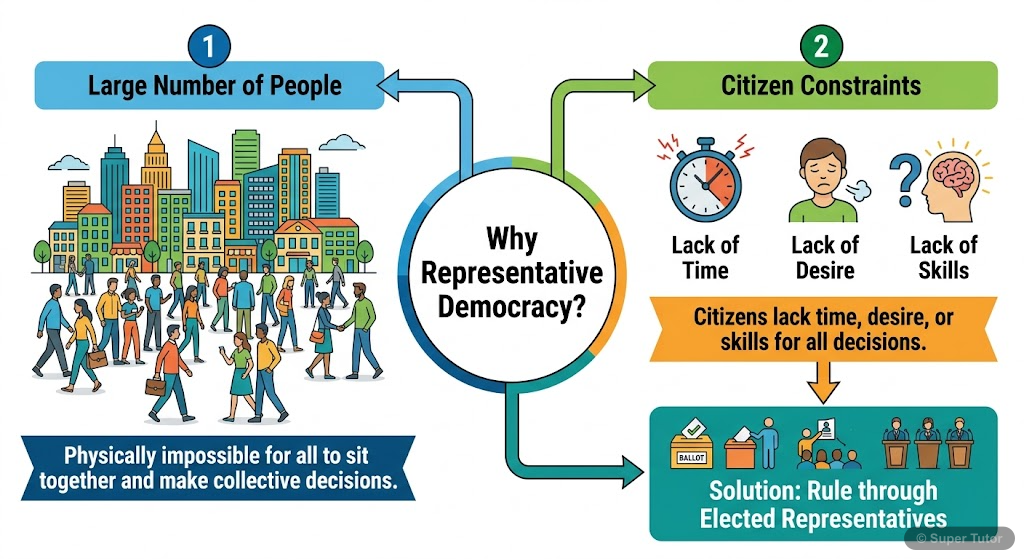
Learn better with visuals Super Tutor has hundreds of illustrations like this across every chapter — all free to try.
Get startedOverview
Electoral Politics is a fundamental chapter that explains how democracy works in practice through elections. This chapter explores why elections are essential for democracy, how they are conducted in India, and what makes elections truly democratic. It covers the entire electoral process from consti
Key Concepts
Elections are essential because in large
Elections are essential because in large democracies, direct rule by all people is impossible. Elections provide a mechanism for people to choose thei
Democratic elections must meet five conditions
Democratic elections must meet five conditions: everyone should have the right to vote with equal value, there should be real choices available, elect
Electoral competition among parties and candidates
Electoral competition among parties and candidates is beneficial despite creating some divisions. It forces political leaders to serve people's intere
India follows an area
India follows an area-based representation system where the country is divided into constituencies. Each constituency elects one representative - MP f
Some constituencies are reserved for Scheduled
Some constituencies are reserved for Scheduled Castes (84 seats) and Scheduled Tribes (47 seats) in Lok Sabha, proportional to their population. This
Learning Objectives
- Understand why elections are necessary and useful in a democracy
- Learn how electoral competition among parties serves the people
- Distinguish between democratic and non-democratic elections
- Analyze the Indian electoral system and its various stages
- Evaluate whether elections in India are free and fair
Frequently Asked Questions
What are the important topics in Electoral Politics for Rajasthan Board Class 9 Social Science?
How to score full marks in Electoral Politics — Rajasthan Board Class 9 Social Science?
Sources & Official References
Content is aligned to the official syllabus. Refer to the board website for the latest curriculum.
More resources for Electoral Politics
Important Questions
Practice with board exam-style questions
Syllabus
What topics to cover
Revision Notes
Key points for last-minute revision
Study Plan
Step-by-step plan to ace this chapter
Flashcards
Quick-fire cards for active recall
Formula Sheet
All formulas in one place
Practice Quiz
Test yourself with a quick quiz
Concept Maps
See how topics connect visually
For serious students
Get the full Electoral Politics chapter — for free.
Quizzes, flashcards, AI doubt-solver and a step-by-step study plan for Rajasthan Board Class 9 Social Science.