Biomolecules
Uttar Pradesh Board · Class 12 · Chemistry
Flashcards for Biomolecules — Uttar Pradesh Board Class 12 Chemistry. Quick Q&A cards covering key concepts, definitions, and formulas.
Interactive on Super Tutor
Studying Biomolecules? Get the full interactive chapter.
Quizzes, flashcards, AI doubt-solver and a step-by-step study plan — built for flashcards and more.
1,000+ Class 12 students started this chapter today
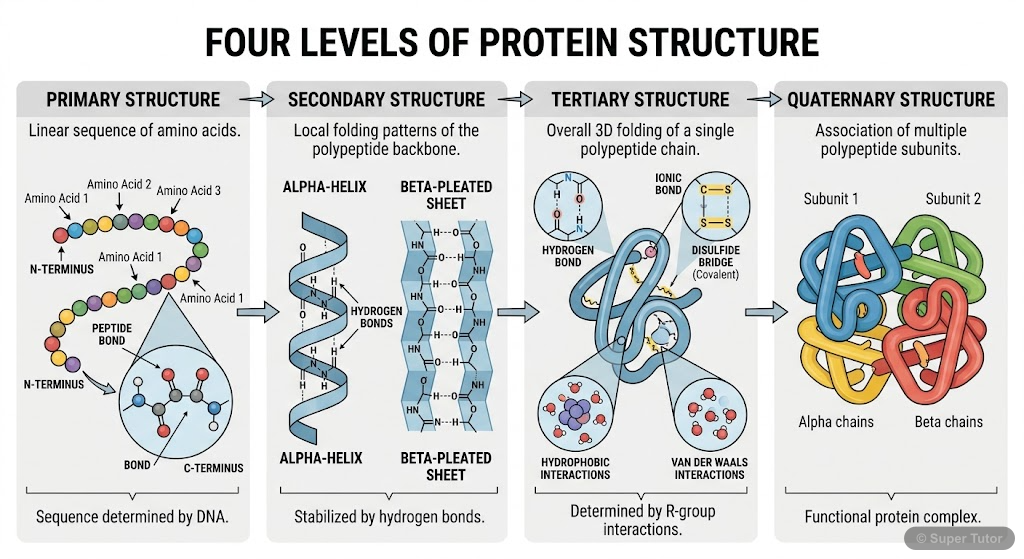
Super Tutor has 24+ illustrations like this for Biomolecules alone — flashcards, concept maps, and step-by-step visuals.
See them allDefine carbohydrates and give their general formula.
Answer
Carbohydrates are optically active polyhydroxy aldehydes or ketones or compounds that produce such units on hydrolysis. General formula: Cx(H2O)y. They are also called saccharides (Greek: sakcharon me…
Classify carbohydrates based on their hydrolysis behavior with examples.
Answer
1. Monosaccharides: Cannot be hydrolyzed further (glucose, fructose, ribose) 2. Oligosaccharides: Yield 2-10 monosaccharide units (sucrose, maltose, lactose) 3. Polysaccharides: Yield large number of …
What is the difference between aldose and ketose? Give examples.
Answer
Aldose: Monosaccharides containing aldehyde group (-CHO). Example: Glucose Ketose: Monosaccharides containing ketone group (>C=O). Example: Fructose Both are classified based on number of carbons: tri…
Explain the cyclic structure of glucose and the concept of anomers.
Answer
Glucose forms a six-membered pyranose ring when -OH at C-5 adds to -CHO group, forming hemiacetal. Two forms exist: α-glucose (m.p. 419K) and β-glucose (m.p. 423K). These are called anomers - isomers …
What is glycosidic linkage? Differentiate between reducing and non-reducing sugars.
Answer
Glycosidic linkage: Oxide linkage between two monosaccharides formed by loss of water molecule. Reducing sugars: Have free aldehydic/ketonic groups, reduce Fehling's solution (maltose, lactose) Non-re…
Compare the structures and properties of starch, cellulose, and glycogen.
Answer
Starch: Storage polysaccharide in plants, α-glucose units, C1-C4 linkage, has amylose (unbranched) and amylopectin (branched) Cellulose: Structural polysaccharide in plants, β-glucose units, C1-C4 lin…
Define proteins and explain the structure of amino acids.
Answer
Proteins are polymers of α-amino acids connected by peptide bonds. They are the most abundant biomolecules in living systems. α-amino acids contain amino group (-NH2) and carboxyl group (-COOH) attach…
Classify amino acids based on their side chains and nutritional requirements.
Answer
Based on side chains: Acidic (more -COOH), Basic (more -NH2), Neutral (equal -COOH and -NH2) Based on nutrition: Essential amino acids (cannot be synthesized in body, must be obtained from diet - 10 a…
+16 more flashcards available
Practice AllFrequently Asked Questions
What are the important topics in Biomolecules for Uttar Pradesh Board Class 12 Chemistry?
How to score full marks in Biomolecules — Uttar Pradesh Board Class 12 Chemistry?
How many flashcards are available for Biomolecules?
Sources & Official References
Content is aligned to the official syllabus. Refer to the board website for the latest curriculum.
More resources for Biomolecules
Important Questions
Practice with board exam-style questions
Syllabus
What topics to cover
Revision Notes
Key points for last-minute revision
Study Plan
Step-by-step plan to ace this chapter
Formula Sheet
All formulas in one place
Chapter Summary
Understand the chapter at a glance
Practice Quiz
Test yourself with a quick quiz
Concept Maps
See how topics connect visually
For serious students
Get the full Biomolecules chapter — for free.
Quizzes, flashcards, AI doubt-solver and a step-by-step study plan for Uttar Pradesh Board Class 12 Chemistry.