Quadratic Equations
CBSE · Class 10 · Mathematics
Flashcards for Quadratic Equations — CBSE Class 10 Mathematics. Quick Q&A cards covering key concepts, definitions, and formulas.
Interactive on Super Tutor
Studying Quadratic Equations? Get the full interactive chapter.
Quizzes, flashcards, AI doubt-solver and a step-by-step study plan — built for flashcards and more.
1,000+ Class 10 students started this chapter today
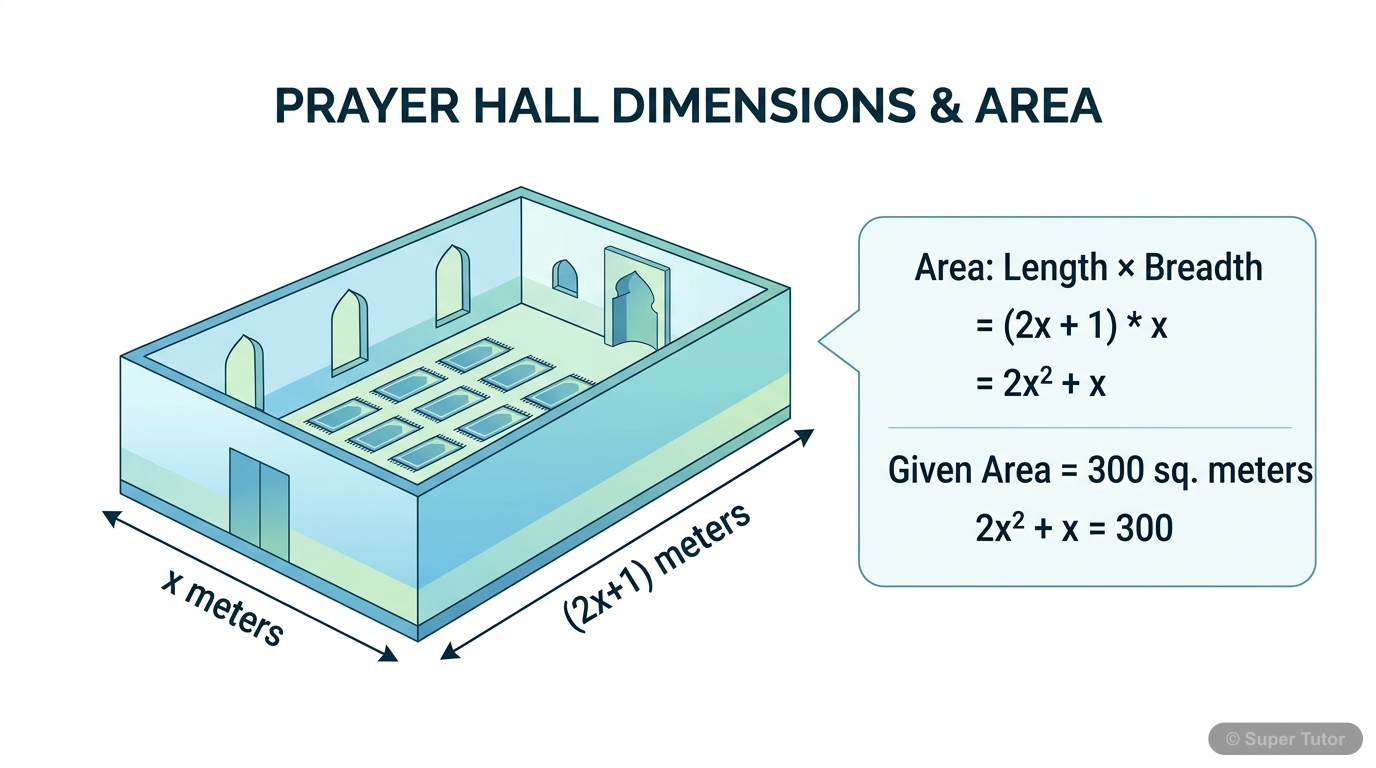
Learn better with visuals Super Tutor has hundreds of illustrations like this across every chapter — all free to try.
Get startedWhat is a quadratic equation? Write its standard form.
Answer
A quadratic equation in variable x is an equation of the form ax² + bx + c = 0, where a, b, c are real numbers and a ≠ 0. This is called the standard form of a quadratic equation. The term 'quadratic'…
Why must the coefficient 'a' be non-zero in ax² + bx + c = 0?
Answer
If a = 0, then the equation becomes bx + c = 0, which is a linear equation (degree 1), not a quadratic equation (degree 2). The term ax² is essential to make it quadratic, so a ≠ 0 is a necessary cond…
Define the root of a quadratic equation.
Answer
A real number α is called a root of the quadratic equation ax² + bx + c = 0 if aα² + bα + c = 0. In other words, when we substitute x = α in the equation, the left-hand side equals zero. The roots are…
What is the relationship between zeros of a quadratic polynomial and roots of a quadratic equation?
Answer
The zeros of the quadratic polynomial ax² + bx + c and the roots of the quadratic equation ax² + bx + c = 0 are exactly the same. If α is a zero of the polynomial, then α is also a root of the equatio…
How many roots can a quadratic equation have at most? Why?
Answer
A quadratic equation can have at most 2 roots. This is because a quadratic polynomial has degree 2, and a polynomial of degree n can have at most n zeros. Since the zeros of the polynomial are the sam…
Solve by factorization: x² - 5x + 6 = 0
Answer
x² - 5x + 6 = 0 We need two numbers that multiply to 6 and add to -5: -2 and -3 x² - 2x - 3x + 6 = 0 x(x - 2) - 3(x - 2) = 0 (x - 2)(x - 3) = 0 Therefore: x - 2 = 0 or x - 3 = 0 So x = 2 or x = 3…
What is the method of completing the square? When is it useful?
Answer
Completing the square is a method where we convert ax² + bx + c = 0 into the form a(x + p)² + q = 0 by adding and subtracting appropriate terms. It's useful when factorization is difficult or when we …
State the quadratic formula for solving ax² + bx + c = 0.
Answer
The quadratic formula is: x = (-b ± √(b² - 4ac)) / (2a), where a ≠ 0 and b² - 4ac ≥ 0. This formula gives the roots of any quadratic equation and is derived using the method of completing the square.
+12 more flashcards available
Practice AllFrequently Asked Questions
What are the important topics in Quadratic Equations for CBSE Class 10 Mathematics?
How to score full marks in Quadratic Equations — CBSE Class 10 Mathematics?
How many flashcards are available for Quadratic Equations?
Sources & Official References
- NCERT Official — ncert.nic.in
- CBSE Academic — cbseacademic.nic.in
- CBSE Official — cbse.gov.in
- National Education Policy 2020 — education.gov.in
Content is aligned to the official syllabus. Refer to the board website for the latest curriculum.
More resources for Quadratic Equations
Important Questions
Practice with board exam-style questions
Syllabus
What topics to cover
Revision Notes
Key points for last-minute revision
Study Plan
Step-by-step plan to ace this chapter
Formula Sheet
All formulas in one place
Chapter Summary
Understand the chapter at a glance
Practice Quiz
Test yourself with a quick quiz
Concept Maps
See how topics connect visually
For serious students
Get the full Quadratic Equations chapter — for free.
Quizzes, flashcards, AI doubt-solver and a step-by-step study plan for CBSE Class 10 Mathematics.