Accounting for Partnership: Basic Concepts
CBSE · Class 12 · Accountancy
Summary of Accounting for Partnership: Basic Concepts for CBSE Class 12 Accountancy. Key concepts, important points, and chapter overview.
Interactive on Super Tutor
Studying Accounting for Partnership: Basic Concepts? Get the full interactive chapter.
Quizzes, flashcards, AI doubt-solver and a step-by-step study plan — built for chapter summary and more.
1,000+ Class 12 students started this chapter today
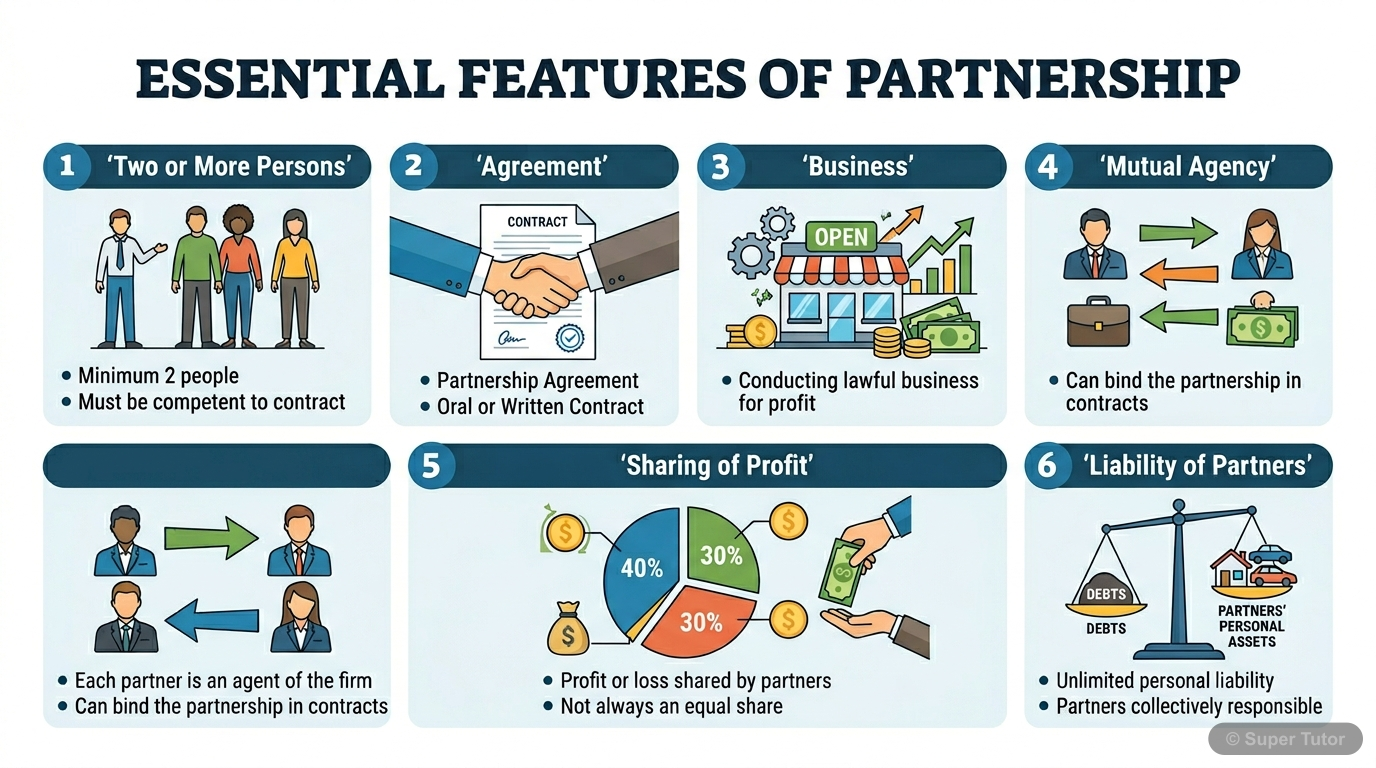
Learn better with visuals Super Tutor has hundreds of illustrations like this across every chapter — all free to try.
Get startedOverview
Partnership is a popular form of business organization where two or more persons come together to carry on business activities and share profits and losses. Unlike sole proprietorship, partnership accounting involves unique procedures for maintaining partners' capital accounts, distributing profits,
Key Concepts
Partnership is defined as 'relation between
Partnership is defined as 'relation between persons who have agreed to share the profits of a business carried on by all or any of them acting for all
A written document containing terms
A written document containing terms of partnership agreement covering business objectives, capital contributions, profit-sharing ratios, interest rate
Fixed Capital Method
Fixed Capital Method: Capital remains constant, other transactions recorded in Current Account. Fluctuating Capital Method: All transactions recorded
Extension of Profit and Loss Account
Extension of Profit and Loss Account showing how profits are distributed among partners. Debited with interest on capital, salaries, commissions; cred
Calculated only when partnership deed provides
Calculated only when partnership deed provides for it. Based on capital amount and time period capital remained in business. For additions/withdrawals
Learning Objectives
- Define partnership and identify its essential features according to Indian Partnership Act 1932
- Understand provisions of Partnership Act relevant for accounting procedures
- Learn to maintain partners' capital accounts using fixed and fluctuating capital methods
- Master the preparation of Profit and Loss Appropriation Account for profit distribution
- Calculate interest on capital and drawings under various situations and time periods
Frequently Asked Questions
What are the important topics in Accounting for Partnership: Basic Concepts for CBSE Class 12 Accountancy?
How to score full marks in Accounting for Partnership: Basic Concepts — CBSE Class 12 Accountancy?
Sources & Official References
- NCERT Official — ncert.nic.in
- CBSE Academic — cbseacademic.nic.in
- CBSE Official — cbse.gov.in
- National Education Policy 2020 — education.gov.in
Content is aligned to the official syllabus. Refer to the board website for the latest curriculum.
More resources for Accounting for Partnership: Basic Concepts
Important Questions
Practice with board exam-style questions
Syllabus
What topics to cover
Revision Notes
Key points for last-minute revision
Study Plan
Step-by-step plan to ace this chapter
Flashcards
Quick-fire cards for active recall
Formula Sheet
All formulas in one place
Practice Quiz
Test yourself with a quick quiz
Concept Maps
See how topics connect visually
For serious students
Get the full Accounting for Partnership: Basic Concepts chapter — for free.
Quizzes, flashcards, AI doubt-solver and a step-by-step study plan for CBSE Class 12 Accountancy.