Security Aspects
CBSE · Class 12 · Computer Science
Flashcards for Security Aspects — CBSE Class 12 Computer Science. Quick Q&A cards covering key concepts, definitions, and formulas.
Interactive on Super Tutor
Studying Security Aspects? Get the full interactive chapter.
Quizzes, flashcards, AI doubt-solver and a step-by-step study plan — built for flashcards and more.
1,000+ Class 12 students started this chapter today
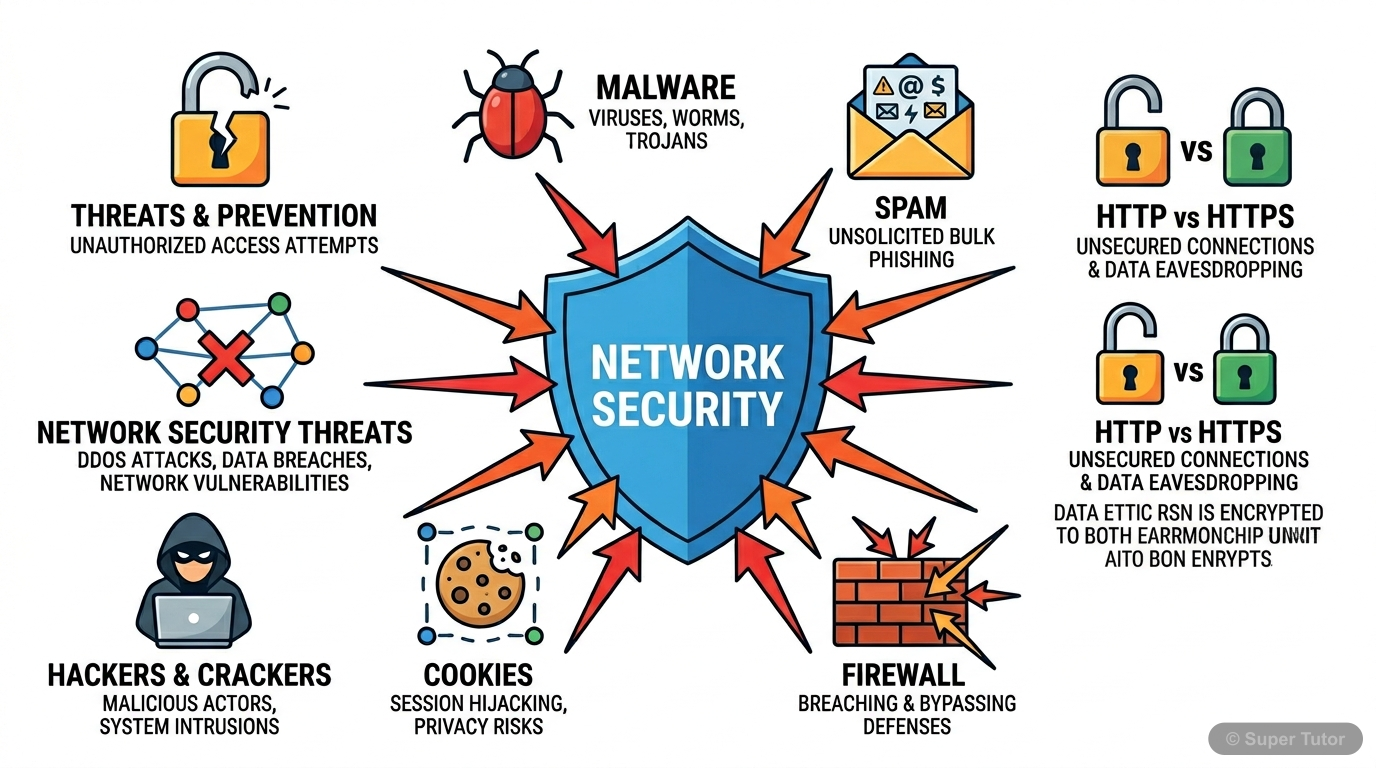
Super Tutor has 20+ illustrations like this for Security Aspects alone — flashcards, concept maps, and step-by-step visuals.
See them allWhat is malware and what does the term stand for?
Answer
Malware stands for MALicious softWARE. It is any software developed with an intention to damage hardware devices, steal data, or cause any other trouble to the user. Examples include viruses, worms, r…
How does a computer virus differ from a worm in terms of replication and host dependency?
Answer
Virus: Needs a host program to insert its code into and requires human triggering for replication (when user opens/executes infected file). Worm: Standalone program that works independently, replicate…
What is ransomware and how did WannaCry demonstrate its impact?
Answer
Ransomware is malware that blocks user access to their data or threatens to publish personal data online, demanding ransom payment. WannaCry (May 2017) infected 200,000 computers across 150 countries …
Why is a Trojan called by this name and how does it work?
Answer
Named after the ancient Greek wooden horse used to infiltrate Troy. A Trojan looks like legitimate software but once installed, acts like a virus or worm. Unlike viruses/worms, it doesn't self-replica…
What is spyware and what type of information does it typically collect?
Answer
Spyware is malware that secretly gathers information about a person or organization without user knowledge. It typically tracks: internet usage data, credit card/bank account information, login creden…
How does an online virtual keyboard differ from an on-screen keyboard in terms of security?
Answer
On-screen keyboard: Uses fixed QWERTY layout, can be exploited by sophisticated keylogger software. Online virtual keyboard: Randomizes key layout every time it's used, making it very difficult for ke…
List four common modes of malware distribution.
Answer
1. Downloaded from Internet (disguised as free software), 2. Spam email (malicious links or attachments), 3. Removable storage devices (pen drives, SD cards infected with replicating malware), 4. Netw…
What are five key signs that indicate possible malware infection?
Answer
1. Frequent pop-up windows prompting downloads, 2. Changes to browser's default homepage, 3. Mass emails sent from your account, 4. Unusually slow computer with frequent crashes, 5. Unknown programs s…
+12 more flashcards available
Practice AllFrequently Asked Questions
What are the important topics in Security Aspects for CBSE Class 12 Computer Science?
How to score full marks in Security Aspects — CBSE Class 12 Computer Science?
How many flashcards are available for Security Aspects?
Sources & Official References
- NCERT Official — ncert.nic.in
- CBSE Academic — cbseacademic.nic.in
- CBSE Official — cbse.gov.in
- National Education Policy 2020 — education.gov.in
Content is aligned to the official syllabus. Refer to the board website for the latest curriculum.
More resources for Security Aspects
Important Questions
Practice with board exam-style questions
Syllabus
What topics to cover
Revision Notes
Key points for last-minute revision
Study Plan
Step-by-step plan to ace this chapter
Formula Sheet
All formulas in one place
Chapter Summary
Understand the chapter at a glance
Practice Quiz
Test yourself with a quick quiz
Concept Maps
See how topics connect visually
For serious students
Get the full Security Aspects chapter — for free.
Quizzes, flashcards, AI doubt-solver and a step-by-step study plan for CBSE Class 12 Computer Science.