Isometric Projection
CBSE · Class 12 · Engineering Graphics
Summary of Isometric Projection for CBSE Class 12 Engineering Graphics. Key concepts, important points, and chapter overview.
Interactive on Super Tutor
Studying Isometric Projection? Get the full interactive chapter.
Quizzes, flashcards, AI doubt-solver and a step-by-step study plan — built for chapter summary and more.
1,000+ Class 12 students started this chapter today
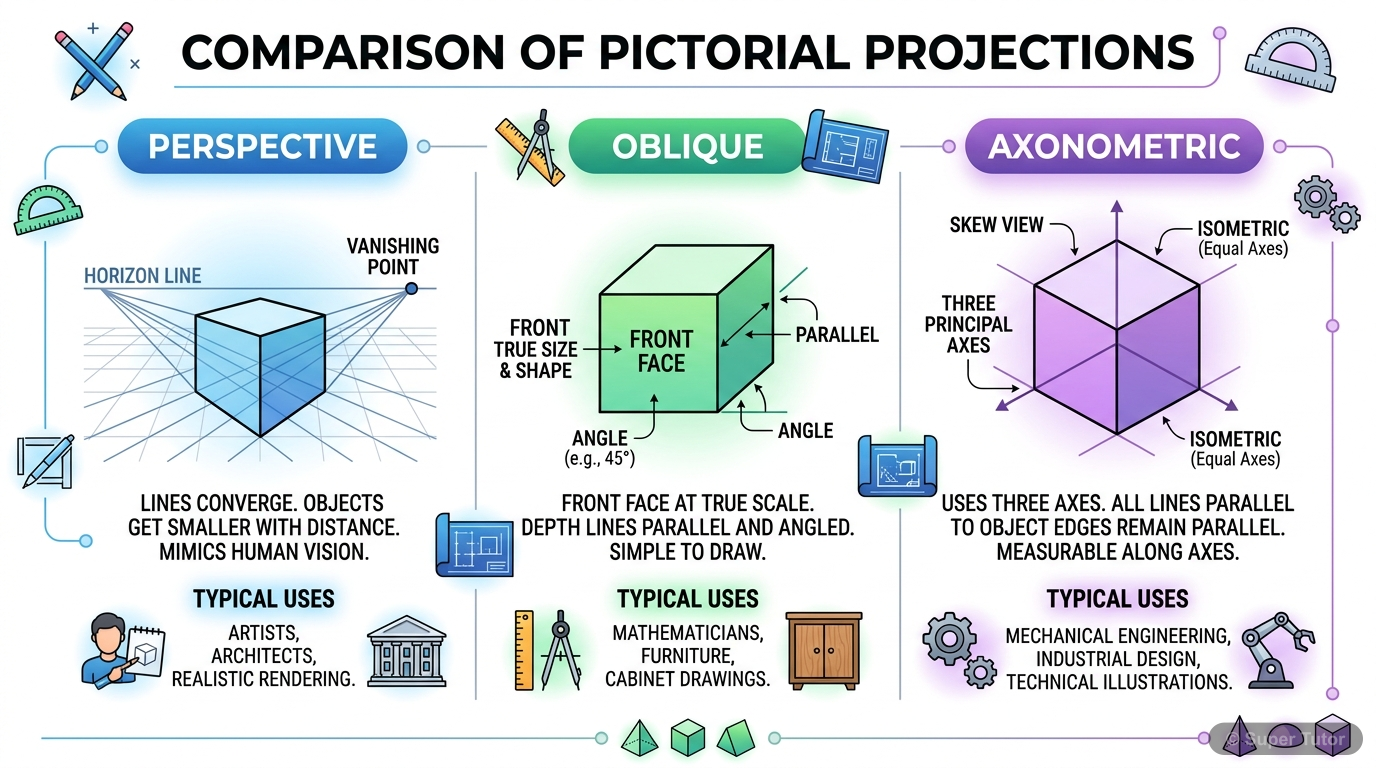
Learn better with visuals Super Tutor has hundreds of illustrations like this across every chapter — all free to try.
Get startedOverview
Isometric projection is a method of drawing three-dimensional objects on a two-dimensional plane, providing a pictorial view that shows the object approximately as it appears to the viewer. This technique is extensively used in engineering to communicate the structure and form of objects effectively
Key Concepts
There are three main types
There are three main types: Perspective Projection (converges at vanishing point, used by artists), Oblique Projection (adds third dimension at angle,
In isometric projection
In isometric projection, all three principal axes are inclined at equal angles of 120° to each other. The axes are positioned at 30°, 90°, and 30° to
The isometric scale compensates for foreshortening
The isometric scale compensates for foreshortening by providing converted lengths. Construction involves drawing a horizontal line, marking true lengt
A systematic approach involving
A systematic approach involving: drawing the base as helping figure, enclosing in rectangle with center lines, creating isometric box using principal
Solids are positioned based on their
Solids are positioned based on their relationship to Vertical Plane (V.P.) and Horizontal Plane (H.P.). Position can be vertical (resting on base), ho
Learning Objectives
- Understand the concept and importance of isometric projection in engineering graphics
- Learn to construct and use isometric scale for accurate measurements
- Master the technique of drawing isometric projections of regular solids (prisms, pyramids, cylinders, cones, spheres)
- Develop skills to create isometric views of frustums and combination of solids
- Apply proper positioning and orientation principles for different types of solids
Frequently Asked Questions
What are the important topics in Isometric Projection for CBSE Class 12 Engineering Graphics?
How to score full marks in Isometric Projection — CBSE Class 12 Engineering Graphics?
Sources & Official References
- NCERT Official — ncert.nic.in
- CBSE Academic — cbseacademic.nic.in
- CBSE Official — cbse.gov.in
- National Education Policy 2020 — education.gov.in
Content is aligned to the official syllabus. Refer to the board website for the latest curriculum.
More resources for Isometric Projection
Important Questions
Practice with board exam-style questions
Syllabus
What topics to cover
Revision Notes
Key points for last-minute revision
Study Plan
Step-by-step plan to ace this chapter
Flashcards
Quick-fire cards for active recall
Formula Sheet
All formulas in one place
Practice Quiz
Test yourself with a quick quiz
Concept Maps
See how topics connect visually
For serious students
Get the full Isometric Projection chapter — for free.
Quizzes, flashcards, AI doubt-solver and a step-by-step study plan for CBSE Class 12 Engineering Graphics.