International Trade
CBSE · Class 12 · Geography
Summary of International Trade for CBSE Class 12 Geography. Key concepts, important points, and chapter overview.
Interactive on Super Tutor
Studying International Trade? Get the full interactive chapter.
Quizzes, flashcards, AI doubt-solver and a step-by-step study plan — built for chapter summary and more.
1,000+ Class 12 students started this chapter today
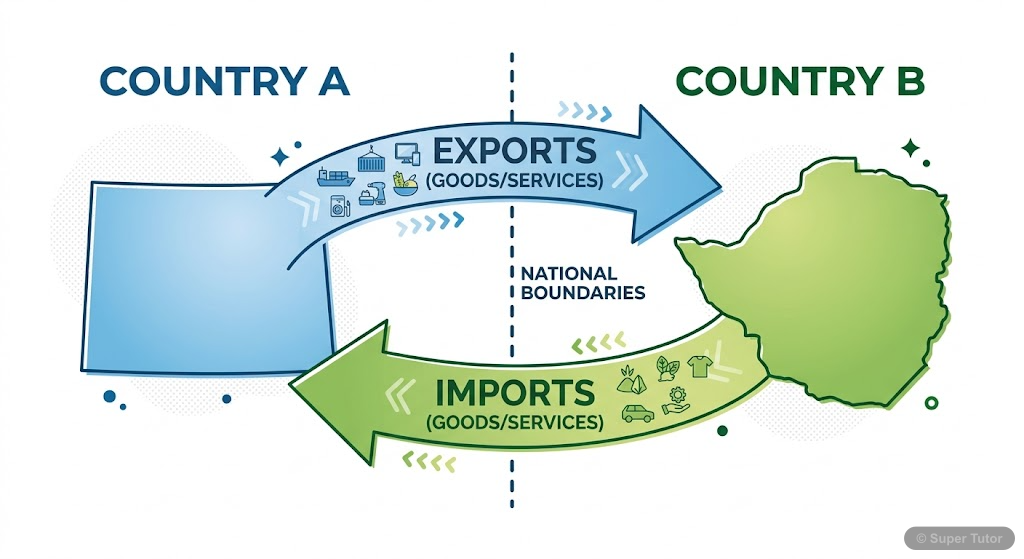
Super Tutor has 12+ illustrations like this for International Trade alone — flashcards, concept maps, and step-by-step visuals.
See them allOverview
International trade refers to the exchange of goods and services between countries across national boundaries. This chapter explores how countries trade to obtain commodities they cannot produce themselves or can purchase elsewhere at lower prices. From ancient barter systems to modern global trade
Key Concepts
Trade evolved from primitive barter systems
Trade evolved from primitive barter systems (like Jon Beel Mela in Assam) where goods were directly exchanged, to money-based systems using various fo
International trade is based on five
International trade is based on five main factors: (1) Uneven distribution of natural resources (geological structure, minerals, climate), (2) Populat
Balance of trade records the volume
Balance of trade records the volume of goods and services imported and exported. Positive balance occurs when exports exceed imports; negative balance
Bilateral trade involves two countries trading
Bilateral trade involves two countries trading specified commodities with each other. Multilateral trade involves multiple countries, with some nation
Free trade involves reducing trade barriers
Free trade involves reducing trade barriers like tariffs to allow global competition. GATT (1948) evolved into WTO (1995) to promote fair trade. Howev
Learning Objectives
- Understand the concept and evolution of international trade from barter system to modern currency-based exchanges
- Analyze the basis of international trade including resource distribution, population factors, and economic development stages
- Examine the concepts of balance of trade, bilateral and multilateral trade arrangements
- Evaluate the role of international organizations like GATT and WTO in promoting free trade
- Assess the advantages and disadvantages of international trade and globalization
Frequently Asked Questions
What are the important topics in International Trade for CBSE Class 12 Geography?
How to score full marks in International Trade — CBSE Class 12 Geography?
Sources & Official References
- NCERT Official — ncert.nic.in
- CBSE Academic — cbseacademic.nic.in
- CBSE Official — cbse.gov.in
- National Education Policy 2020 — education.gov.in
Content is aligned to the official syllabus. Refer to the board website for the latest curriculum.
More resources for International Trade
Important Questions
Practice with board exam-style questions
Syllabus
What topics to cover
Revision Notes
Key points for last-minute revision
Study Plan
Step-by-step plan to ace this chapter
Flashcards
Quick-fire cards for active recall
Formula Sheet
All formulas in one place
Practice Quiz
Test yourself with a quick quiz
Concept Maps
See how topics connect visually
For serious students
Get the full International Trade chapter — for free.
Quizzes, flashcards, AI doubt-solver and a step-by-step study plan for CBSE Class 12 Geography.