Sequences And Series — Study Plan
AEEE · Mathematics
Step-by-step Sequences And Series study plan for AEEE Mathematics 2026 — structured month-wise approach to mastering this chapter.
Interactive on Super Tutor
Studying Sequences And Series? Get the full chapter — free.
Practice questions, revision notes, formula sheet and AI doubt-solver — built for AEEE Mathematics.
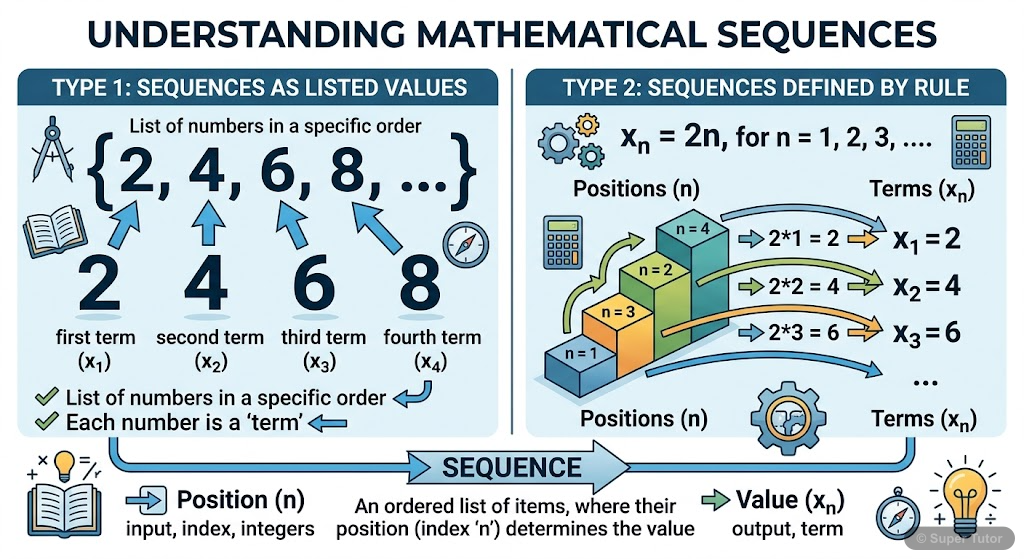
Learn better with visuals Super Tutor has hundreds of illustrations like this across every chapter — all free to try.
Get startedHow to Study Sequences And Series
A structured approach to studying Sequences And Series for AEEE Mathematics.
Study Plan for Sequences And Series
Day 1–2: Learn the Theory
Study the chapter thoroughly. Note down definitions, formulas, and key concepts.
Day 3: Practice Problems
Solve practice questions and previous year AEEE problems. There are 337 questions available for this chapter.
Day 4: Revise & Test
Revise key formulas and concepts without looking at notes. Take a practice quiz to test your understanding.
What to Focus On
- A sequence is a mapping from natural numbers to real numbers
- Terms are arranged in a specific order with identifiable positions
- Domain represents position of terms, range represents values
- Series = Sum of terms of a sequence
- Finite series: x₁ + x₂ + ... + xₙ = Σₖ₌₁ⁿ xₖ
- Infinite series: x₁ + x₂ + x₃ + ... = Σᵢ₌₁∞ xᵢ
- Common difference d = aₙ₊₁ - aₙ (constant for all terms)
- General term: aₙ = a + (n-1)d
- nth term from end: aₙ = l - (n-1)d, where l is last term
Common Mistakes to Avoid
The sum of first n terms of AP is always Sn = n/2[2a + (n-1)d], so I can use this formula even when the last term is given.
In GP, when r < 1, I should always use the formula Sn = a(1-r^n)/(1-r), and when r > 1, I use Sn = a(r^n-1)/(r-1).
AM ≥ GM means Arithmetic Mean is always greater than Geometric Mean.
Want a personalised study plan?
Super Tutor creates a day-by-day plan for AEEE Mathematics that adapts to your exam date and pace.
Create My Study Plan — FreeFrequently Asked Questions
What topics are covered in Sequences And Series for AEEE?
How important is Sequences And Series for AEEE?
How to prepare Sequences And Series for AEEE?
More resources for Sequences And Series
For AEEE aspirants
Get the full Sequences And Series chapter — for free.
Practice questions, revision notes, formula sheet and AI doubt-solver for AEEE Mathematics.