Motion in a Straight Line — Study Plan
AEEE · Physics
Step-by-step Motion in a Straight Line study plan for AEEE Physics 2026 — structured month-wise approach to mastering this chapter.
Interactive on Super Tutor
Studying Motion in a Straight Line? Get the full chapter — free.
Practice questions, revision notes, formula sheet and AI doubt-solver — built for AEEE Physics.
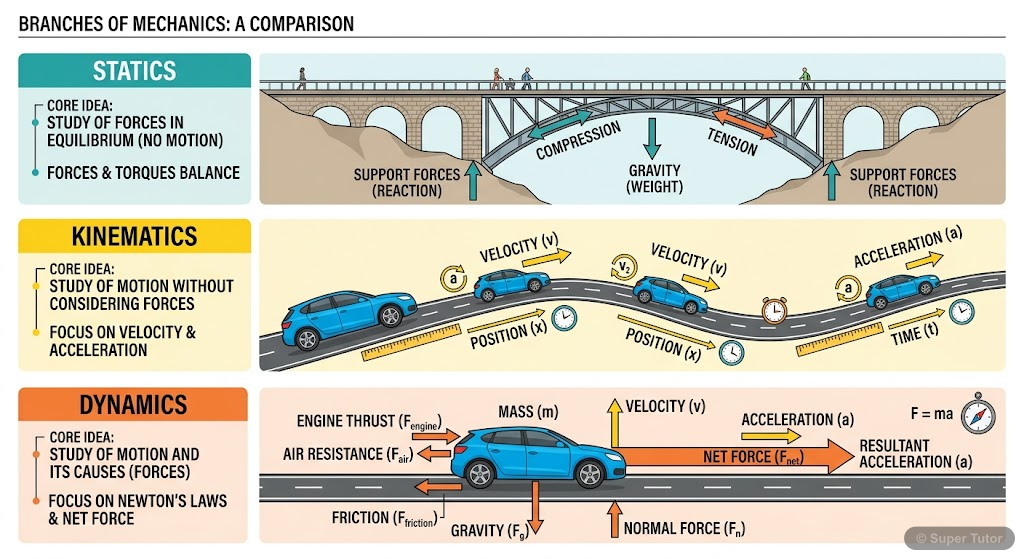
Super Tutor has 17+ illustrations like this for Motion in a Straight Line alone — flashcards, concept maps, and step-by-step visuals.
See them allHow to Study Motion in a Straight Line
A structured approach to studying Motion in a Straight Line for AEEE Physics.
Study Plan for Motion in a Straight Line
Day 1–2: Learn the Theory
Study the chapter thoroughly. Note down definitions, formulas, and key concepts.
Day 3: Practice Problems
Solve practice questions and previous year AEEE problems. There are 197 questions available for this chapter.
Day 4: Revise & Test
Revise key formulas and concepts without looking at notes. Take a practice quiz to test your understanding.
What to Focus On
- Kinematics deals with description of motion without considering causes
- Point object approximation is valid when object size << distance traveled
- Frame of reference consists of coordinate system + clock
- Position is measured from a reference point (origin)
- Distance is path length (scalar, always positive)
- Displacement is change in position (vector, can be positive/negative/zero)
- Average velocity = displacement/time (can be positive, negative, or zero)
- Average speed = distance/time (always positive)
- Instantaneous velocity = dx/dt (slope of x-t curve)
Common Mistakes to Avoid
Distance and displacement are the same thing, just measured differently
Acceleration is always in the direction of motion
In velocity-time graphs, the line represents the path of motion
Want a personalised study plan?
Super Tutor creates a day-by-day plan for AEEE Physics that adapts to your exam date and pace.
Create My Study Plan — FreeFrequently Asked Questions
What topics are covered in Motion in a Straight Line for AEEE?
How important is Motion in a Straight Line for AEEE?
How to prepare Motion in a Straight Line for AEEE?
More resources for Motion in a Straight Line
For AEEE aspirants
Get the full Motion in a Straight Line chapter — for free.
Practice questions, revision notes, formula sheet and AI doubt-solver for AEEE Physics.