Semiconductor Electronics Materials, Devices and Simple Circuits — Important Topics
CUSAT CAT · Physics
Most important topics from Semiconductor Electronics Materials, Devices and Simple Circuits for CUSAT CAT Physics 2026 — high-weightage areas based on previous year analysis.
Interactive on Super Tutor
Studying Semiconductor Electronics Materials, Devices and Simple Circuits? Get the full chapter — free.
Practice questions, revision notes, formula sheet and AI doubt-solver — built for CUSAT CAT Physics.
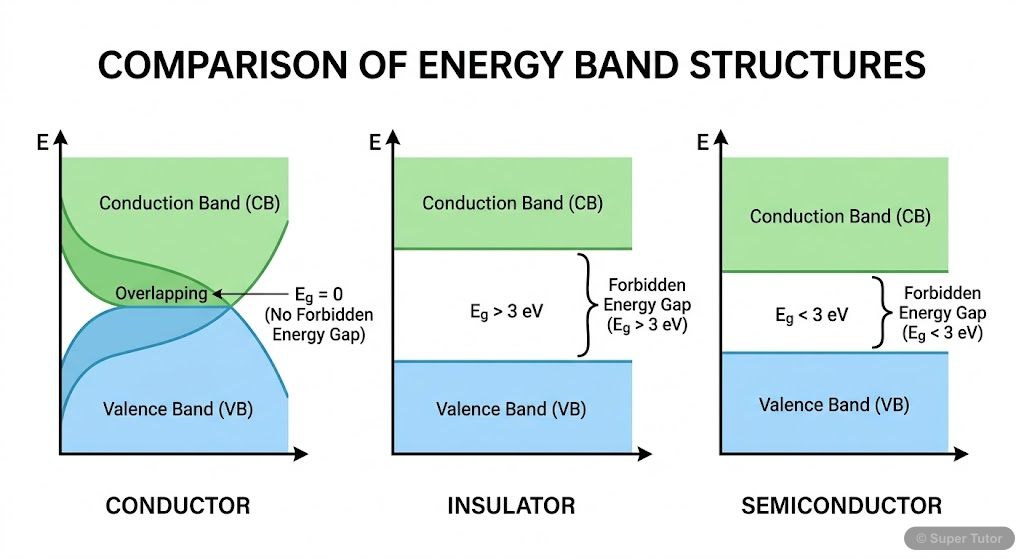
Super Tutor has 19+ illustrations like this for Semiconductor Electronics Materials, Devices and Simple Circuits alone — flashcards, concept maps, and step-by-step visuals.
See them allSemiconductor Electronics Materials, Devices and Simple Circuits — Syllabus & Topics
Topics covered in Semiconductor Electronics Materials, Devices and Simple Circuits for CUSAT CAT Physics.
Topics in Semiconductor Electronics Materials, Devices and Simple Circuits
Classification of Materials and Energy Band Theory
- Materials are classified into conductors, semiconductors, and insulators based on their energy band structure
- Valence band contains valence electrons that don't contribute to conduction
- Conduction band contains free electrons that contribute to electrical conduction
Intrinsic and Extrinsic Semiconductors
- Intrinsic semiconductor: Pure semiconductor with ne = nh = ni
- Conductivity increases with temperature due to thermal generation of electron-hole pairs
- n-type: Doped with pentavalent impurities (As, P, Sb) - electrons are majority carriers
p-n Junction and Diode Characteristics
- p-n junction forms depletion layer with immobile ions
- Built-in potential barrier: ~0.3V for Ge, ~0.7V for Si
- Forward bias: p-side positive, reduces barrier, high current
Rectifiers and Applications
- Rectification converts AC to pulsating DC using diode's unidirectional property
- Half-wave rectifier uses one diode, rectifies only one half of AC cycle
- Full-wave rectifier uses two diodes with center-tapped transformer
Key Concepts
Frequently Asked Questions
What topics are covered in Semiconductor Electronics Materials, Devices and Simple Circuits for CUSAT CAT?
How important is Semiconductor Electronics Materials, Devices and Simple Circuits for CUSAT CAT?
How to prepare Semiconductor Electronics Materials, Devices and Simple Circuits for CUSAT CAT?
More resources for Semiconductor Electronics Materials, Devices and Simple Circuits
Syllabus
Semiconductor Electronics Materials, Devices and Simple Circuits — syllabus
Revision Notes
Semiconductor Electronics Materials, Devices and Simple Circuits — revision notes
Practice Questions
Semiconductor Electronics Materials, Devices and Simple Circuits — practice questions
Study Plan
Semiconductor Electronics Materials, Devices and Simple Circuits — study plan
Formula Sheet
Semiconductor Electronics Materials, Devices and Simple Circuits — formula sheet
For CUSAT CAT aspirants
Get the full Semiconductor Electronics Materials, Devices and Simple Circuits chapter — for free.
Practice questions, revision notes, formula sheet and AI doubt-solver for CUSAT CAT Physics.