Electrostatic Potential and Capacitance — Syllabus
CUSAT CAT · Physics
Free Electrostatic Potential and Capacitance syllabus for CUSAT CAT Physics 2026 — topics covered, weightage, and preparation priorities for this chapter.
Interactive on Super Tutor
Studying Electrostatic Potential and Capacitance? Get the full chapter — free.
Practice questions, revision notes, formula sheet and AI doubt-solver — built for CUSAT CAT Physics.
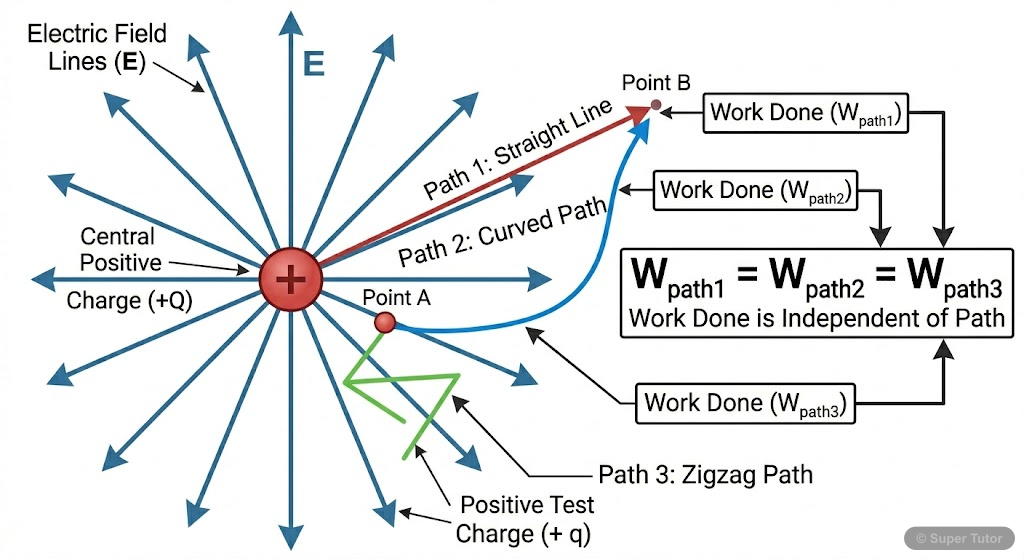
Learn better with visuals Super Tutor has hundreds of illustrations like this across every chapter — all free to try.
Get startedElectrostatic Potential and Capacitance — Syllabus & Topics
Topics covered in Electrostatic Potential and Capacitance for CUSAT CAT Physics.
Topics in Electrostatic Potential and Capacitance
Electrostatic Potential and Potential Difference
- Electric potential at a point is the work done per unit charge in bringing a positive test charge from infinity to that point
- Potential difference between two points is the work done per unit charge in moving a charge from one point to another
- Electric potential is a scalar quantity with SI unit volt (V) where 1V = 1J/C
Potential due to Different Charge Configurations
- Potential due to point charge: V = kQ/r
- Potential due to system of charges: algebraic sum of individual potentials
- Potential due to electric dipole varies with position and angle
Potential Energy and Work in Electric Fields
- Potential energy of two-charge system: U = kq₁q₂/r
- Work done by electric field is negative of change in potential energy
- Potential energy of dipole in external field: U = -p⃗·E⃗ = -pE cosθ
Capacitance and Capacitors
- Capacitance C = Q/V is the ability to store charge per unit potential
- Capacitance depends on geometry and dielectric material, not on charge or voltage
- Parallel plate capacitor: C = ε₀A/d
Key Concepts
Frequently Asked Questions
What topics are covered in Electrostatic Potential and Capacitance for CUSAT CAT?
How important is Electrostatic Potential and Capacitance for CUSAT CAT?
How to prepare Electrostatic Potential and Capacitance for CUSAT CAT?
More resources for Electrostatic Potential and Capacitance
Revision Notes
Electrostatic Potential and Capacitance — revision notes
Important Topics
Electrostatic Potential and Capacitance — important topics
Practice Questions
Electrostatic Potential and Capacitance — practice questions
Study Plan
Electrostatic Potential and Capacitance — study plan
Formula Sheet
Electrostatic Potential and Capacitance — formula sheet
For CUSAT CAT aspirants
Get the full Electrostatic Potential and Capacitance chapter — for free.
Practice questions, revision notes, formula sheet and AI doubt-solver for CUSAT CAT Physics.