Electric Charges and Fields — Study Plan
KIITEE · Physics
Step-by-step Electric Charges and Fields study plan for KIITEE Physics 2026 — structured month-wise approach to mastering this chapter.
Interactive on Super Tutor
Studying Electric Charges and Fields? Get the full chapter — free.
Practice questions, revision notes, formula sheet and AI doubt-solver — built for KIITEE Physics.
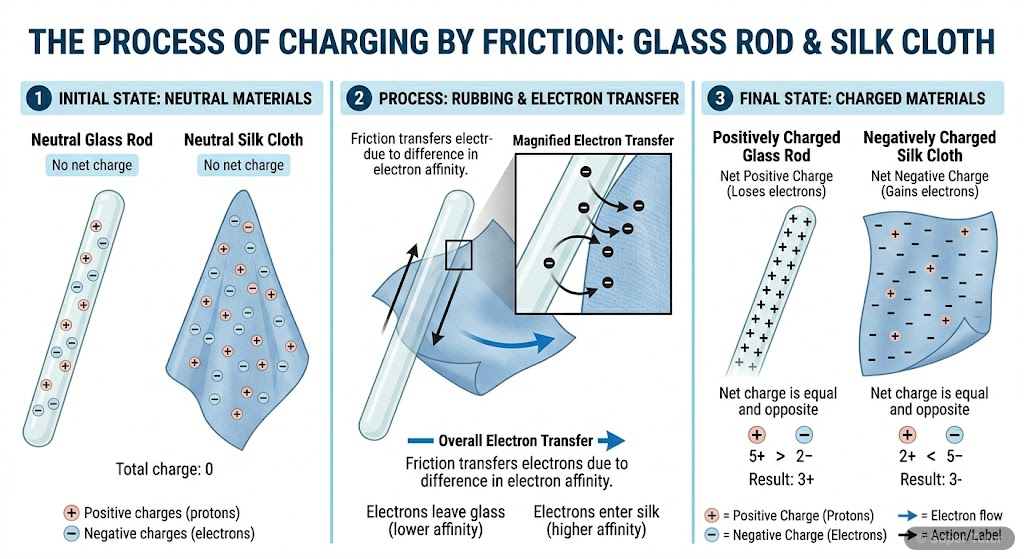
Super Tutor has 29+ illustrations like this for Electric Charges and Fields alone — flashcards, concept maps, and step-by-step visuals.
See them allHow to Study Electric Charges and Fields
A structured approach to studying Electric Charges and Fields for KIITEE Physics.
Study Plan for Electric Charges and Fields
Day 1–2: Learn the Theory
Study the chapter thoroughly. Note down definitions, formulas, and key concepts.
Day 3: Practice Problems
Solve practice questions and previous year KIITEE problems. There are 358 questions available for this chapter.
Day 4: Revise & Test
Revise key formulas and concepts without looking at notes. Take a practice quiz to test your understanding.
What to Focus On
- Two types of charges exist: positive and negative
- Like charges repel, unlike charges attract
- Charge is quantized in multiples of elementary charge e = 1.6 × 10⁻¹⁹ C
- Force is proportional to product of charges: F ∝ q₁q₂
- Force is inversely proportional to square of distance: F ∝ 1/r²
- Coulomb's constant k = 9 × 10⁹ N⋅m²/C²
- Electric field E = F/q₀ where q₀ is positive test charge
- Field due to positive charge points outward, negative charge inward
- Superposition principle applies: net field is vector sum
Common Mistakes to Avoid
Electric field lines represent the path of motion of positive charges
Electric field inside a conductor is zero only when current is not flowing
Electric flux depends on the shape and size of the Gaussian surface
Want a personalised study plan?
Super Tutor creates a day-by-day plan for KIITEE Physics that adapts to your exam date and pace.
Create My Study Plan — FreeFrequently Asked Questions
What topics are covered in Electric Charges and Fields for KIITEE?
How important is Electric Charges and Fields for KIITEE?
How to prepare Electric Charges and Fields for KIITEE?
More resources for Electric Charges and Fields
For KIITEE aspirants
Get the full Electric Charges and Fields chapter — for free.
Practice questions, revision notes, formula sheet and AI doubt-solver for KIITEE Physics.