Basic Approach to Experimental Physics — Important Topics
NEET-UG · Physics
Most important topics from Basic Approach to Experimental Physics for NEET-UG Physics 2026 — high-weightage areas based on previous year analysis.
Interactive on Super Tutor
Studying Basic Approach to Experimental Physics? Get the full chapter — free.
Practice questions, revision notes, formula sheet and AI doubt-solver — built for NEET-UG Physics.
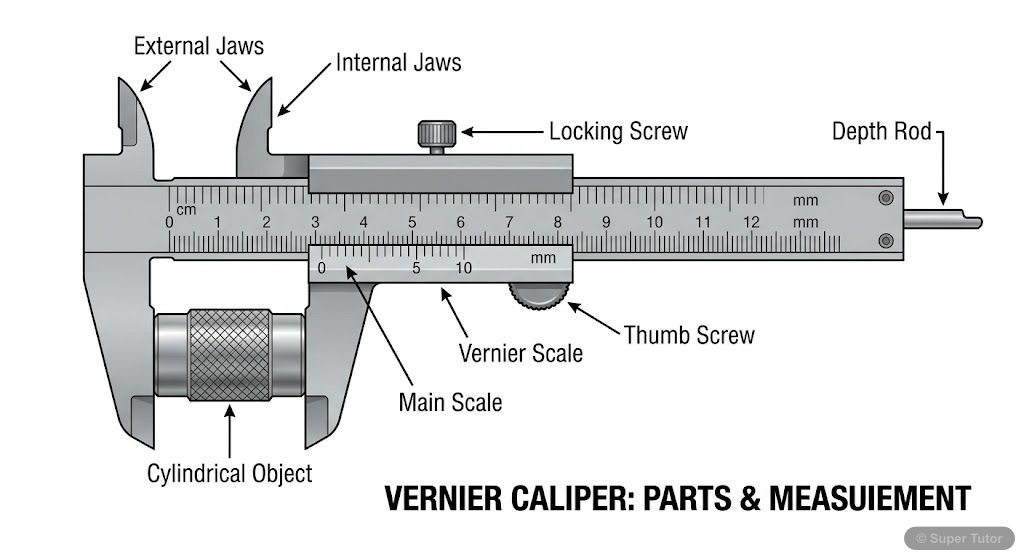
Super Tutor has 5+ illustrations like this for Basic Approach to Experimental Physics alone — flashcards, concept maps, and step-by-step visuals.
See them allBasic Approach to Experimental Physics — Syllabus & Topics
Topics covered in Basic Approach to Experimental Physics for NEET-UG Physics.
Topics in Basic Approach to Experimental Physics
1. Vernier Calipers - Precision Measurement Tool
- Used for measuring internal diameter, external diameter, and depth of vessels
- Consists of main scale and vernier scale for precise measurements
- Least Count (LC) = 1 MSD - 1 VSD = 1/n × MSD where n = number of vernier divisions
2. Screw Gauge (Micrometer) - Ultra Precision Tool
- Used for measuring thickness of thin sheets, diameter of wires
- Pitch = distance moved per complete rotation = distance between consecutive threads
- Least Count = Pitch/Number of divisions on circular scale
3. Simple Pendulum - Energy Dissipation Study
- Demonstrates exponential decay of energy due to air resistance and friction
- Total energy E ∝ A² (amplitude squared)
- Energy dissipation follows: E = E₀e^(-λt) where λ is decay constant
4. Principle of Moments - Mass Determination
- Based on rotational equilibrium: Sum of clockwise moments = Sum of anticlockwise moments
- Unknown mass can be found using known masses and distances
- Centre of mass acts as fulcrum for balanced system
Key Concepts
Frequently Asked Questions
What topics are covered in Basic Approach to Experimental Physics for NEET-UG?
How important is Basic Approach to Experimental Physics for NEET-UG?
How to prepare Basic Approach to Experimental Physics for NEET-UG?
More resources for Basic Approach to Experimental Physics
Syllabus
Basic Approach to Experimental Physics — syllabus
Revision Notes
Basic Approach to Experimental Physics — revision notes
Practice Questions
Basic Approach to Experimental Physics — practice questions
Study Plan
Basic Approach to Experimental Physics — study plan
Formula Sheet
Basic Approach to Experimental Physics — formula sheet
For NEET-UG aspirants
Get the full Basic Approach to Experimental Physics chapter — for free.
Practice questions, revision notes, formula sheet and AI doubt-solver for NEET-UG Physics.