Chapter 25 of 28
Revision Notes
Oscillations — Revision Notes
NEST · Physics
Free Oscillations revision notes for NEST Physics 2026 — key concepts, formulas, and definitions for quick revision.
Interactive on Super Tutor
Studying Oscillations? Get the full chapter — free.
Practice questions, revision notes, formula sheet and AI doubt-solver — built for NEST Physics.
Super Tutor
This is just one of 14+ visuals inside Super Tutor's Oscillations chapter
Explore the full setRevision Notes — Oscillations
Key concepts, formulas, and definitions from Oscillations for NEST Physics preparation.
Key Topics to Revise
1
13.1-13.2 Introduction and Periodic Motion
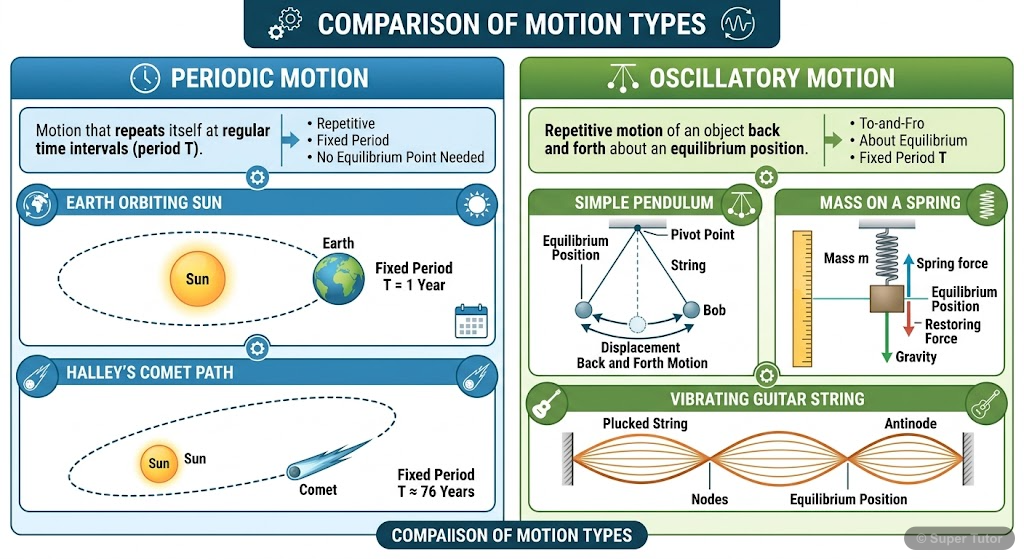
- Periodic motion repeats identically after fixed intervals (period T)
- Oscillatory motion is periodic motion confined between limits about a mean position
- Time period T is the smallest interval after which motion repeats
2
13.3 Simple Harmonic Motion (SHM)
- SHM is motion with acceleration proportional to displacement and directed toward equilibrium
- Standard equation: a = -ω²x (acceleration ∝ -displacement)
- Displacement equation: x(t) = A cos(ωt + φ)
3
13.4 SHM and Uniform Circular Motion
- SHM is the projection of uniform circular motion on any diameter
- Particle moving in circle of radius A with angular speed ω
- x-projection: x = A cos(ωt), y-projection: y = A sin(ωt)
4
13.5 Velocity and Acceleration in SHM
- Velocity: v(t) = -ωA sin(ωt + φ), maximum at mean position
- Acceleration: a(t) = -ω²A cos(ωt + φ) = -ω²x(t)
- Maximum velocity: vₘₐₓ = ωA (at x = 0)
Get complete revision notes with diagrams and examples — continue in Super Tutor
Key Concepts
Periodic motion repeats after fixed intervalsMotion with acceleration proportional to displacementSHM is the projection of uniformFor x = A cos(ωt +Restoring force F =
Frequently Asked Questions
What topics are covered in Oscillations for NEST?
Oscillations is an important chapter in NEST Physics. It covers key concepts and formulas that are frequently tested in the exam. Key topics include: 13.1-13.2 Introduction and Periodic Motion, 13.3 Simple Harmonic Motion (SHM), 13.4 SHM and Uniform Circular Motion, 13.5 Velocity and Acceleration in SHM.
How important is Oscillations for NEST?
Oscillations is a frequently tested chapter in NEST Physics. Questions from this chapter appear regularly in previous year papers. There are 235 practice questions available for this chapter.
How to prepare Oscillations for NEST?
Start by understanding the core concepts, then solve practice questions. Focus on formulas and their applications. Use revision notes for quick review before the exam.
More resources for Oscillations
For NEST aspirants
Get the full Oscillations chapter — for free.
Practice questions, revision notes, formula sheet and AI doubt-solver for NEST Physics.