Spectrum
ICSE · Class 10 · Physics
Step-by-step guide to study Spectrum in ICSE Class 10 Physics. Topics to cover, practice strategy, and time allocation.
Interactive on Super Tutor
Studying Spectrum? Get the full interactive chapter.
Quizzes, flashcards, AI doubt-solver and a step-by-step study plan — built for study plan and more.
1,000+ Class 10 students started this chapter today
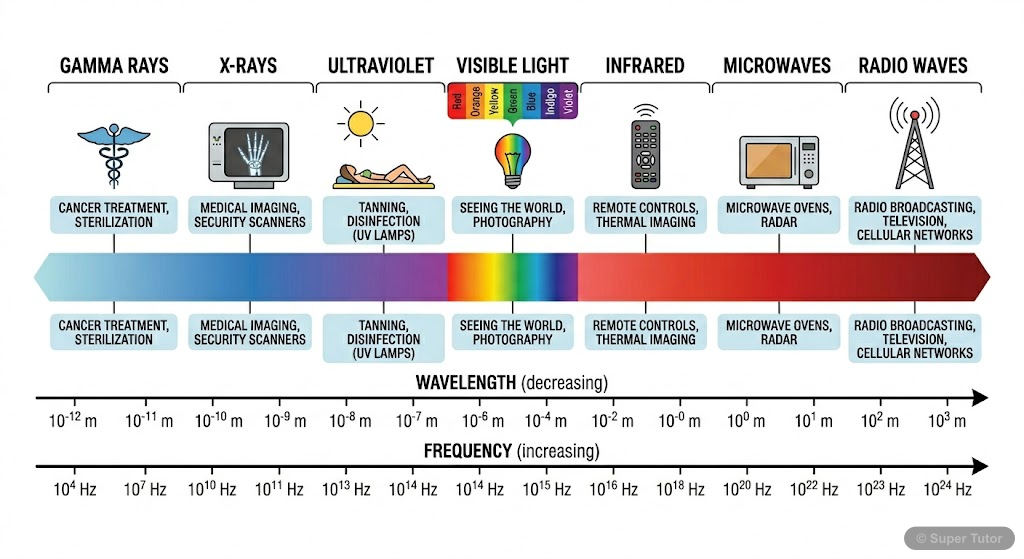
Super Tutor has 5+ illustrations like this for Spectrum alone — flashcards, concept maps, and step-by-step visuals.
See them allStudy Plan
Learn the Theory
Read the textbook chapter carefully. Note down definitions, formulas, and key concepts.
Practice Problems
Solve textbook exercises and additional practice questions. There are 44 questions available for this chapter.
Revise & Test
Revise key formulas and concepts without looking at notes. Take a practice quiz to test your understanding. Mark weak areas for re-revision.
Spaced Revision
Revisit Spectrum after a week. Use flashcards for quick recall. Solve previous year questions from this chapter.
What to Focus On
- The angle of deviation (δ) is the angle between the incident ray and the emergent ray after passing through a prism.
- Total deviation δ = δ₁ + δ₂, where δ₁ and δ₂ are deviations at each refracting surface.
- For a small-angled prism: δ = (μ - 1)A
- Dispersion: The splitting of white light into its seven constituent colours (VIBGYOR) by a prism.
- The spectrum is the band of seven colours: Violet, Indigo, Blue, Green, Yellow, Orange, Red.
- Cause: Different wavelengths → different refractive indices → different speeds → different bending.
- Electromagnetic waves consist of oscillating electric and magnetic fields perpendicular to each other and to direction of propagation.
- All EM waves travel at c = 3 × 10⁸ m/s in vacuum.
- EM spectrum in increasing wavelength order: γ-rays → X-rays → UV → Visible → IR → Microwaves → Radio waves.
Common Mistakes to Avoid
A prism CREATES the seven colours of white light — the colours are produced inside the prism.
Violet light deviates MORE than red light because violet is 'stronger' or 'more energetic', so it bends more easily.
Dispersion occurs at BOTH surfaces of the prism, so the spectrum forms twice.
Memory Tips
Order of colours in the visible spectrum (VIBGYOR)
Violet deviates most, Red deviates least through a prism
Refractive index increases as wavelength decreases (μ ∝ 1/λ²)
Dispersion occurs only at the first surface; deviation at both surfaces
Want a personalised study plan?
Super Tutor creates a day-by-day plan for ICSE Class 10 Physics that adapts to your exam date and pace.
Create My Study Plan — FreeFrequently Asked Questions
What are the important topics in Spectrum for ICSE Class 10 Physics?
How to score full marks in Spectrum — ICSE Class 10 Physics?
Sources & Official References
Content is aligned to the official syllabus. Refer to the board website for the latest curriculum.
More resources for Spectrum
Important Questions
Practice with board exam-style questions
Syllabus
What topics to cover
Revision Notes
Key points for last-minute revision
Flashcards
Quick-fire cards for active recall
Formula Sheet
All formulas in one place
Chapter Summary
Understand the chapter at a glance
Practice Quiz
Test yourself with a quick quiz
Concept Maps
See how topics connect visually
For serious students
Get the full Spectrum chapter — for free.
Quizzes, flashcards, AI doubt-solver and a step-by-step study plan for ICSE Class 10 Physics.