Globalisation
ICSE · Class 9 · Economic Applications
Summary of Globalisation for ICSE Class 9 Economic Applications. Key concepts, important points, and chapter overview.
Interactive on Super Tutor
Studying Globalisation? Get the full interactive chapter.
Quizzes, flashcards, AI doubt-solver and a step-by-step study plan — built for chapter summary and more.
1,000+ Class 9 students started this chapter today
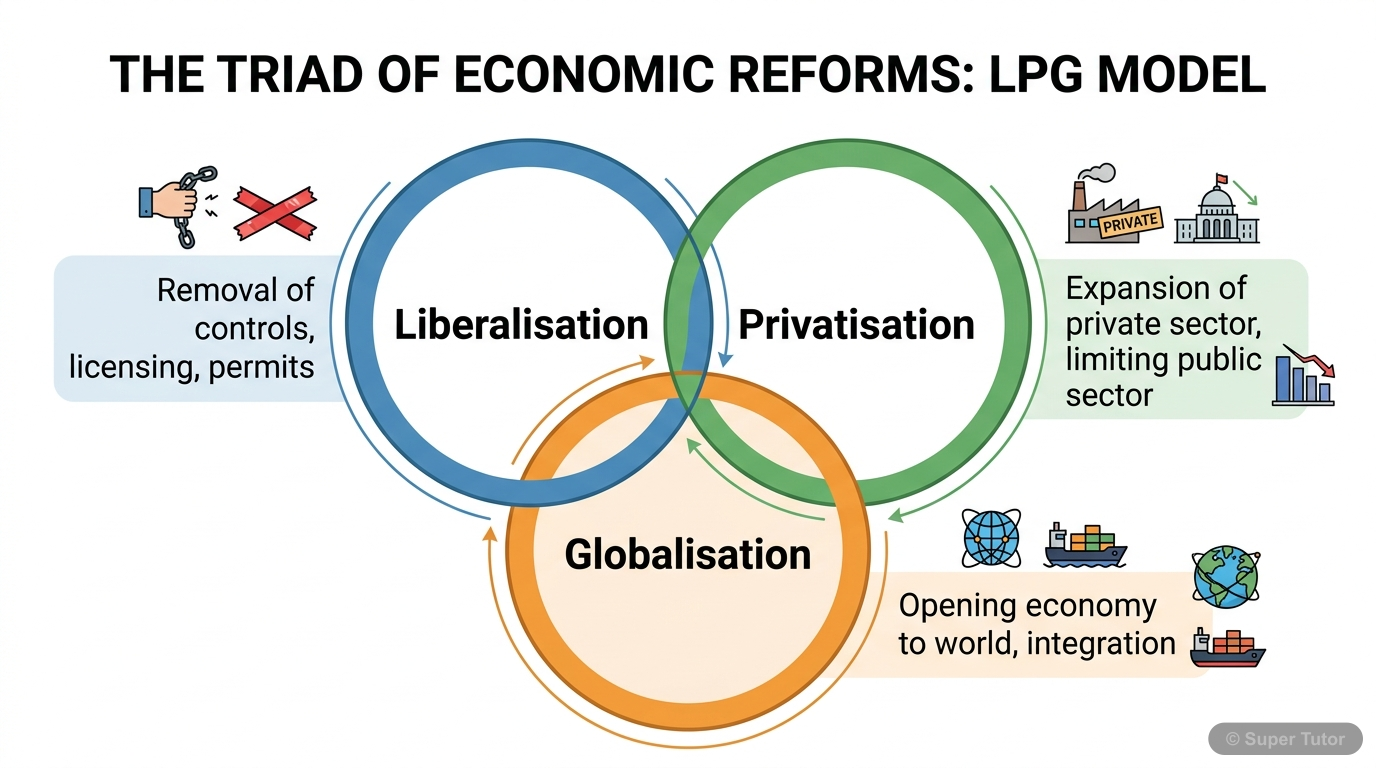
Learn better with visuals Super Tutor has hundreds of illustrations like this across every chapter — all free to try.
Get startedOverview
Globalisation represents one of the most significant economic transformations in modern India. Starting in 1991, India adopted a new economic policy based on three pillars: Liberalisation (L), Privatisation (P), and Globalisation (G), collectively known as LPG reforms. This chapter explores how glob
Key Concepts
Globalisation is the process of integrating
Globalisation is the process of integrating a country's economy with other world economies through three main channels: opening up world trade (removi
India faced a severe foreign exchange
India faced a severe foreign exchange crisis in 1991 due to the Gulf War (which increased oil prices), rising external debt, withdrawal of NRI deposit
India moved from a fixed exchange
India moved from a fixed exchange rate system to a market-determined flexible exchange rate system. The Indian rupee became partially convertible on t
FDI refers to investment made by
FDI refers to investment made by foreign companies in Indian businesses or setting up operations in India. The government gradually increased FDI limi
WTO is an international organisation established
WTO is an international organisation established in 1995 to supervise and liberalise global trade. India is a founding member. WTO sets rules for inte
Learning Objectives
- Understand the meaning and channels of globalisation
- Analyze the factors that led to India's adoption of globalisation in 1991
- Examine the positive and negative effects of globalisation on India's economy
- Evaluate the impact of globalisation on Indian industries
- Learn about the role of World Trade Organisation (WTO) in global trade
Frequently Asked Questions
What are the important topics in Globalisation for ICSE Class 9 Economic Applications?
How to score full marks in Globalisation — ICSE Class 9 Economic Applications?
Sources & Official References
Content is aligned to the official syllabus. Refer to the board website for the latest curriculum.
More resources for Globalisation
Important Questions
Practice with board exam-style questions
Syllabus
What topics to cover
Revision Notes
Key points for last-minute revision
Study Plan
Step-by-step plan to ace this chapter
Flashcards
Quick-fire cards for active recall
Formula Sheet
All formulas in one place
Practice Quiz
Test yourself with a quick quiz
Concept Maps
See how topics connect visually
For serious students
Get the full Globalisation chapter — for free.
Quizzes, flashcards, AI doubt-solver and a step-by-step study plan for ICSE Class 9 Economic Applications.