Rational and Irrational Numbers
ICSE · Class 9 · Mathematics
Summary of Rational and Irrational Numbers for ICSE Class 9 Mathematics. Key concepts, important points, and chapter overview.
Interactive on Super Tutor
Studying Rational and Irrational Numbers? Get the full interactive chapter.
Quizzes, flashcards, AI doubt-solver and a step-by-step study plan — built for chapter summary and more.
1,000+ Class 9 students started this chapter today
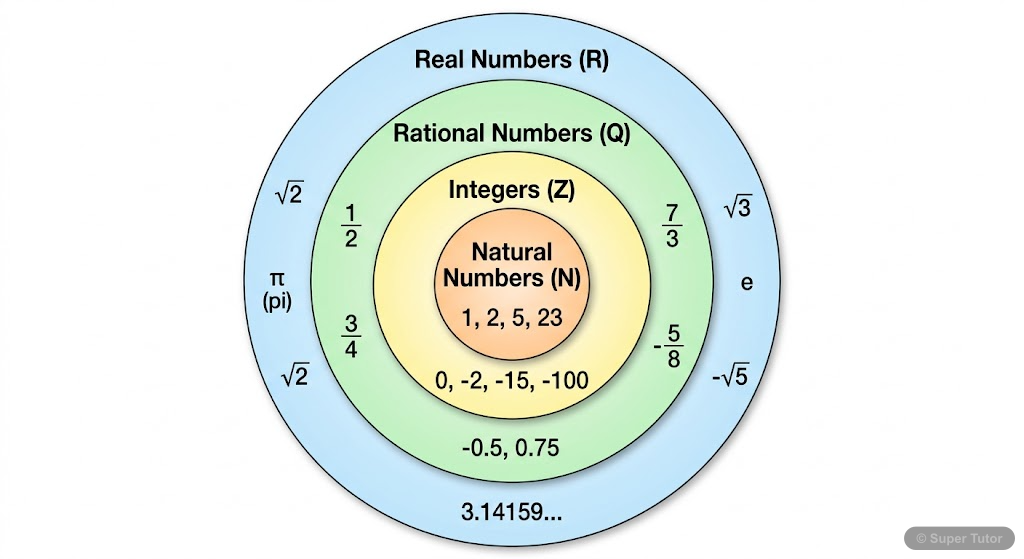
Learn better with visuals Super Tutor has hundreds of illustrations like this across every chapter — all free to try.
Get startedOverview
This chapter explores the complete real number system, focusing on rational and irrational numbers. We learn to classify numbers, understand their decimal representations, and work with different operations. The chapter builds a strong foundation for understanding how numbers are organized and used
Key Concepts
Real numbers are divided into two
Real numbers are divided into two main categories: Rational numbers (Q) and Irrational numbers (Q̄). Rational numbers can be expressed as a/b where a
Rational numbers have either terminating decimals
Rational numbers have either terminating decimals (like 1/4 = 0.25) or non-terminating recurring decimals (like 1/3 = 0.333... = 0.3̄). A rational num
Between any two rational numbers
Between any two rational numbers, there are infinitely many rational numbers. We can find them using (a+b)/2 method or by using d = (y-x)/(n+1) formul
Any recurring decimal can be converted
Any recurring decimal can be converted to a fraction. For pure recurring decimals like 0.7̄, we use algebraic methods. For mixed recurring decimals li
A surd is an irrational number
A surd is an irrational number of the form ⁿ√a where a is a positive rational number and ⁿ√a is irrational. Rationalization involves removing surds fr
Learning Objectives
- Understand the classification of real numbers into rational and irrational numbers
- Identify and work with different types of rational numbers including integers, whole numbers, and natural numbers
- Convert between fractional and decimal forms of rational numbers
- Distinguish between terminating and non-terminating recurring decimals
- Recognize and work with irrational numbers and surds
Frequently Asked Questions
What are the important topics in Rational and Irrational Numbers for ICSE Class 9 Mathematics?
How to score full marks in Rational and Irrational Numbers — ICSE Class 9 Mathematics?
Sources & Official References
Content is aligned to the official syllabus. Refer to the board website for the latest curriculum.
More resources for Rational and Irrational Numbers
Important Questions
Practice with board exam-style questions
Syllabus
What topics to cover
Revision Notes
Key points for last-minute revision
Study Plan
Step-by-step plan to ace this chapter
Flashcards
Quick-fire cards for active recall
Formula Sheet
All formulas in one place
Practice Quiz
Test yourself with a quick quiz
Concept Maps
See how topics connect visually
For serious students
Get the full Rational and Irrational Numbers chapter — for free.
Quizzes, flashcards, AI doubt-solver and a step-by-step study plan for ICSE Class 9 Mathematics.