Motion in one Dimension
ICSE · Class 9 · Physics
Summary of Motion in one Dimension for ICSE Class 9 Physics. Key concepts, important points, and chapter overview.
Interactive on Super Tutor
Studying Motion in one Dimension? Get the full interactive chapter.
Quizzes, flashcards, AI doubt-solver and a step-by-step study plan — built for chapter summary and more.
1,000+ Class 9 students started this chapter today
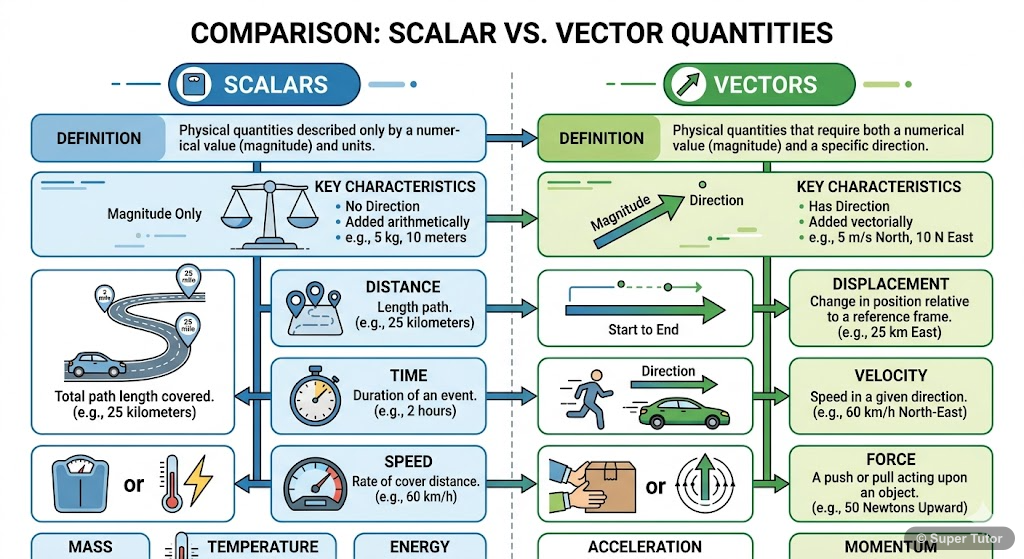
Super Tutor has 16+ illustrations like this for Motion in one Dimension alone — flashcards, concept maps, and step-by-step visuals.
See them allOverview
Motion in one dimension deals with the study of objects moving along a straight line path. This chapter introduces fundamental concepts of motion including distance, displacement, speed, velocity, and acceleration. It also covers graphical representation of motion and equations of uniformly accelera
Key Concepts
Scalars have only magnitude (mass
Scalars have only magnitude (mass, time, speed, distance) while vectors have both magnitude and direction (displacement, velocity, acceleration, force
Distance is the total path length
Distance is the total path length traveled (always positive, scalar). Displacement is the shortest distance between initial and final positions with d
Speed = distance/time (scalar
Speed = distance/time (scalar, always positive). Velocity = displacement/time (vector, can be positive/negative). Uniform speed/velocity means equal d
Acceleration = change in velocity/time =
Acceleration = change in velocity/time = (v-u)/t. When velocity increases, it's acceleration (+ve). When velocity decreases, it's retardation (-ve acc
Distance
Distance-time graph: slope gives speed. Velocity-time graph: slope gives acceleration, area gives displacement. Straight line = uniform motion, curve
Learning Objectives
- Distinguish between scalar and vector quantities with examples
- Understand the concepts of distance, displacement, speed, and velocity
- Define acceleration and retardation with their applications
- Interpret distance-time and velocity-time graphs
- Apply equations of motion to solve numerical problems
Frequently Asked Questions
What are the important topics in Motion in one Dimension for ICSE Class 9 Physics?
How to score full marks in Motion in one Dimension — ICSE Class 9 Physics?
Sources & Official References
Content is aligned to the official syllabus. Refer to the board website for the latest curriculum.
More resources for Motion in one Dimension
Important Questions
Practice with board exam-style questions
Syllabus
What topics to cover
Revision Notes
Key points for last-minute revision
Study Plan
Step-by-step plan to ace this chapter
Flashcards
Quick-fire cards for active recall
Formula Sheet
All formulas in one place
Practice Quiz
Test yourself with a quick quiz
Concept Maps
See how topics connect visually
For serious students
Get the full Motion in one Dimension chapter — for free.
Quizzes, flashcards, AI doubt-solver and a step-by-step study plan for ICSE Class 9 Physics.