Relations and Functions
Karnataka Board · Class 12 · Mathematics
Summary of Relations and Functions for Karnataka Board Class 12 Mathematics. Key concepts, important points, and chapter overview.
Interactive on Super Tutor
Studying Relations and Functions? Get the full interactive chapter.
Quizzes, flashcards, AI doubt-solver and a step-by-step study plan — built for chapter summary and more.
1,000+ Class 12 students started this chapter today
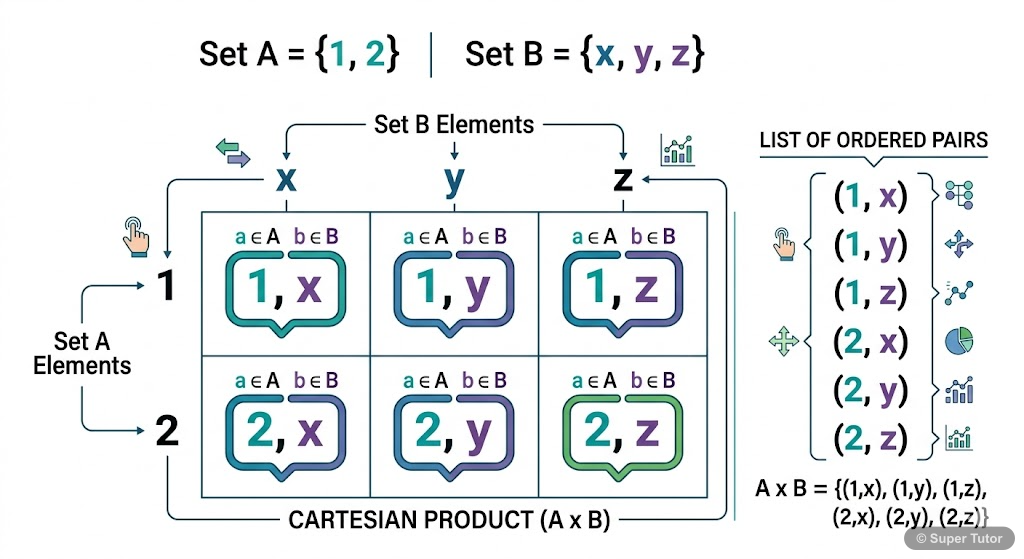
This is just one of 8+ visuals inside Super Tutor's Relations and Functions chapter
Explore the full setOverview
Relations and Functions form the foundation of advanced mathematics, connecting abstract mathematical concepts with practical applications. This chapter explores how elements from different sets are connected through relations, and how functions provide unique mappings between sets. Understanding th
Key Concepts
Relations are classified based on their
Relations are classified based on their properties: Empty relation R = ∅ (no elements related), Universal relation R = A × A (all elements related to
A relation R in set
A relation R in set A is reflexive if (a,a) ∈ R for every a ∈ A. Example: R = {(a,b): a ≤ b} in set {1,2,3} is reflexive because (1,1), (2,2), (3,3) a
A relation R is symmetric if
A relation R is symmetric if (a,b) ∈ R implies (b,a) ∈ R. Example: R = {(a,b): |a - b| ≤ 2} in {1,2,3,4}. If (1,3) ∈ R, then (3,1) must also ∈ R. Step
A relation R is transitive if
A relation R is transitive if (a,b) ∈ R and (b,c) ∈ R implies (a,c) ∈ R. Example: R = {(a,b): a ≤ b}. If a ≤ b and b ≤ c, then a ≤ c. Problem-solving
A relation that is reflexive
A relation that is reflexive, symmetric, and transitive. Example: R = {(a,b): a ≡ b (mod 3)} in integers. Step 1: Check reflexive - a ≡ a (mod 3) ✓. S
Learning Objectives
- Understand and classify different types of relations (empty, universal, reflexive, symmetric, transitive)
- Master the concept of equivalence relations and their applications
- Identify and work with different types of functions (one-one, onto, bijective)
- Learn composition of functions and solve related problems step-by-step
- Understand invertible functions and find inverse functions
Frequently Asked Questions
What are the important topics in Relations and Functions for Karnataka Board Class 12 Mathematics?
How to score full marks in Relations and Functions — Karnataka Board Class 12 Mathematics?
Sources & Official References
- Karnataka SSLC — kseeb.kar.nic.in
- Dept of Pre-University Education, Karnataka
- National Education Policy 2020 — education.gov.in
Content is aligned to the official syllabus. Refer to the board website for the latest curriculum.
More resources for Relations and Functions
Important Questions
Practice with board exam-style questions
Syllabus
What topics to cover
Revision Notes
Key points for last-minute revision
Study Plan
Step-by-step plan to ace this chapter
Flashcards
Quick-fire cards for active recall
Formula Sheet
All formulas in one place
Practice Quiz
Test yourself with a quick quiz
Concept Maps
See how topics connect visually
For serious students
Get the full Relations and Functions chapter — for free.
Quizzes, flashcards, AI doubt-solver and a step-by-step study plan for Karnataka Board Class 12 Mathematics.