Tissues
Uttarakhand Board · Class 9 · Science
Flashcards for Tissues — Uttarakhand Board Class 9 Science. Quick Q&A cards covering key concepts, definitions, and formulas.
Interactive on Super Tutor
Studying Tissues? Get the full interactive chapter.
Quizzes, flashcards, AI doubt-solver and a step-by-step study plan — built for flashcards and more.
1,000+ Class 9 students started this chapter today
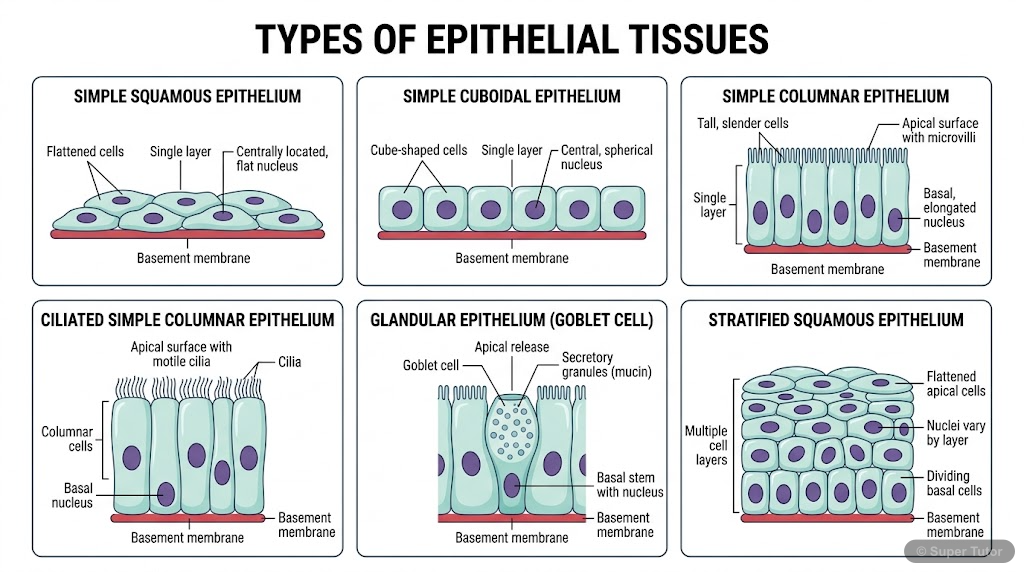
Learn better with visuals Super Tutor has hundreds of illustrations like this across every chapter — all free to try.
Get startedWhat is a tissue? Give the definition.
Answer
A tissue is a group of cells that are similar in structure and/or work together to achieve a particular function. Examples include blood, phloem, and muscle tissues.
Why do plants have more supportive tissue compared to animals?
Answer
Plants are stationary and need to remain upright, so they require a large quantity of supportive tissue. This supportive tissue generally contains dead cells that provide structural strength.
What is meristematic tissue and where is it found?
Answer
Meristematic tissue is the dividing tissue present in growing regions of plants. It is found at growing tips of stems and roots (apical), in the cambium for girth increase (lateral), and near nodes in…
List the characteristics of meristematic tissue cells.
Answer
Meristematic tissue cells have: 1) Dense cytoplasm, 2) Thin cellulose walls, 3) Prominent nuclei, 4) Very active cells, 5) Lack vacuoles (because vacuoles would hinder active division).
What is differentiation in plant tissues?
Answer
Differentiation is the process by which cells formed by meristematic tissue take up a permanent shape, size, and function, losing their ability to divide and forming permanent tissue.
Name the three types of simple permanent tissues and their main functions.
Answer
1) Parenchyma - stores food, performs photosynthesis (chlorenchyma), provides buoyancy (aerenchyma). 2) Collenchyma - provides flexibility and mechanical support. 3) Sclerenchyma - makes plants hard a…
What are the key differences between parenchyma, collenchyma, and sclerenchyma cells?
Answer
Parenchyma: Living cells, thin walls, large intercellular spaces. Collenchyma: Living cells, thickened corners, little intercellular space. Sclerenchyma: Dead cells, thick lignified walls, no intercel…
What is epidermis and what are its main functions?
Answer
Epidermis is the outermost layer of cells that covers the entire plant surface. Functions: 1) Protection against water loss, 2) Mechanical injury protection, 3) Protection from parasitic fungi, 4) Con…
+17 more flashcards available
Practice AllFrequently Asked Questions
What are the important topics in Tissues for Uttarakhand Board Class 9 Science?
How to score full marks in Tissues — Uttarakhand Board Class 9 Science?
How many flashcards are available for Tissues?
Sources & Official References
Content is aligned to the official syllabus. Refer to the board website for the latest curriculum.
More resources for Tissues
Important Questions
Practice with board exam-style questions
Syllabus
What topics to cover
Revision Notes
Key points for last-minute revision
Study Plan
Step-by-step plan to ace this chapter
Formula Sheet
All formulas in one place
Chapter Summary
Understand the chapter at a glance
Practice Quiz
Test yourself with a quick quiz
Concept Maps
See how topics connect visually
For serious students
Get the full Tissues chapter — for free.
Quizzes, flashcards, AI doubt-solver and a step-by-step study plan for Uttarakhand Board Class 9 Science.