Gravitation
Uttarakhand Board · Class 9 · Science
Step-by-step guide to study Gravitation in Uttarakhand Board Class 9 Science. Topics to cover, practice strategy, and time allocation.
Interactive on Super Tutor
Studying Gravitation? Get the full interactive chapter.
Quizzes, flashcards, AI doubt-solver and a step-by-step study plan — built for study plan and more.
1,000+ Class 9 students started this chapter today
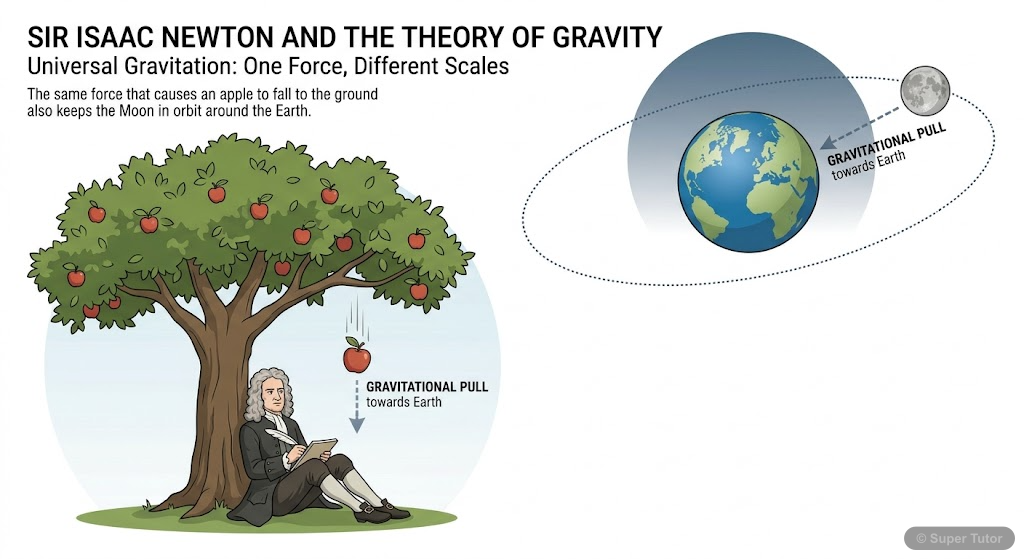
Super Tutor has 14+ illustrations like this for Gravitation alone — flashcards, concept maps, and step-by-step visuals.
See them allStudy Plan
Learn the Theory
Read the textbook chapter carefully. Note down definitions, formulas, and key concepts.
Practice Problems
Solve textbook exercises and additional practice questions. There are 30 questions available for this chapter.
Revise & Test
Revise key formulas and concepts without looking at notes. Take a practice quiz to test your understanding. Mark weak areas for re-revision.
Spaced Revision
Revisit Gravitation after a week. Use flashcards for quick recall. Solve previous year questions from this chapter.
What to Focus On
- Gravitation is the universal force of attraction between any two objects with mass.
- Newton proposed that the same gravitational force causes apples to fall and the moon to orbit Earth.
- Universal Law: F = GMm/d², where G = 6.674 × 10⁻¹¹ N m² kg⁻².
- Free fall: motion of an object under Earth's gravity alone, with no other forces acting.
- Acceleration due to gravity (g) ≈ 9.8 m/s², often approximated as 10 m/s².
- Formula: g = GMₑ/Rₑ² (derived by combining Newton's Second Law and Universal Gravitation Law).
- Mass is the measure of inertia; it is constant everywhere and measured in kilograms (kg).
- Weight is the gravitational force on an object: W = mg; it is measured in Newtons (N).
- Weight is a vector (downward direction); mass is a scalar.
Common Mistakes to Avoid
Weight and mass are the same thing — they can be used interchangeably.
Heavier objects fall faster than lighter objects.
There is no gravity in space — that is why astronauts float.
Memory Tips
Universal Law of Gravitation — every object attracts every other object
Gravitational force is directly proportional to product of masses (F ∝ m₁ × m₂)
Gravitational force is inversely proportional to square of distance (F ∝ 1/d²)
Value of G = 6.674 × 10⁻¹¹ N m² kg⁻²
Want a personalised study plan?
Super Tutor creates a day-by-day plan for Uttarakhand Board Class 9 Science that adapts to your exam date and pace.
Create My Study Plan — FreeFrequently Asked Questions
What are the important topics in Gravitation for Uttarakhand Board Class 9 Science?
How to score full marks in Gravitation — Uttarakhand Board Class 9 Science?
Sources & Official References
Content is aligned to the official syllabus. Refer to the board website for the latest curriculum.
More resources for Gravitation
Important Questions
Practice with board exam-style questions
Syllabus
What topics to cover
Revision Notes
Key points for last-minute revision
Flashcards
Quick-fire cards for active recall
Formula Sheet
All formulas in one place
Chapter Summary
Understand the chapter at a glance
Practice Quiz
Test yourself with a quick quiz
Concept Maps
See how topics connect visually
For serious students
Get the full Gravitation chapter — for free.
Quizzes, flashcards, AI doubt-solver and a step-by-step study plan for Uttarakhand Board Class 9 Science.