Probability
Uttar Pradesh Board · Class 10 · Mathematics
Summary of Probability for Uttar Pradesh Board Class 10 Mathematics. Key concepts, important points, and chapter overview.
Interactive on Super Tutor
Studying Probability? Get the full interactive chapter.
Quizzes, flashcards, AI doubt-solver and a step-by-step study plan — built for chapter summary and more.
1,000+ Class 10 students started this chapter today
Learn better with visuals Super Tutor has hundreds of illustrations like this across every chapter — all free to try.
Get startedOverview
Probability is a branch of mathematics that deals with the likelihood or chance of events occurring. This chapter introduces the theoretical approach to probability, moving beyond experimental observations to mathematical calculations. Understanding probability helps us make predictions about uncert
Key Concepts
Outcomes that have the same chance
Outcomes that have the same chance of occurring. For example, when tossing a fair coin, getting heads or tails are equally likely outcomes. When rolli
P(E) = Number of favorable outcomes
P(E) = Number of favorable outcomes / Total number of possible outcomes. This formula, given by Laplace in 1795, allows us to calculate probability wi
Events that have only one outcome
Events that have only one outcome. For a die, getting exactly 1, getting exactly 2, etc. are elementary events. The sum of probabilities of all elemen
Two events are complementary if one
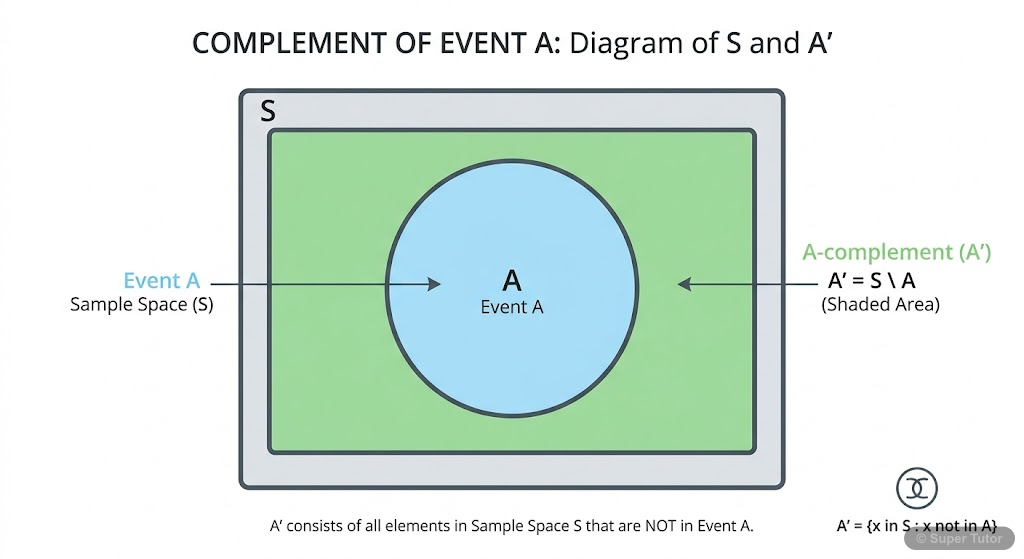
Two events are complementary if one is 'not' the other, and together they cover all possible outcomes. If E is an event, then Ē (not E) is its complem
Probability values always lie between 0
Probability values always lie between 0 and 1 (inclusive). P(E) = 0 means the event is impossible (like getting a 7 on a standard die). P(E) = 1 means
Learning Objectives
- Understand the difference between experimental and theoretical probability
- Learn to identify equally likely outcomes in various experiments
- Apply the classical probability formula to solve problems
- Recognize and work with complementary events
- Understand the range of probability values (0 to 1)
Frequently Asked Questions
What are the important topics in Probability for Uttar Pradesh Board Class 10 Mathematics?
How to score full marks in Probability — Uttar Pradesh Board Class 10 Mathematics?
Sources & Official References
Content is aligned to the official syllabus. Refer to the board website for the latest curriculum.
More resources for Probability
Important Questions
Practice with board exam-style questions
Syllabus
What topics to cover
Revision Notes
Key points for last-minute revision
Study Plan
Step-by-step plan to ace this chapter
Flashcards
Quick-fire cards for active recall
Formula Sheet
All formulas in one place
Practice Quiz
Test yourself with a quick quiz
Concept Maps
See how topics connect visually
For serious students
Get the full Probability chapter — for free.
Quizzes, flashcards, AI doubt-solver and a step-by-step study plan for Uttar Pradesh Board Class 10 Mathematics.