Electrostatic Potential and Capacitance
Uttar Pradesh Board · Class 12 · Physics
Summary of Electrostatic Potential and Capacitance for Uttar Pradesh Board Class 12 Physics. Key concepts, important points, and chapter overview.
Interactive on Super Tutor
Studying Electrostatic Potential and Capacitance? Get the full interactive chapter.
Quizzes, flashcards, AI doubt-solver and a step-by-step study plan — built for chapter summary and more.
1,000+ Class 12 students started this chapter today
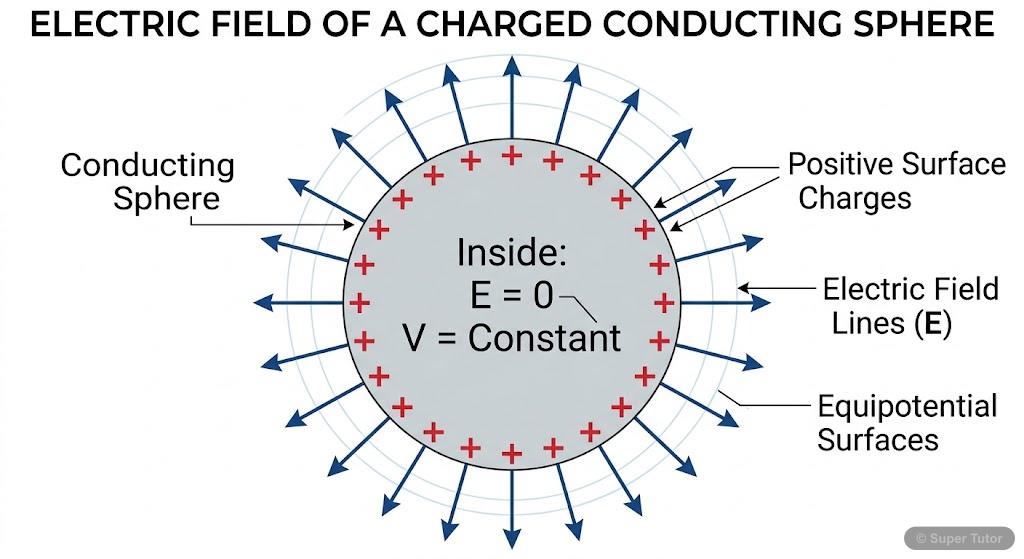
Super Tutor has 24+ illustrations like this for Electrostatic Potential and Capacitance alone — flashcards, concept maps, and step-by-step visuals.
See them allOverview
This chapter explores the fundamental concepts of electrostatic potential and capacitance, building upon our understanding of electric fields from previous chapters. We learn how electric potential energy and potential are defined, calculated, and applied in various situations. The chapter also intr
Key Concepts
The work done by an external
The work done by an external force in bringing a charge from infinity to a point in an electric field. It represents the energy stored in the charge-f
The work done per unit positive
The work done per unit positive charge in bringing it from infinity to a point. V = U/q = (1/4πε₀)(Q/r) for a point charge Q. Potential is a scalar qu
Surfaces where all points have
Surfaces where all points have the same electric potential. Electric field lines are always perpendicular to equipotential surfaces. For a point charg
For a dipole with moment p
For a dipole with moment p at distance r >> a, V = (1/4πε₀)(p⃗·r̂/r²) = (1/4πε₀)(p cos θ/r²), where θ is angle between p⃗ and r⃗.
Inside a conductor
Inside a conductor: E = 0, potential is constant. At the surface: E = σ/ε₀ (normal to surface), where σ is surface charge density. All excess charge r
Learning Objectives
- Define and calculate electrostatic potential and potential energy
- Understand the relationship between electric field and potential
- Calculate potential due to point charges, dipoles, and charge distributions
- Analyze equipotential surfaces and their properties
- Understand the behavior of conductors in electrostatic equilibrium
Frequently Asked Questions
What are the important topics in Electrostatic Potential and Capacitance for Uttar Pradesh Board Class 12 Physics?
How to score full marks in Electrostatic Potential and Capacitance — Uttar Pradesh Board Class 12 Physics?
Sources & Official References
Content is aligned to the official syllabus. Refer to the board website for the latest curriculum.
More resources for Electrostatic Potential and Capacitance
Important Questions
Practice with board exam-style questions
Syllabus
What topics to cover
Revision Notes
Key points for last-minute revision
Study Plan
Step-by-step plan to ace this chapter
Flashcards
Quick-fire cards for active recall
Formula Sheet
All formulas in one place
Practice Quiz
Test yourself with a quick quiz
Concept Maps
See how topics connect visually
For serious students
Get the full Electrostatic Potential and Capacitance chapter — for free.
Quizzes, flashcards, AI doubt-solver and a step-by-step study plan for Uttar Pradesh Board Class 12 Physics.