Light - Reflection and Refraction
CBSE · Class 10 · Science
Summary of Light - Reflection and Refraction for CBSE Class 10 Science. Key concepts, important points, and chapter overview.
Interactive on Super Tutor
Studying Light - Reflection and Refraction? Get the full interactive chapter.
Quizzes, flashcards, AI doubt-solver and a step-by-step study plan — built for chapter summary and more.
1,000+ Class 10 students started this chapter today
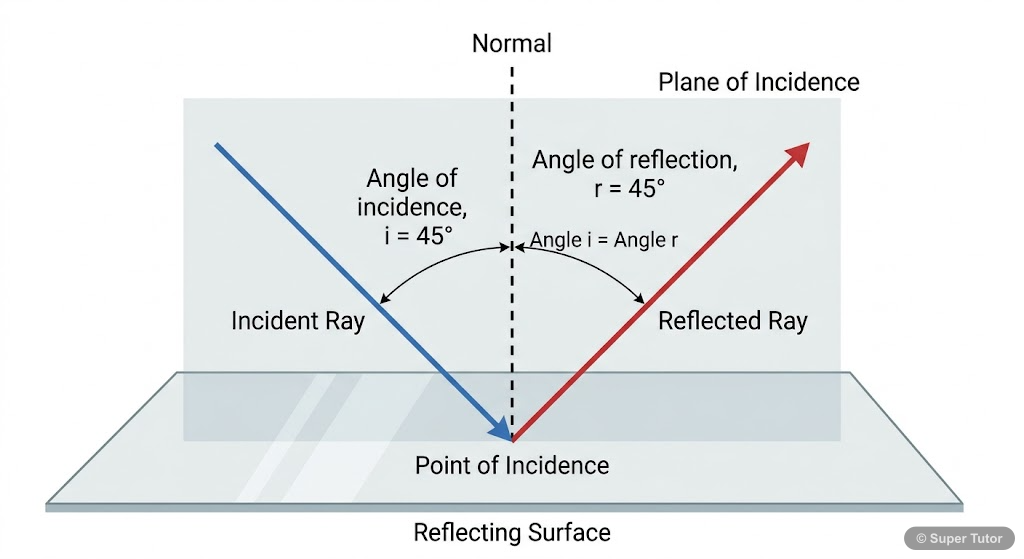
Super Tutor has 35+ illustrations like this for Light - Reflection and Refraction alone — flashcards, concept maps, and step-by-step visuals.
See them allOverview
Light is a form of energy that enables us to see the world around us. We can see objects because they either emit light or reflect light that falls on them. This chapter explores how light behaves when it encounters different surfaces and materials. We study two fundamental phenomena: reflection, wh
Key Concepts
Two fundamental laws govern reflection
Two fundamental laws govern reflection: (1) The angle of incidence equals the angle of reflection, and (2) The incident ray, reflected ray, and normal
Spherical mirrors have curved reflecting surfaces
Spherical mirrors have curved reflecting surfaces that form part of a sphere. Concave mirrors curve inward (like a spoon's inner surface) and can form
The mirror formula 1/f = 1/v
The mirror formula 1/f = 1/v + 1/u relates focal length (f), image distance (v), and object distance (u). This formula works for all spherical mirrors
Refraction occurs when light passes from
Refraction occurs when light passes from one medium to another. The laws state: (1) The incident ray, refracted ray, and normal lie in the same plane,
The refractive index (n) of
The refractive index (n) of a medium is the ratio of the speed of light in vacuum to the speed of light in that medium: n = c/v. It indicates how much
Learning Objectives
- Understand the laws of reflection and their applications in plane and spherical mirrors
- Learn about different types of spherical mirrors and their image formation properties
- Master the mirror formula and magnification calculations
- Comprehend the phenomenon of refraction and its laws
- Study refraction through different media and the concept of refractive index
Frequently Asked Questions
What are the important topics in Light - Reflection and Refraction for CBSE Class 10 Science?
How to score full marks in Light - Reflection and Refraction — CBSE Class 10 Science?
Sources & Official References
- NCERT Official — ncert.nic.in
- CBSE Academic — cbseacademic.nic.in
- CBSE Official — cbse.gov.in
- National Education Policy 2020 — education.gov.in
Content is aligned to the official syllabus. Refer to the board website for the latest curriculum.
More resources for Light - Reflection and Refraction
Important Questions
Practice with board exam-style questions
Syllabus
What topics to cover
Revision Notes
Key points for last-minute revision
Study Plan
Step-by-step plan to ace this chapter
Flashcards
Quick-fire cards for active recall
Formula Sheet
All formulas in one place
Practice Quiz
Test yourself with a quick quiz
Concept Maps
See how topics connect visually
For serious students
Get the full Light - Reflection and Refraction chapter — for free.
Quizzes, flashcards, AI doubt-solver and a step-by-step study plan for CBSE Class 10 Science.