Simple and Compound Interest — Revision Notes
CMAT · Quantitative Techniques & Data Interpretation
Free Simple and Compound Interest revision notes for CMAT Quantitative Techniques & Data Interpretation 2026 — key concepts, formulas, and definitions for quick revision.
Interactive on Super Tutor
Studying Simple and Compound Interest? Get the full chapter — free.
Practice questions, revision notes, formula sheet and AI doubt-solver — built for CMAT Quantitative Techniques & Data Interpretation.
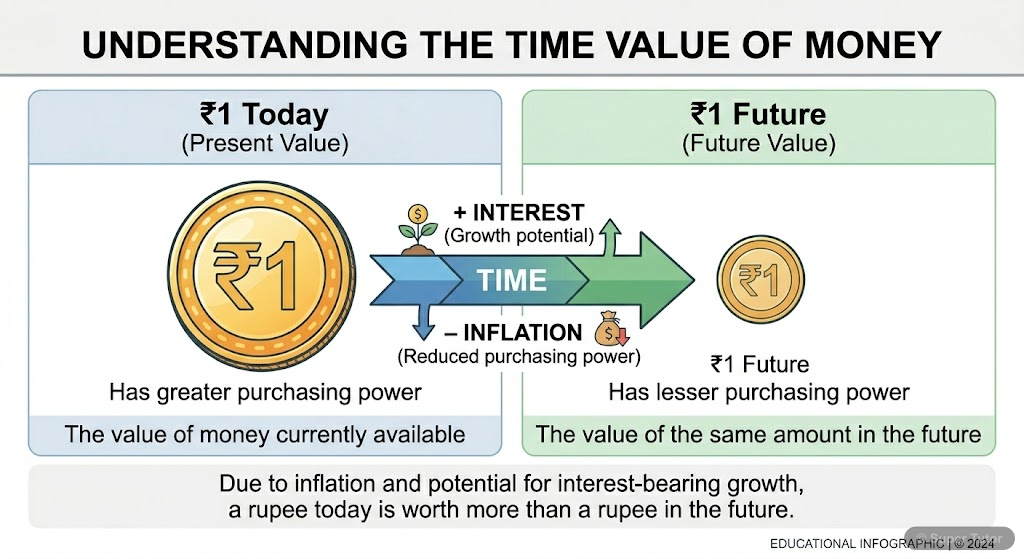
Learn better with visuals Super Tutor has hundreds of illustrations like this across every chapter — all free to try.
Get startedRevision Notes — Simple and Compound Interest
Key concepts, formulas, and definitions from Simple and Compound Interest for CMAT Quantitative Techniques & Data Interpretation preparation.
Key Topics to Revise
Basic Concepts and Terminology
- Interest is compensation for the time value of money - money today is worth more than money tomorrow
- Principal (P): The original amount of money borrowed or invested
- Rate (R): The percentage of interest charged per unit time (usually per annum)
Simple Interest Applications
- Simple Interest grows linearly - same amount added each year
- Forms an Arithmetic Progression: P, P+SI, P+2SI, P+3SI...
- If money doubles in 't' years at SI, rate = 100/t %
Compound Interest Fundamentals
- Interest is calculated on principal + accumulated interest
- Forms a Geometric Progression with ratio (1 + R/100)
- Amount grows exponentially, not linearly
Difference Between CI and SI
- For 1 year: CI = SI (no difference)
- For 2 years: CI - SI = P(R/100)²
- For 3 years: CI - SI = P(R/100)²(3 + R/100)
Get complete revision notes with diagrams and examples — continue in Super Tutor
Key Concepts
Frequently Asked Questions
What topics are covered in Simple and Compound Interest for CMAT?
How important is Simple and Compound Interest for CMAT?
How to prepare Simple and Compound Interest for CMAT?
More resources for Simple and Compound Interest
For CMAT aspirants
Get the full Simple and Compound Interest chapter — for free.
Practice questions, revision notes, formula sheet and AI doubt-solver for CMAT Quantitative Techniques & Data Interpretation.