Measurement and Errors — Study Plan
JEE Mains · Physics
Step-by-step Measurement and Errors study plan for JEE Mains Physics 2026 — structured month-wise approach to mastering this chapter.
Interactive on Super Tutor
Studying Measurement and Errors? Get the full chapter — free.
Practice questions, revision notes, formula sheet and AI doubt-solver — built for JEE Mains Physics.
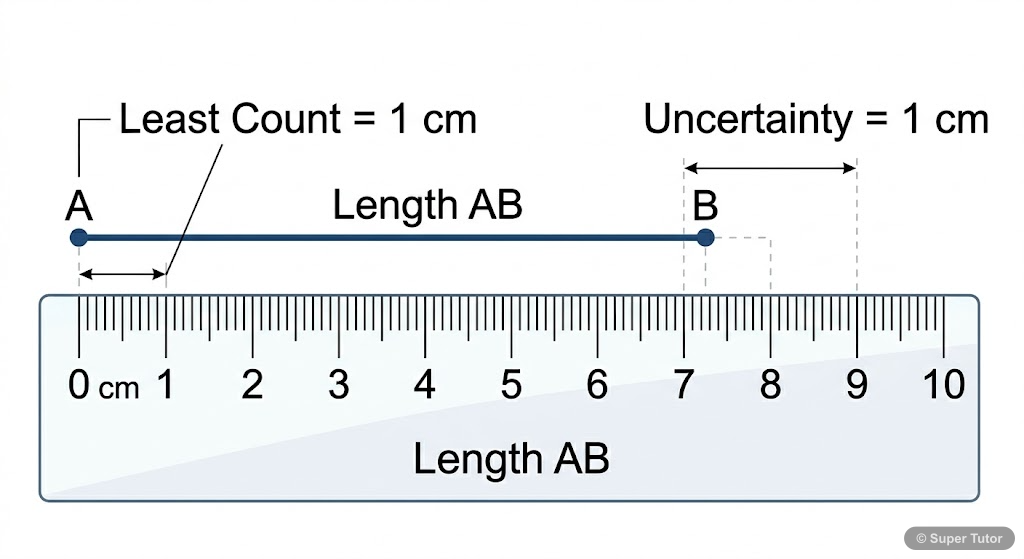
This is just one of 14+ visuals inside Super Tutor's Measurement and Errors chapter
Explore the full setHow to Study Measurement and Errors
A structured approach to studying Measurement and Errors for JEE Mains Physics.
Study Plan for Measurement and Errors
Day 1–2: Learn the Theory
Study the chapter thoroughly. Note down definitions, formulas, and key concepts.
Day 3: Practice Problems
Solve practice questions and previous year JEE Mains problems. There are 60 questions available for this chapter.
Day 4: Revise & Test
Revise key formulas and concepts without looking at notes. Take a practice quiz to test your understanding.
What to Focus On
- Least Count (LC) is the smallest measurement an instrument can accurately make.
- Maximum permissible error in a single measurement = LC of the instrument.
- A measurement l = (a ± LC) means the true value lies between (a - LC) and (a + LC).
- SF = all certain digits + first uncertain digit.
- Non-zero digits: always significant (Rule 1).
- Captive zeros (between non-zero digits): always significant (Rule 2).
- Dropped digit < 5: preceding digit unchanged (round down).
- Dropped digit > 5: preceding digit incremented by 1 (round up).
- Dropped digit = 5 followed by non-zero digits: always round up (Rule 2).
Common Mistakes to Avoid
Trailing zeros in a whole number (without a decimal point) are always significant.
In error propagation, the percentage error in a quantity like x = aⁿ is n × (percentage error in a), but the same multiplication rule applies only for products of different variables, not for powers.
When adding or subtracting measurements, the result should be rounded to the least number of SIGNIFICANT FIGURES among the quantities being added/subtracted.
Want a personalised study plan?
Super Tutor creates a day-by-day plan for JEE Mains Physics that adapts to your exam date and pace.
Create My Study Plan — FreeFrequently Asked Questions
What topics are covered in Measurement and Errors for JEE Mains?
How important is Measurement and Errors for JEE Mains?
How to prepare Measurement and Errors for JEE Mains?
More resources for Measurement and Errors
For JEE Mains aspirants
Get the full Measurement and Errors chapter — for free.
Practice questions, revision notes, formula sheet and AI doubt-solver for JEE Mains Physics.