Electrostatics — Study Plan
JEE Mains · Physics
Step-by-step Electrostatics study plan for JEE Mains Physics 2026 — structured month-wise approach to mastering this chapter.
Interactive on Super Tutor
Studying Electrostatics? Get the full chapter — free.
Practice questions, revision notes, formula sheet and AI doubt-solver — built for JEE Mains Physics.
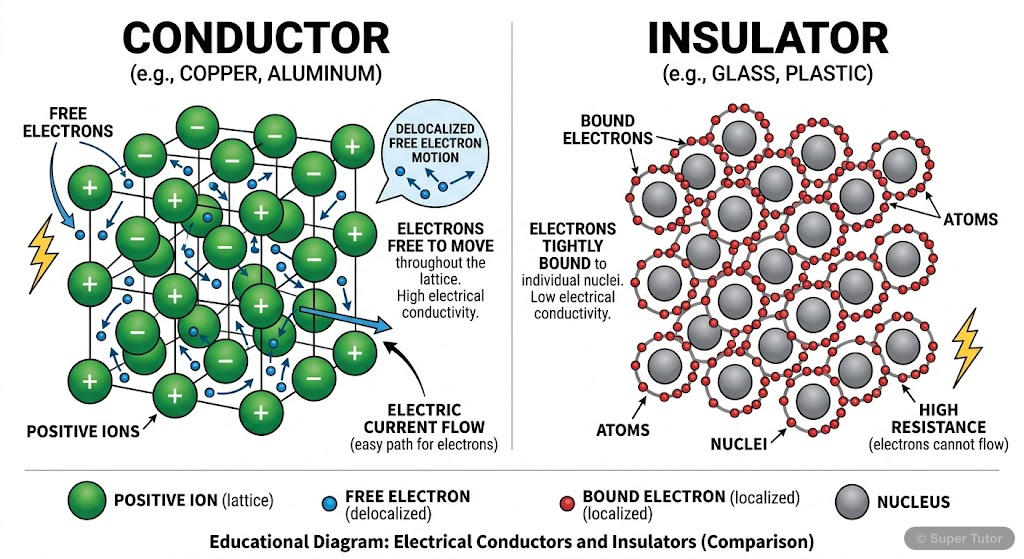
This is just one of 24+ visuals inside Super Tutor's Electrostatics chapter
Explore the full setHow to Study Electrostatics
A structured approach to studying Electrostatics for JEE Mains Physics.
Study Plan for Electrostatics
Day 1–2: Learn the Theory
Study the chapter thoroughly. Note down definitions, formulas, and key concepts.
Day 3: Practice Problems
Solve practice questions and previous year JEE Mains problems. There are 101 questions available for this chapter.
Day 4: Revise & Test
Revise key formulas and concepts without looking at notes. Take a practice quiz to test your understanding.
What to Focus On
- q = ne; e = 1.6 × 10⁻¹⁹ C; n is always a positive integer
- Charge is conserved in all physical processes — algebraic sum of charges in an isolated system is constant
- Charge is relativistically invariant — does not change with the speed of the charged body
- F = kq₁q₂/r²; k = 9 × 10⁹ N·m²/C²; ε₀ = 8.85 × 10⁻¹² C²/N·m²
- Force in medium = Force in vacuum / K; force always decreases in a medium
- Coulomb force is conservative, central, and obeys Newton's third law
- E = F/q₀ (limit q₀→0); unit N/C or V/m; it is a vector
- Point charge: E = kq/r² (∝ 1/r²); Line charge: E = λ/2πε₀r (∝ 1/r); Sheet: E = σ/2ε₀ (constant)
- Ring axis: E_x = kqx/(R²+x²)^(3/2); zero at centre, maximum at x = R/√2
Common Mistakes to Avoid
Electric field inside a conductor is zero because there are no charges inside it.
Gauss's Law can always be used to find the electric field by simply dividing enclosed charge by ε₀ and the area of the Gaussian surface.
If the potential at a point is zero, the electric field at that point must also be zero.
Want a personalised study plan?
Super Tutor creates a day-by-day plan for JEE Mains Physics that adapts to your exam date and pace.
Create My Study Plan — FreeFrequently Asked Questions
What topics are covered in Electrostatics for JEE Mains?
How important is Electrostatics for JEE Mains?
How to prepare Electrostatics for JEE Mains?
More resources for Electrostatics
For JEE Mains aspirants
Get the full Electrostatics chapter — for free.
Practice questions, revision notes, formula sheet and AI doubt-solver for JEE Mains Physics.