Chapter 2 of 22
Revision Notes
Structure of Atom — Revision Notes
NEET-UG · Chemistry
Quick revision notes for Structure of Atom — key concepts, formulas, and definitions for NEET-UG Chemistry preparation.
Interactive on Super Tutor
Studying Structure of Atom? Get the full chapter — free.
Practice questions, revision notes, formula sheet and AI doubt-solver — built for NEET-UG Chemistry.
Super Tutor
This is just one of 19+ visuals inside Super Tutor's Structure of Atom chapter
Explore the full setRevision Notes — Structure of Atom
Key concepts, formulas, and definitions from Structure of Atom for NEET-UG Chemistry preparation.
Key Topics to Revise
1
Historical Development of Atomic Models
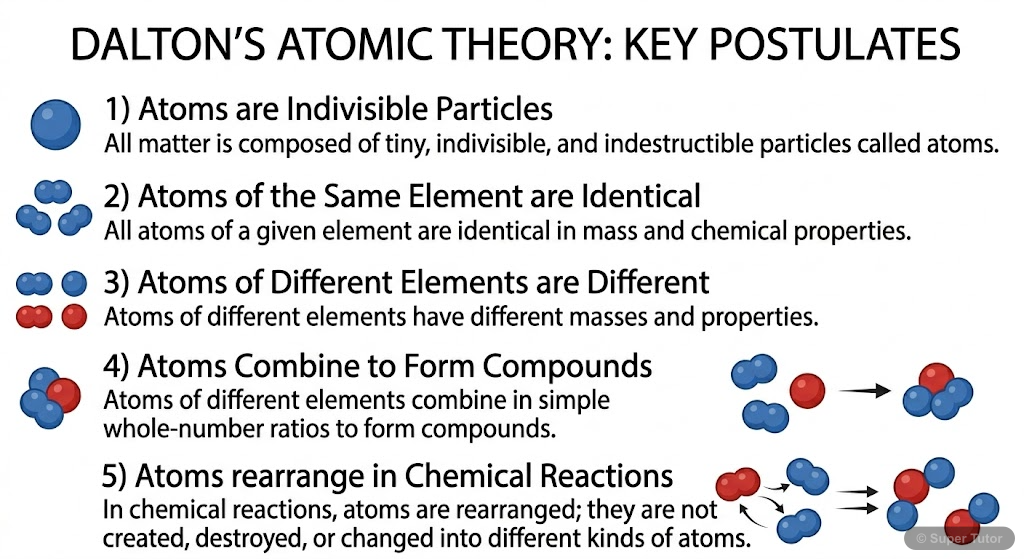
- Dalton's atomic theory (1803): Matter consists of indivisible atoms
- Thomson's model (1898): 'Plum pudding' model with electrons embedded in positive sphere
- Rutherford's nuclear model (1911): Dense nucleus with electrons orbiting around it
2
Bohr's Atomic Model and Hydrogen Spectrum
- Electrons revolve in fixed circular orbits without losing energy
- Angular momentum is quantized: mvr = nh/2π
- Energy is emitted/absorbed only when electron jumps between orbits
3
Wave-Particle Duality and de Broglie Equation
- Light exhibits dual nature: wave (diffraction, interference) and particle (photoelectric effect)
- Matter also has dual nature as proposed by de Broglie
- de Broglie wavelength is inversely proportional to momentum
4
Quantum Numbers and Electronic Configuration
- Four quantum numbers completely describe an electron in atom
- Principal quantum number (n): shell, energy level, distance from nucleus
- Azimuthal quantum number (ℓ): subshell, shape of orbital, angular momentum
Get complete revision notes with diagrams and examples — continue in Super Tutor
Key Concepts
Proposed that matter consists of indivisibleThree fundamental particlesBased on αElectromagnetic waves characterized by wavelength (λ)Key postulates
Frequently Asked Questions
What topics are covered in Structure of Atom for NEET-UG?
Structure of Atom is an important chapter in NEET-UG Chemistry. It covers key concepts and formulas that are frequently tested in the exam. Key topics include: Historical Development of Atomic Models, Bohr's Atomic Model and Hydrogen Spectrum, Wave-Particle Duality and de Broglie Equation, Quantum Numbers and Electronic Configuration.
How important is Structure of Atom for NEET-UG?
Structure of Atom is a frequently tested chapter in NEET-UG Chemistry. Questions from this chapter appear regularly in previous year papers. There are 76 practice questions available for this chapter.
How to prepare Structure of Atom for NEET-UG?
Start by understanding the core concepts, then solve practice questions. Focus on formulas and their applications. Use revision notes for quick review before the exam.
More resources for Structure of Atom
For NEET-UG aspirants
Get the full Structure of Atom chapter — for free.
Practice questions, revision notes, formula sheet and AI doubt-solver for NEET-UG Chemistry.