Critical Reasoning — Revision Notes
SNAP · Verbal Ability & Reading Comprehension
Quick revision notes for Critical Reasoning — key concepts, formulas, and definitions for SNAP Verbal Ability & Reading Comprehension preparation.
Interactive on Super Tutor
Studying Critical Reasoning? Get the full chapter — free.
Practice questions, revision notes, formula sheet and AI doubt-solver — built for SNAP Verbal Ability & Reading Comprehension.
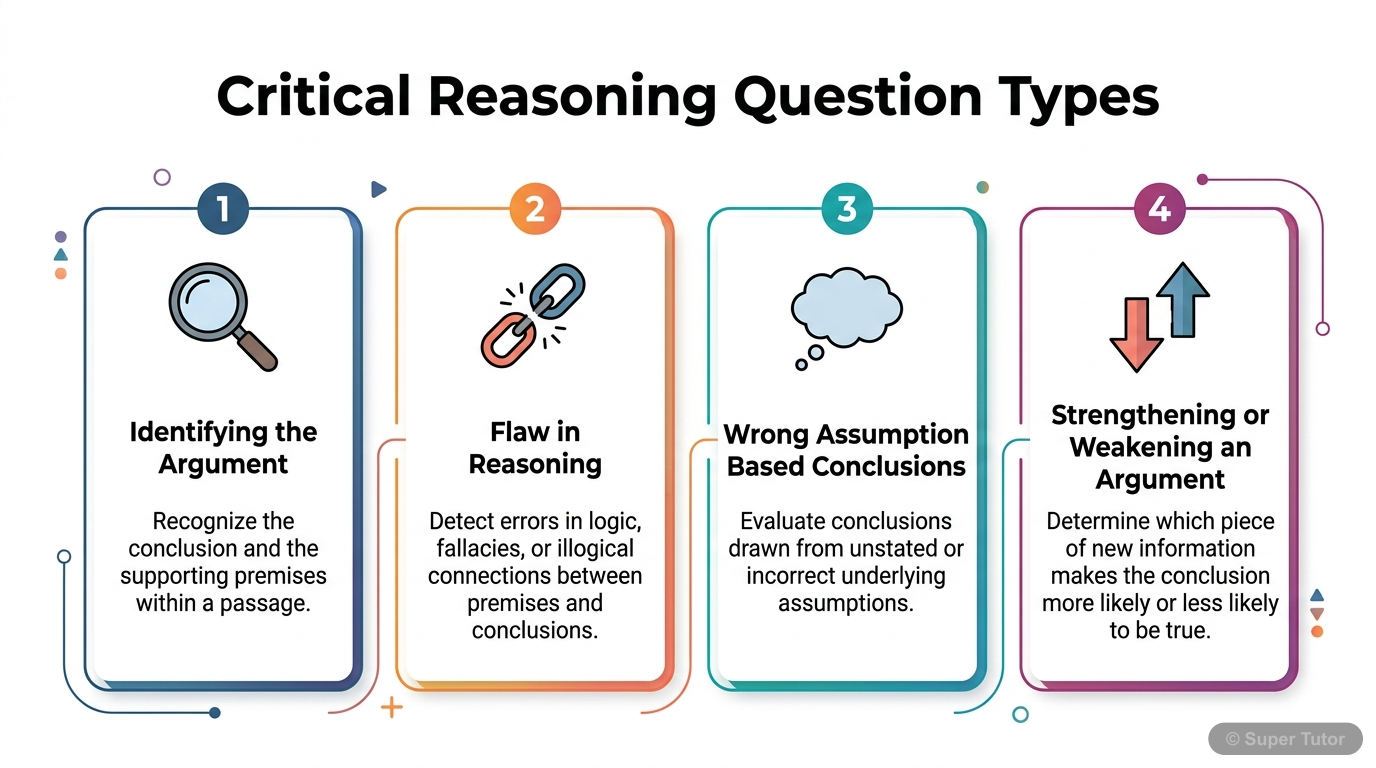
Learn better with visuals Super Tutor has hundreds of illustrations like this across every chapter — all free to try.
Get startedRevision Notes — Critical Reasoning
Key concepts, formulas, and definitions from Critical Reasoning for SNAP Verbal Ability & Reading Comprehension preparation.
Key Topics to Revise
Understanding Arguments in Critical Reasoning
- An argument in CR is not a conflict but a piece of reasoning that proves or disproves an assertion
- Every argument has three components: Premise (given facts), Connection (logical link), and Conclusion (derived statement)
- Arguments can be evaluated for their logical validity and soundness
Types of Critical Reasoning Questions
- Main Point Questions: Identify the central argument or conclusion of a passage
- Assumption Questions: Find unstated beliefs that support the argument
- Strengthen/Weaken Questions: Identify options that support or undermine the argument
Common Logical Fallacies
- Fallacy of Irrelevant Reason: Using reasons that don't logically connect to the conclusion
- Correlating Wrong Ends: Drawing conclusions without proper evidence or credentials
- Hasty Generalization: Making broad conclusions from limited examples
Strategies for Strengthening and Weakening Arguments
- To strengthen: Provide additional evidence supporting the premise-conclusion connection
- To weaken: Attack either the premises, the connection, or introduce contradictory evidence
- Focus on the logical gap between premises and conclusion
Get complete revision notes with diagrams and examples — continue in Super Tutor
Key Concepts
Frequently Asked Questions
What topics are covered in Critical Reasoning for SNAP?
How important is Critical Reasoning for SNAP?
How to prepare Critical Reasoning for SNAP?
More resources for Critical Reasoning
For SNAP aspirants
Get the full Critical Reasoning chapter — for free.
Practice questions, revision notes, formula sheet and AI doubt-solver for SNAP Verbal Ability & Reading Comprehension.