Critical Reasoning — Study Plan
SNAP · Verbal Ability & Reading Comprehension
Step-by-step study plan for Critical Reasoning — structured approach to mastering this chapter for SNAP Verbal Ability & Reading Comprehension.
Interactive on Super Tutor
Studying Critical Reasoning? Get the full chapter — free.
Practice questions, revision notes, formula sheet and AI doubt-solver — built for SNAP Verbal Ability & Reading Comprehension.
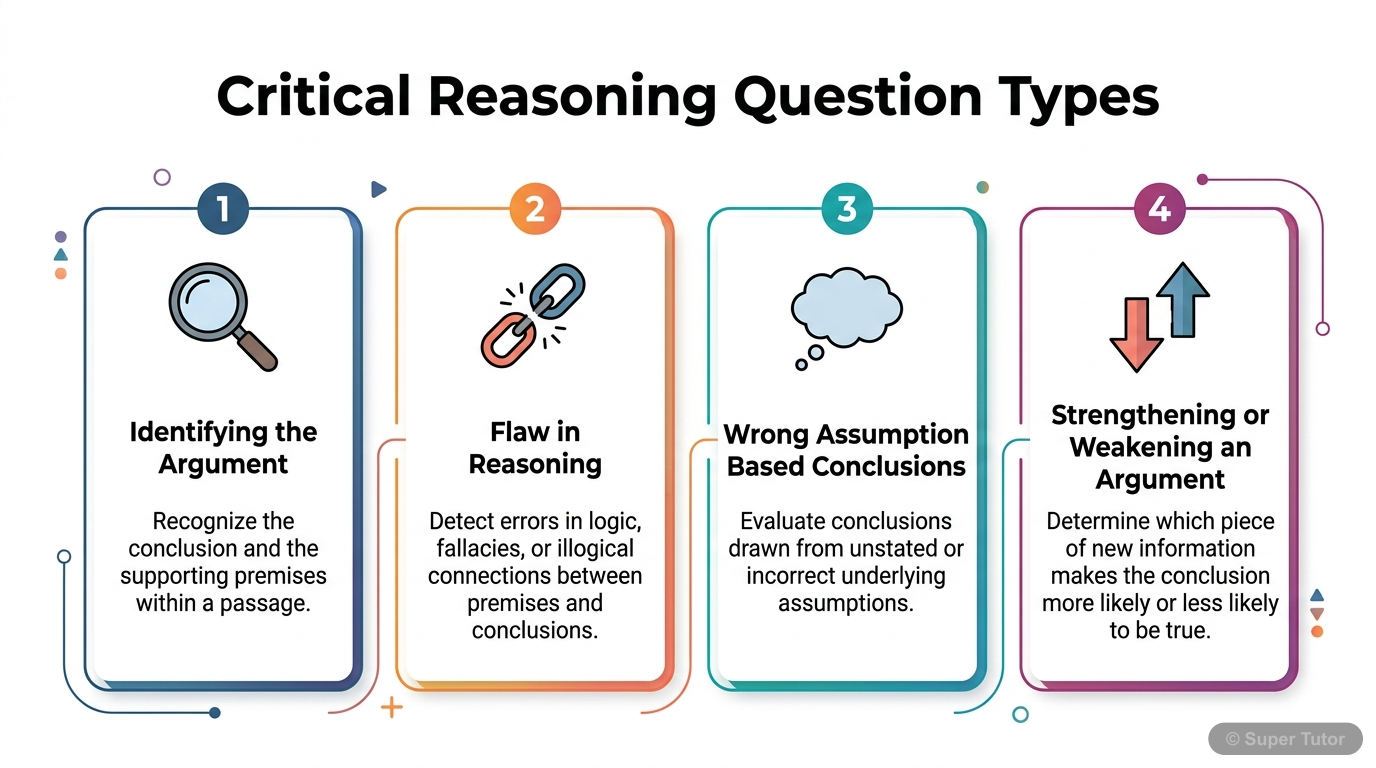
Learn better with visuals Super Tutor has hundreds of illustrations like this across every chapter — all free to try.
Get startedHow to Study Critical Reasoning
A structured approach to studying Critical Reasoning for SNAP Verbal Ability & Reading Comprehension.
Study Plan for Critical Reasoning
Day 1–2: Learn the Theory
Study the chapter thoroughly. Note down definitions, formulas, and key concepts.
Day 3: Practice Problems
Solve practice questions and previous year SNAP problems. There are 45 questions available for this chapter.
Day 4: Revise & Test
Revise key formulas and concepts without looking at notes. Take a practice quiz to test your understanding.
What to Focus On
- An argument consists of premise, reasoning, and conclusion
- Premises are usually given facts that cannot be disputed
- The connection between premise and conclusion is where most flaws occur
- Four main question types: identification, flaw detection, assumption analysis, strengthening/weakening
- Each type tests different aspects of logical reasoning
- Understanding question types helps in choosing the right approach
- Assumptions are unstated beliefs that support the argument
- Conclusions are explicitly stated and verifiable
- Assumptions fill logical gaps between premises and conclusions
Common Mistakes to Avoid
Assumption and conclusion are the same thing
Strengthening/weakening means agreeing/disagreeing with the conclusion
All stated information in the passage is a premise
Want a personalised study plan?
Super Tutor creates a day-by-day plan for SNAP Verbal Ability & Reading Comprehension that adapts to your exam date and pace.
Create My Study Plan — FreeFrequently Asked Questions
What topics are covered in Critical Reasoning for SNAP?
How important is Critical Reasoning for SNAP?
How to prepare Critical Reasoning for SNAP?
More resources for Critical Reasoning
For SNAP aspirants
Get the full Critical Reasoning chapter — for free.
Practice questions, revision notes, formula sheet and AI doubt-solver for SNAP Verbal Ability & Reading Comprehension.