Direct and Indirect Speech
ICSE · Class 10 · English Language - Archer
Summary of Direct and Indirect Speech for ICSE Class 10 English Language - Archer. Key concepts, important points, and chapter overview.
Interactive on Super Tutor
Studying Direct and Indirect Speech? Get the full interactive chapter.
Quizzes, flashcards, AI doubt-solver and a step-by-step study plan — built for chapter summary and more.
1,000+ Class 10 students started this chapter today
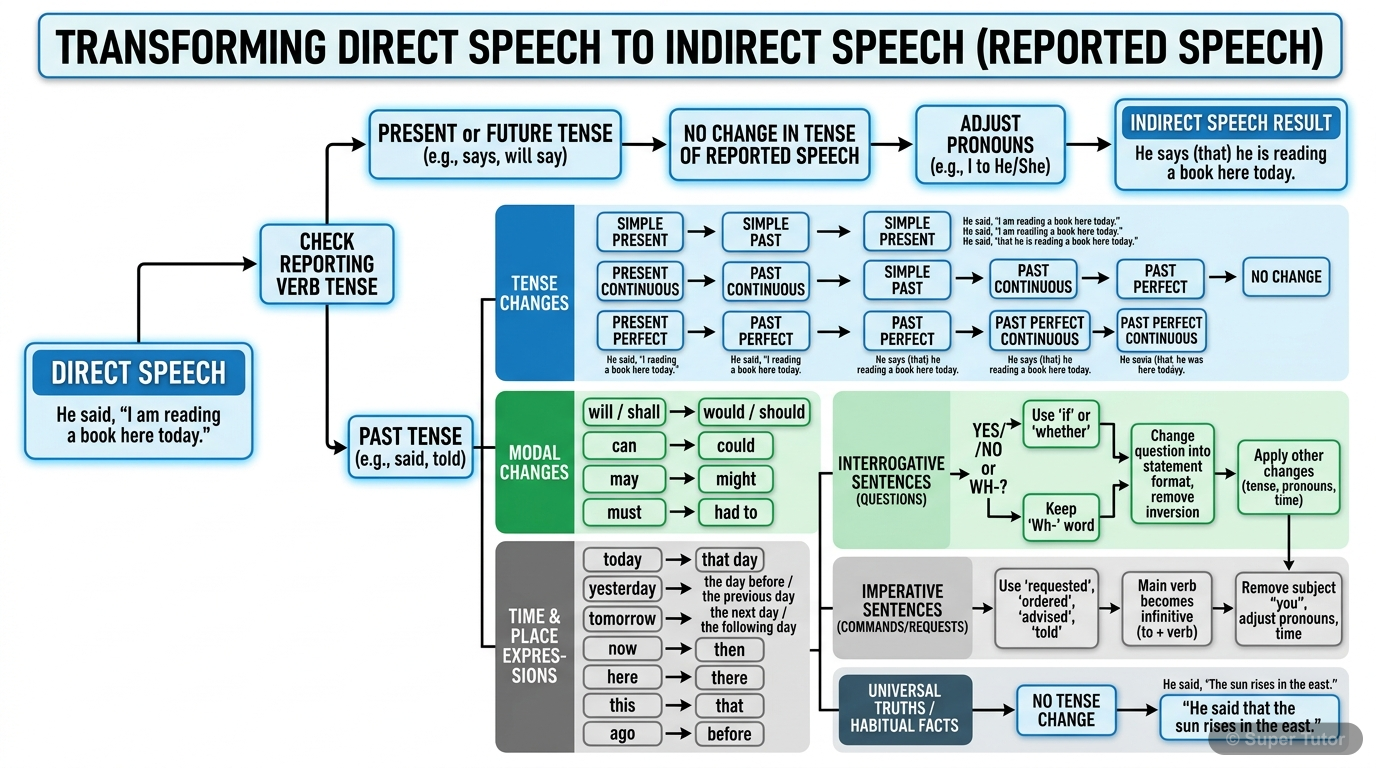
Learn better with visuals Super Tutor has hundreds of illustrations like this across every chapter — all free to try.
Get startedOverview
Direct and Indirect Speech are two fundamental ways of reporting what someone has said. Direct speech repeats the exact words spoken by a person, enclosed in quotation marks, while indirect speech (also called reported speech) conveys the same message without using the speaker's exact words. Underst
Key Concepts
Direct speech reproduces the exact words
Direct speech reproduces the exact words spoken by someone, enclosed in quotation marks. Example: Namrata said, 'It is extremely hot today.' The speak
Indirect speech reports what someone said
Indirect speech reports what someone said without using their exact words, typically introduced by 'that'. Example: Namrata said that it was extremely
When the reporting verb is
When the reporting verb is in past tense, specific tense changes occur: Simple Present becomes Simple Past, Present Continuous becomes Past Continuous
Words indicating time and place change
Words indicating time and place change during conversion: 'today' becomes 'that day', 'yesterday' becomes 'the day before', 'here' becomes 'there', 't
The word 'said' can be replaced
The word 'said' can be replaced with more specific verbs like 'announced', 'complained', 'whispered', 'argued', 'admitted' depending on the tone and n
Learning Objectives
- Understand the difference between direct and indirect speech
- Learn the rules for converting direct speech to indirect speech
- Master the changes in tense, pronouns, and time expressions during conversion
- Identify and use appropriate reporting verbs for different types of sentences
- Apply conversion rules for statements, questions, commands, and exclamations
Frequently Asked Questions
What are the important topics in Direct and Indirect Speech for ICSE Class 10 English Language - Archer?
How to score full marks in Direct and Indirect Speech — ICSE Class 10 English Language - Archer?
Sources & Official References
Content is aligned to the official syllabus. Refer to the board website for the latest curriculum.
More resources for Direct and Indirect Speech
Important Questions
Practice with board exam-style questions
Syllabus
What topics to cover
Revision Notes
Key points for last-minute revision
Study Plan
Step-by-step plan to ace this chapter
Flashcards
Quick-fire cards for active recall
Formula Sheet
All formulas in one place
Practice Quiz
Test yourself with a quick quiz
Concept Maps
See how topics connect visually
For serious students
Get the full Direct and Indirect Speech chapter — for free.
Quizzes, flashcards, AI doubt-solver and a step-by-step study plan for ICSE Class 10 English Language - Archer.