Active and Passive Voice
ICSE · Class 10 · English Language - Archer
Summary of Active and Passive Voice for ICSE Class 10 English Language - Archer. Key concepts, important points, and chapter overview.
Interactive on Super Tutor
Studying Active and Passive Voice? Get the full interactive chapter.
Quizzes, flashcards, AI doubt-solver and a step-by-step study plan — built for chapter summary and more.
1,000+ Class 10 students started this chapter today
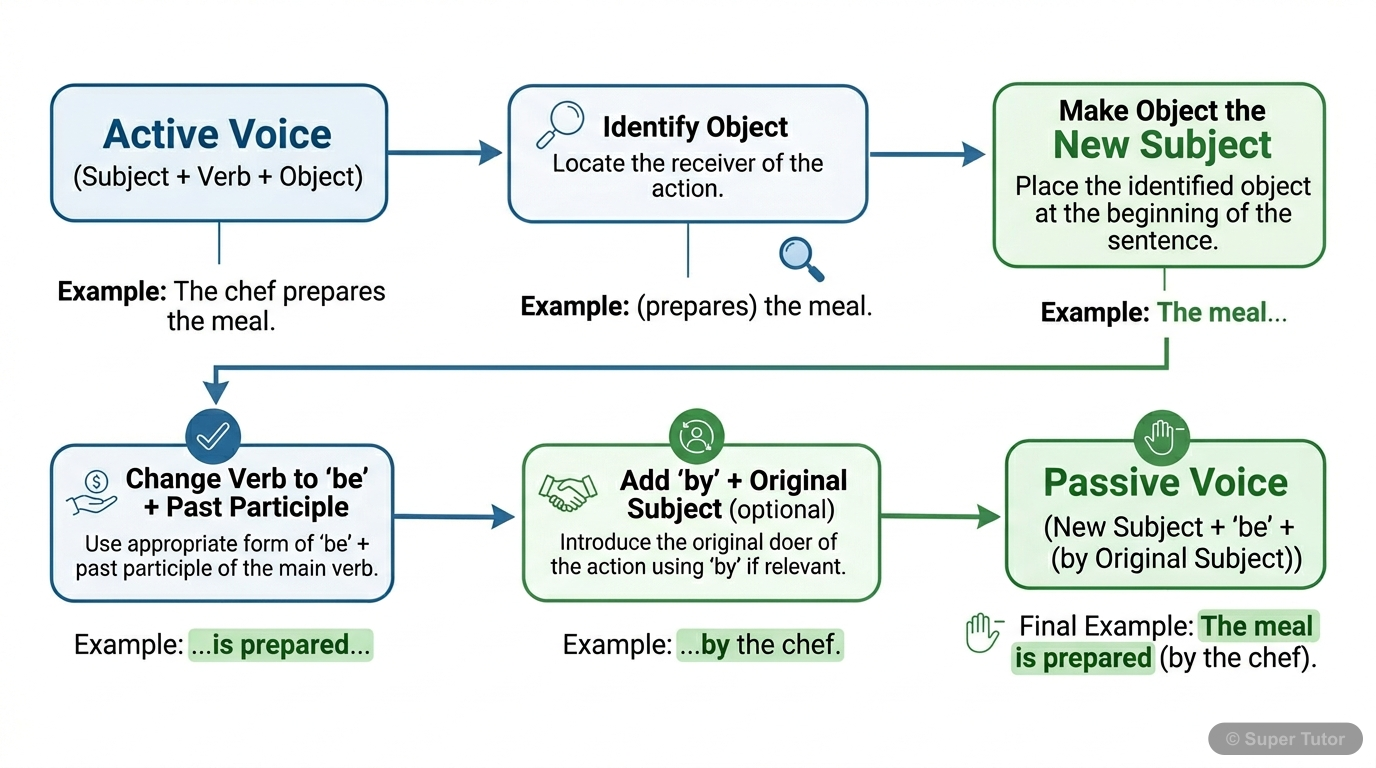
Super Tutor has 5+ illustrations like this for Active and Passive Voice alone — flashcards, concept maps, and step-by-step visuals.
See them allOverview
Active and Passive Voice are two different ways of expressing the same action in English grammar. In active voice, the subject performs the action, while in passive voice, the subject receives the action. Understanding these voice forms is crucial for effective communication and helps in varying sen
Key Concepts
In active voice
In active voice, the subject of the sentence performs the action. The structure follows: Subject + Verb + Object. For example: 'Priya fed the hungry c
In passive voice
In passive voice, the subject receives the action rather than performing it. The structure follows: Subject + be verb + past participle + by + agent.
To convert active to passive
To convert active to passive: (1) The object becomes the subject, (2) The verb changes to appropriate form of 'be' + past participle, (3) The original
When a sentence has both direct
When a sentence has both direct and indirect objects, either can become the subject in passive voice. For example: 'The teacher taught French and Germ
Only transitive verbs (verbs that take
Only transitive verbs (verbs that take objects) can be converted to passive voice. Intransitive verbs like 'sleep', 'laugh', 'shine' cannot form passi
Learning Objectives
- Understand the difference between active and passive voice
- Learn to convert sentences from active to passive voice and vice versa
- Master the rules for forming passive voice across different tenses
- Recognize when to use passive voice appropriately
- Apply voice transformations in various sentence structures including those with two objects
Frequently Asked Questions
What are the important topics in Active and Passive Voice for ICSE Class 10 English Language - Archer?
How to score full marks in Active and Passive Voice — ICSE Class 10 English Language - Archer?
Sources & Official References
Content is aligned to the official syllabus. Refer to the board website for the latest curriculum.
More resources for Active and Passive Voice
Important Questions
Practice with board exam-style questions
Syllabus
What topics to cover
Revision Notes
Key points for last-minute revision
Study Plan
Step-by-step plan to ace this chapter
Flashcards
Quick-fire cards for active recall
Formula Sheet
All formulas in one place
Practice Quiz
Test yourself with a quick quiz
Concept Maps
See how topics connect visually
For serious students
Get the full Active and Passive Voice chapter — for free.
Quizzes, flashcards, AI doubt-solver and a step-by-step study plan for ICSE Class 10 English Language - Archer.