Current Electricity
ICSE · Class 10 · Physics
Summary of Current Electricity for ICSE Class 10 Physics. Key concepts, important points, and chapter overview.
Interactive on Super Tutor
Studying Current Electricity? Get the full interactive chapter.
Quizzes, flashcards, AI doubt-solver and a step-by-step study plan — built for chapter summary and more.
1,000+ Class 10 students started this chapter today
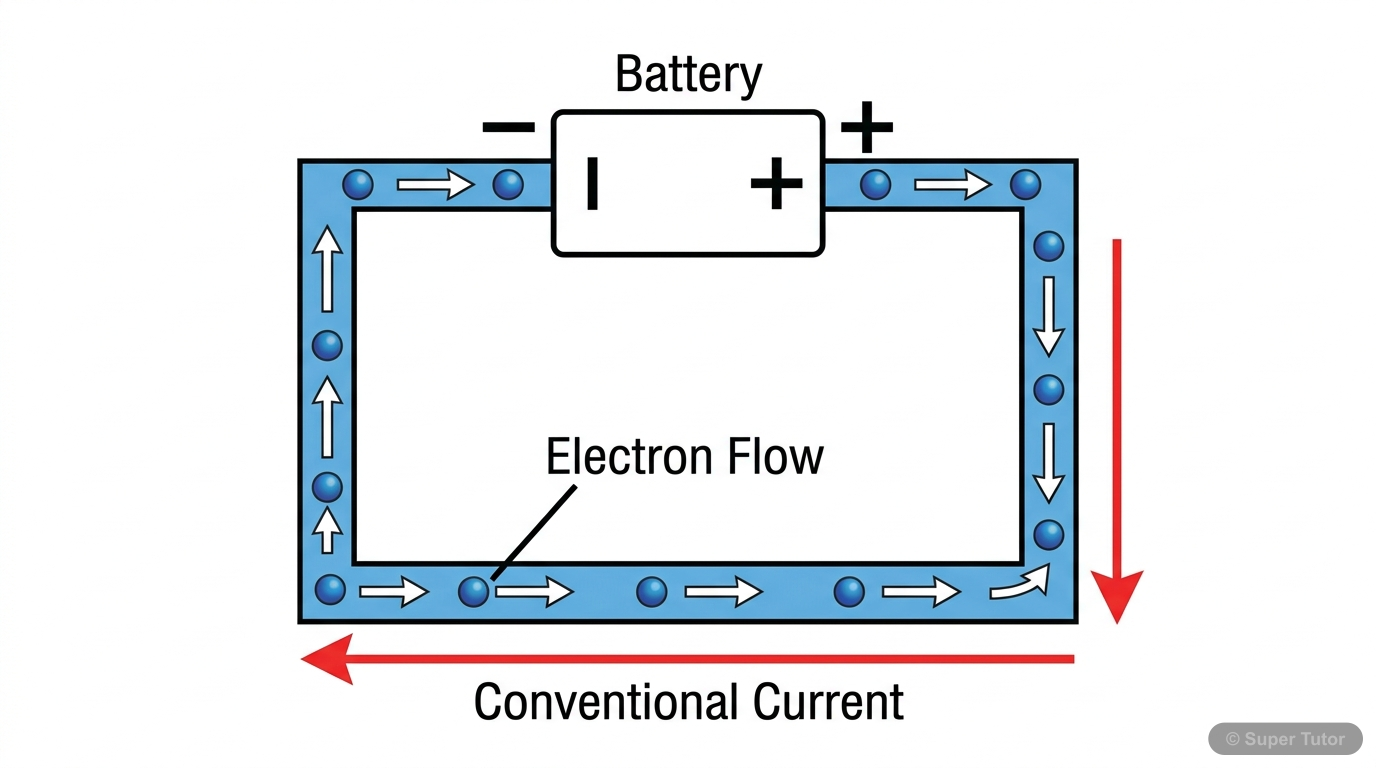
Learn better with visuals Super Tutor has hundreds of illustrations like this across every chapter — all free to try.
Get startedOverview
Current electricity is the branch of physics that deals with the flow of electric charges through conductors. Unlike static electricity where charges remain at rest, current electricity involves the continuous movement of electric charges, forming electric current. This chapter explores fundamental
Key Concepts
Electric current is defined as
Electric current is defined as the rate of flow of electric charge. It is given by i = Q/t, where Q is charge and t is time. The SI unit is ampere (A)
Electric potential at a point
Electric potential at a point is the work done in bringing unit positive charge from infinity to that point. Potential difference between two points i
Resistance is the opposition offered
Resistance is the opposition offered to the flow of current by a conductor. It depends on the material's nature, length (R ∝ l), area of cross-section
Ohm's law states that current through
Ohm's law states that current through a conductor is directly proportional to the potential difference across it, provided physical conditions remain
Resistivity (ρ) is the resistance
Resistivity (ρ) is the resistance of a material with unit length and unit cross-sectional area. Its unit is Ω-m. Conductivity (σ) is the reciprocal of
Learning Objectives
- Understand the concept of electric current and its measurement
- Explain electric potential and potential difference
- Define resistance and identify factors affecting it
- Apply Ohm's law to solve electrical circuit problems
- Distinguish between ohmic and non-ohmic resistors
Frequently Asked Questions
What are the important topics in Current Electricity for ICSE Class 10 Physics?
How to score full marks in Current Electricity — ICSE Class 10 Physics?
Sources & Official References
Content is aligned to the official syllabus. Refer to the board website for the latest curriculum.
More resources for Current Electricity
Important Questions
Practice with board exam-style questions
Syllabus
What topics to cover
Revision Notes
Key points for last-minute revision
Study Plan
Step-by-step plan to ace this chapter
Flashcards
Quick-fire cards for active recall
Formula Sheet
All formulas in one place
Practice Quiz
Test yourself with a quick quiz
Concept Maps
See how topics connect visually
For serious students
Get the full Current Electricity chapter — for free.
Quizzes, flashcards, AI doubt-solver and a step-by-step study plan for ICSE Class 10 Physics.