Force
ICSE · Class 10 · Physics
Summary of Force for ICSE Class 10 Physics. Key concepts, important points, and chapter overview.
Interactive on Super Tutor
Studying Force? Get the full interactive chapter.
Quizzes, flashcards, AI doubt-solver and a step-by-step study plan — built for chapter summary and more.
1,000+ Class 10 students started this chapter today
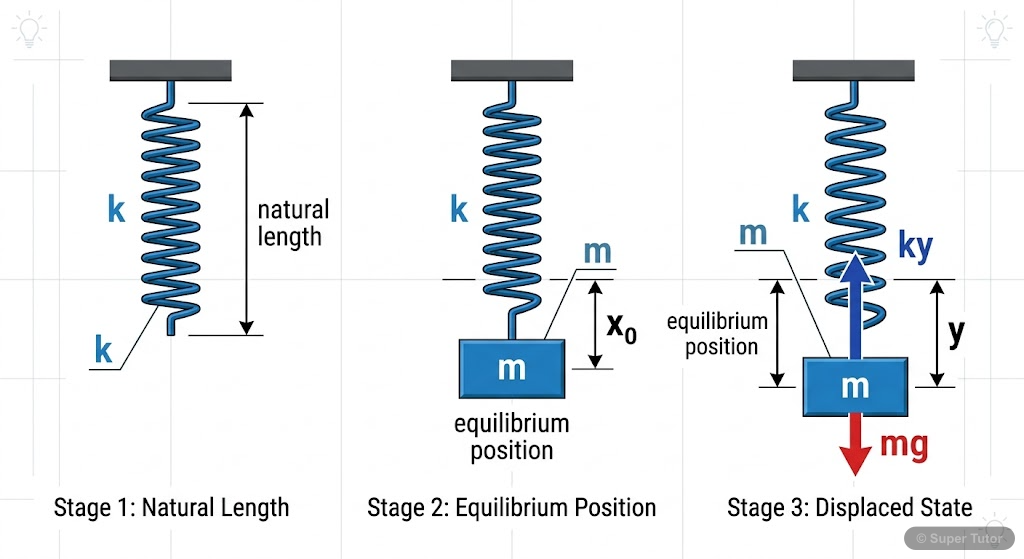
Learn better with visuals Super Tutor has hundreds of illustrations like this across every chapter — all free to try.
Get startedOverview
Force is one of the fundamental concepts in Physics that explains how objects interact with each other and how motion changes. A force is simply a push or pull that can change the state, size, or shape of an object. Understanding force helps us explain everything from why a ball falls to the ground
Key Concepts
Force is a push or pull
Force is a push or pull that can change the state, size, or shape of a body. Forces are classified into Contact Forces (friction, normal reaction, ten
Force is measured in different units
Force is measured in different units: Newton (N) in SI system, dyne in CGS system, and kilogram-force (kgf) in gravitational units. Key conversions: 1
First Law (Law of Inertia)
First Law (Law of Inertia): A body remains at rest or in uniform motion unless acted upon by an external force. Second Law: F = ma (force equals mass
The turning effect of force about
The turning effect of force about an axis of rotation. Mathematically, τ = F × r, where F is force and r is perpendicular distance from axis. Depends
A body is in equilibrium when
A body is in equilibrium when its state of rest or motion remains unchanged under applied forces. Two types: Static (body at rest) and Dynamic (body i
Learning Objectives
- Understand the definition and types of forces (contact and non-contact forces)
- Learn about units of force and conversion between different systems
- Recall Newton's laws of motion and their applications
- Understand moment of force (torque) and its factors
- Learn about equilibrium and its conditions
Frequently Asked Questions
What are the important topics in Force for ICSE Class 10 Physics?
How to score full marks in Force — ICSE Class 10 Physics?
Sources & Official References
Content is aligned to the official syllabus. Refer to the board website for the latest curriculum.
More resources for Force
Important Questions
Practice with board exam-style questions
Syllabus
What topics to cover
Revision Notes
Key points for last-minute revision
Study Plan
Step-by-step plan to ace this chapter
Flashcards
Quick-fire cards for active recall
Formula Sheet
All formulas in one place
Practice Quiz
Test yourself with a quick quiz
Concept Maps
See how topics connect visually
For serious students
Get the full Force chapter — for free.
Quizzes, flashcards, AI doubt-solver and a step-by-step study plan for ICSE Class 10 Physics.