Semiconductor Electronics: Materials, Devices and Simple Circuits
Kerala Board · Class 12 · Physics
Complete topic list for Semiconductor Electronics: Materials, Devices and Simple Circuits in Kerala Board Class 12 Physics. Key concepts, sub-topics, and what to focus on for board exams.
Interactive on Super Tutor
Studying Semiconductor Electronics: Materials, Devices and Simple Circuits? Get the full interactive chapter.
Quizzes, flashcards, AI doubt-solver and a step-by-step study plan — built for syllabus and more.
1,000+ Class 12 students started this chapter today
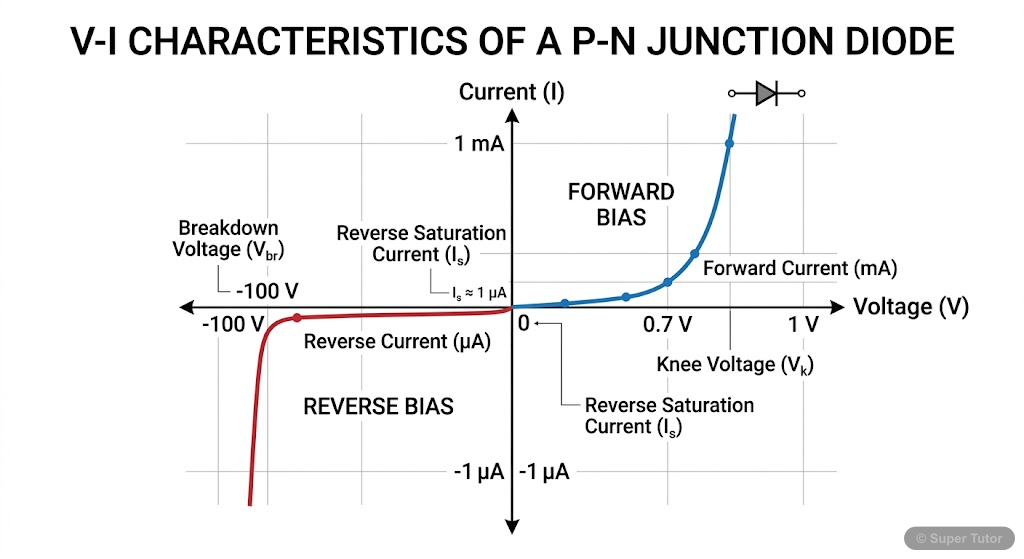
This is just one of 14+ visuals inside Super Tutor's Semiconductor Electronics: Materials, Devices and Simple Circuits chapter
Explore the full setTopics in Semiconductor Electronics: Materials, Devices and Simple Circuits
Classification of Materials
- Materials are classified into metals, semiconductors, and insulators based on electrical conductivity
- Metals have very low resistivity (10⁻² to 10⁻⁸ Ω m) and high conductivity (10² to 10⁸ S m⁻¹)
- Semiconductors have intermediate resistivity (10⁻⁵ to 10⁶ Ω m) and conductivity (10⁻⁶ to 10⁵ S m⁻¹)
Intrinsic Semiconductors
- Pure semiconductors like Si and Ge with no impurities are intrinsic semiconductors
- Silicon and germanium have diamond lattice structure with 4 valence electrons each
- Covalent bonding occurs between neighboring atoms sharing electron pairs
Extrinsic Semiconductors
- Doping pure semiconductors with impurities creates extrinsic semiconductors
- Dopant atoms must have similar size to host atoms to avoid lattice distortion
- Two types: n-type (pentavalent dopants) and p-type (trivalent dopants)
p-n Junction Formation
- p-n junction forms when p-type and n-type regions are created in same semiconductor
- Two processes occur: diffusion (due to concentration gradient) and drift (due to electric field)
- Electrons diffuse from n-side to p-side, holes diffuse from p-side to n-side
Key Concepts
Frequently Asked Questions
What are the important topics in Semiconductor Electronics: Materials, Devices and Simple Circuits for Kerala Board Class 12 Physics?
How to score full marks in Semiconductor Electronics: Materials, Devices and Simple Circuits — Kerala Board Class 12 Physics?
Sources & Official References
- Kerala Board of Public Examinations — keralapareekshabhavan.in
- National Education Policy 2020 — education.gov.in
Content is aligned to the official syllabus. Refer to the board website for the latest curriculum.
More resources for Semiconductor Electronics: Materials, Devices and Simple Circuits
Important Questions
Practice with board exam-style questions
Revision Notes
Key points for last-minute revision
Study Plan
Step-by-step plan to ace this chapter
Flashcards
Quick-fire cards for active recall
Formula Sheet
All formulas in one place
Chapter Summary
Understand the chapter at a glance
Practice Quiz
Test yourself with a quick quiz
Concept Maps
See how topics connect visually
For serious students
Get the full Semiconductor Electronics: Materials, Devices and Simple Circuits chapter — for free.
Quizzes, flashcards, AI doubt-solver and a step-by-step study plan for Kerala Board Class 12 Physics.