Semiconductor Electronics: Materials, Devices and Simple Circuits
Kerala Board · Class 12 · Physics
Summary of Semiconductor Electronics: Materials, Devices and Simple Circuits for Kerala Board Class 12 Physics. Key concepts, important points, and chapter overview.
Interactive on Super Tutor
Studying Semiconductor Electronics: Materials, Devices and Simple Circuits? Get the full interactive chapter.
Quizzes, flashcards, AI doubt-solver and a step-by-step study plan — built for chapter summary and more.
1,000+ Class 12 students started this chapter today
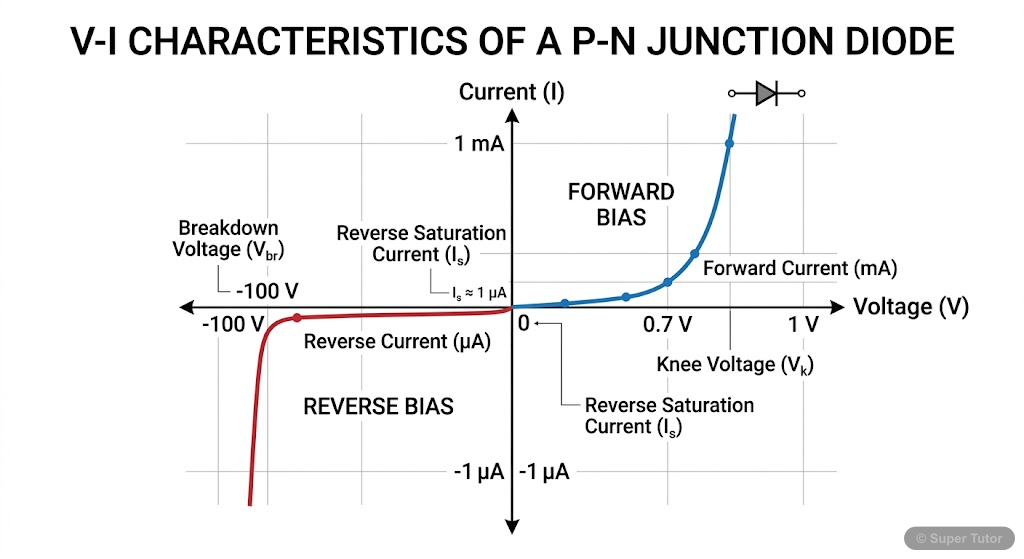
This is just one of 14+ visuals inside Super Tutor's Semiconductor Electronics: Materials, Devices and Simple Circuits chapter
Explore the full setOverview
Semiconductor electronics forms the foundation of modern electronic devices that surround us daily - from smartphones to computers to LED lights. This chapter explores how semiconductors work, their types, and how they form the basic building blocks of electronic circuits. Understanding semiconducto
Key Concepts
Materials are classified based on electrical
Materials are classified based on electrical conductivity: Metals (σ ~ 10² - 10⁸ S/m), Semiconductors (σ ~ 10⁻⁶ - 10⁵ S/m), and Insulators (σ ~ 10⁻¹⁹
Pure semiconductors like Silicon (Si)
Pure semiconductors like Silicon (Si) and Germanium (Ge) where atoms form covalent bonds. At absolute zero, all electrons are bound. With thermal ener
Doped semiconductors created by adding impurities
Doped semiconductors created by adding impurities. N-type: Doped with pentavalent atoms (P, As, Sb) providing extra electrons (ne >> nh). P-type: Dope
When p
When p-type and n-type materials are joined, electrons diffuse from n to p region and holes from p to n region. This creates a depletion region with i
Forward bias
Forward bias: p-side positive, n-side negative, reduces barrier height, allows significant current flow (mA range). Reverse bias: p-side negative, n-s
Learning Objectives
- Understand the classification of materials based on conductivity and energy band structure
- Learn about intrinsic and extrinsic semiconductors and their charge carriers
- Comprehend the formation and behavior of p-n junctions
- Analyze the characteristics of semiconductor diodes under forward and reverse bias
- Apply knowledge of diodes in rectifier circuits for AC to DC conversion
Frequently Asked Questions
What are the important topics in Semiconductor Electronics: Materials, Devices and Simple Circuits for Kerala Board Class 12 Physics?
How to score full marks in Semiconductor Electronics: Materials, Devices and Simple Circuits — Kerala Board Class 12 Physics?
Sources & Official References
- Kerala Board of Public Examinations — keralapareekshabhavan.in
- National Education Policy 2020 — education.gov.in
Content is aligned to the official syllabus. Refer to the board website for the latest curriculum.
More resources for Semiconductor Electronics: Materials, Devices and Simple Circuits
Important Questions
Practice with board exam-style questions
Syllabus
What topics to cover
Revision Notes
Key points for last-minute revision
Study Plan
Step-by-step plan to ace this chapter
Flashcards
Quick-fire cards for active recall
Formula Sheet
All formulas in one place
Practice Quiz
Test yourself with a quick quiz
Concept Maps
See how topics connect visually
For serious students
Get the full Semiconductor Electronics: Materials, Devices and Simple Circuits chapter — for free.
Quizzes, flashcards, AI doubt-solver and a step-by-step study plan for Kerala Board Class 12 Physics.