Climate
NIOS · Class 10 · Social Studies
Step-by-step guide to study Climate in NIOS Class 10 Social Studies. Topics to cover, practice strategy, and time allocation.
Interactive on Super Tutor
Studying Climate? Get the full interactive chapter.
Quizzes, flashcards, AI doubt-solver and a step-by-step study plan — built for study plan and more.
1,000+ Class 10 students started this chapter today
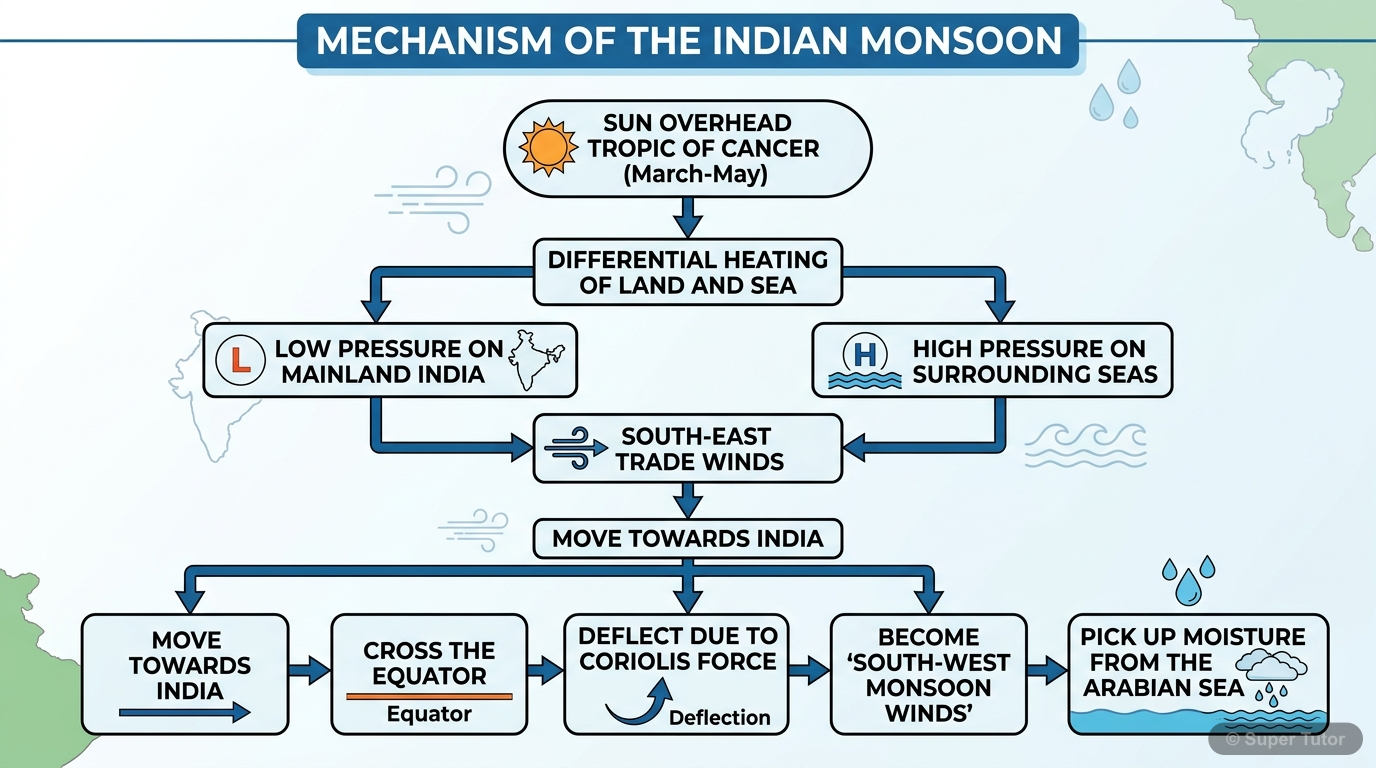
Learn better with visuals Super Tutor has hundreds of illustrations like this across every chapter — all free to try.
Get startedStudy Plan
Learn the Theory
Read the textbook chapter carefully. Note down definitions, formulas, and key concepts.
Practice Problems
Solve textbook exercises and additional practice questions. There are 89 questions available for this chapter.
Revise & Test
Revise key formulas and concepts without looking at notes. Take a practice quiz to test your understanding. Mark weak areas for re-revision.
Spaced Revision
Revisit Climate after a week. Use flashcards for quick recall. Solve previous year questions from this chapter.
What to Focus On
- Latitude: Tropic of Cancer divides India into tropical south and subtropical north
- Distance from sea: Coastal areas have moderate climate, interior areas have extreme climate
- Altitude: Temperature decreases with height, hill stations remain cooler
- Monsoon means seasonal reversal of wind direction
- Summer heating creates low pressure over North Indian plains
- Indian Ocean remains cooler, creating high pressure area
- Four seasons: Cold weather, Hot weather, Advancing monsoon, Retreating monsoon
- Winter: Cold, dry conditions with northeast trade winds
- Summer: High temperatures, Loo winds, dust storms, and thunderstorms
Common Mistakes to Avoid
Monsoon winds always bring rain wherever they blow
Higher altitude always means lower temperature in all seasons
Trade winds and monsoon winds are the same thing
Memory Tips
Factors affecting climate of India
Monsoon mechanism
Four seasons of India
Tropic of Cancer passes through India at 23.5°N
Want a personalised study plan?
Super Tutor creates a day-by-day plan for NIOS Class 10 Social Studies that adapts to your exam date and pace.
Create My Study Plan — FreeFrequently Asked Questions
What are the important topics in Climate for NIOS Class 10 Social Studies?
How to score full marks in Climate — NIOS Class 10 Social Studies?
Sources & Official References
Content is aligned to the official syllabus. Refer to the board website for the latest curriculum.
More resources for Climate
Important Questions
Practice with board exam-style questions
Syllabus
What topics to cover
Revision Notes
Key points for last-minute revision
Flashcards
Quick-fire cards for active recall
Formula Sheet
All formulas in one place
Chapter Summary
Understand the chapter at a glance
Practice Quiz
Test yourself with a quick quiz
Concept Maps
See how topics connect visually
For serious students
Get the full Climate chapter — for free.
Quizzes, flashcards, AI doubt-solver and a step-by-step study plan for NIOS Class 10 Social Studies.