Biomolecules
CBSE · Class 12 · Chemistry
Summary of Biomolecules for CBSE Class 12 Chemistry. Key concepts, important points, and chapter overview.
Interactive on Super Tutor
Studying Biomolecules? Get the full interactive chapter.
Quizzes, flashcards, AI doubt-solver and a step-by-step study plan — built for chapter summary and more.
1,000+ Class 12 students started this chapter today
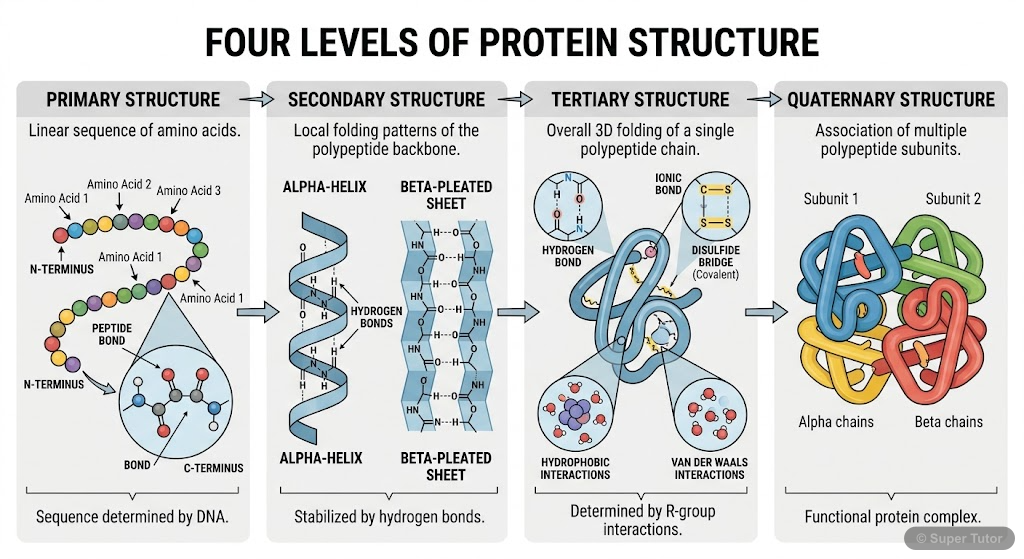
Super Tutor has 32+ illustrations like this for Biomolecules alone — flashcards, concept maps, and step-by-step visuals.
See them allOverview
Biomolecules are the fundamental building blocks of life, composed of non-living atoms and molecules that form living systems. This chapter explores the four major classes of biomolecules - carbohydrates, proteins, nucleic acids, and lipids - along with vitamins, enzymes, and hormones. Understanding
Key Concepts
Optically active polyhydroxy aldehydes or ketones
Optically active polyhydroxy aldehydes or ketones with general formula Cx(H2O)y. Classified into monosaccharides (glucose, fructose), disaccharides (s
Polymers of α
Polymers of α-amino acids connected by peptide bonds. Amino acids are classified as acidic, basic, or neutral, and as essential or non-essential. Prot
Biocatalysts that are mostly globular proteins
Biocatalysts that are mostly globular proteins, highly specific for particular reactions and substrates. They reduce activation energy and are named a
Organic compounds required in small amounts
Organic compounds required in small amounts for normal growth and health. Classified as fat-soluble (A, D, E, K) stored in liver and adipose tissues,
Polynucleotides composed of nucleotides (base +
Polynucleotides composed of nucleotides (base + pentose sugar + phosphoric acid). DNA contains deoxyribose and bases A, T, G, C with double helix stru
Learning Objectives
- Explain the characteristics and classification of carbohydrates, proteins, nucleic acids, and hormones
- Classify biomolecules based on their structures and functional groups
- Differentiate between DNA and RNA in terms of structure and function
- Describe the role of biomolecules in biological systems
- Understand the importance of vitamins and enzymes in living organisms
Frequently Asked Questions
What are the important topics in Biomolecules for CBSE Class 12 Chemistry?
How to score full marks in Biomolecules — CBSE Class 12 Chemistry?
Sources & Official References
- NCERT Official — ncert.nic.in
- CBSE Academic — cbseacademic.nic.in
- CBSE Official — cbse.gov.in
- National Education Policy 2020 — education.gov.in
Content is aligned to the official syllabus. Refer to the board website for the latest curriculum.
More resources for Biomolecules
Important Questions
Practice with board exam-style questions
Syllabus
What topics to cover
Revision Notes
Key points for last-minute revision
Study Plan
Step-by-step plan to ace this chapter
Flashcards
Quick-fire cards for active recall
Formula Sheet
All formulas in one place
Practice Quiz
Test yourself with a quick quiz
Concept Maps
See how topics connect visually
For serious students
Get the full Biomolecules chapter — for free.
Quizzes, flashcards, AI doubt-solver and a step-by-step study plan for CBSE Class 12 Chemistry.