Solutions
CBSE · Class 12 · Chemistry
Summary of Solutions for CBSE Class 12 Chemistry. Key concepts, important points, and chapter overview.
Interactive on Super Tutor
Studying Solutions? Get the full interactive chapter.
Quizzes, flashcards, AI doubt-solver and a step-by-step study plan — built for chapter summary and more.
1,000+ Class 12 students started this chapter today
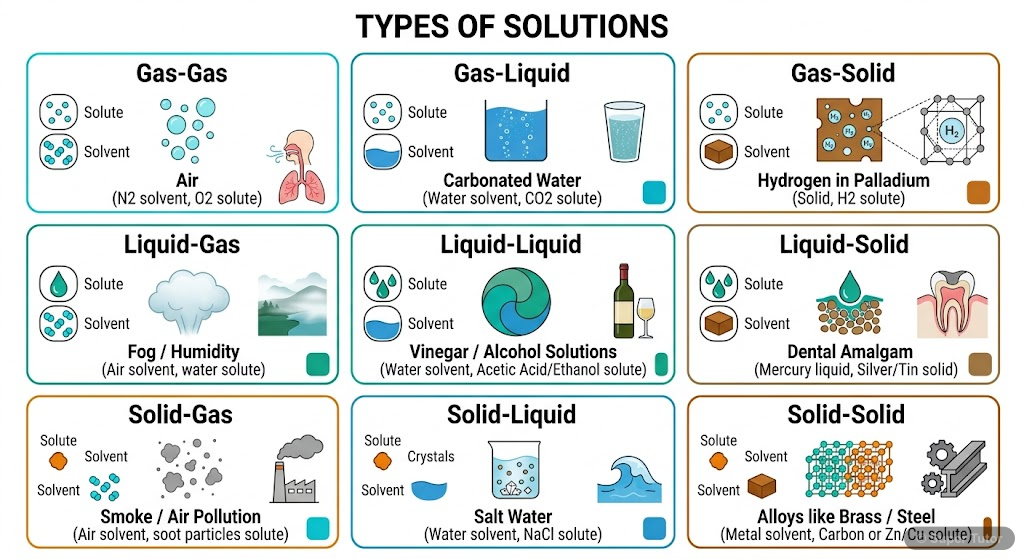
Super Tutor has 18+ illustrations like this for Solutions alone — flashcards, concept maps, and step-by-step visuals.
See them allOverview
Solutions are homogeneous mixtures of two or more substances that play a crucial role in chemistry and daily life. From the salt water we drink to the blood flowing in our veins, solutions are everywhere. This chapter explores the formation, properties, and behavior of different types of solutions,
Key Concepts
Solutions are classified based on physical
Solutions are classified based on physical states: Gaseous (gas in gas like air), Liquid (solid/liquid/gas in liquid like sugar in water), and Solid (
Mass % = (mass of component/total
Mass % = (mass of component/total mass) × 100; Volume % = (volume of component/total volume) × 100; ppm = (parts of component/total parts) × 10⁶; Mole
At constant temperature
At constant temperature, gas solubility in liquid is directly proportional to its partial pressure: p = KH × x, where KH is Henry's law constant. High
For volatile liquids
For volatile liquids: partial vapor pressure = vapor pressure of pure component × mole fraction (p₁ = p₁⁰ × x₁). For non-volatile solutes: relative lo
Ideal solutions obey Raoult's law completely
Ideal solutions obey Raoult's law completely with ΔmixH = 0 and ΔmixV = 0. Non-ideal show positive deviation (weaker A-B interactions) or negative dev
Learning Objectives
- Understand the formation and classification of different types of solutions (gaseous, liquid, and solid)
- Express solution concentration using various units: mass percentage, volume percentage, ppm, mole fraction, molarity, and molality
- Apply Henry's law to understand gas solubility in liquids under different pressure conditions
- Explain Raoult's law and distinguish between ideal and non-ideal solutions with their deviations
- Calculate colligative properties: vapor pressure lowering, boiling point elevation, freezing point depression, and osmotic pressure
Frequently Asked Questions
What are the important topics in Solutions for CBSE Class 12 Chemistry?
How to score full marks in Solutions — CBSE Class 12 Chemistry?
Sources & Official References
- NCERT Official — ncert.nic.in
- CBSE Academic — cbseacademic.nic.in
- CBSE Official — cbse.gov.in
- National Education Policy 2020 — education.gov.in
Content is aligned to the official syllabus. Refer to the board website for the latest curriculum.
More resources for Solutions
Important Questions
Practice with board exam-style questions
Syllabus
What topics to cover
Revision Notes
Key points for last-minute revision
Study Plan
Step-by-step plan to ace this chapter
Flashcards
Quick-fire cards for active recall
Formula Sheet
All formulas in one place
Practice Quiz
Test yourself with a quick quiz
Concept Maps
See how topics connect visually
For serious students
Get the full Solutions chapter — for free.
Quizzes, flashcards, AI doubt-solver and a step-by-step study plan for CBSE Class 12 Chemistry.