Coordination Compounds
CBSE · Class 12 · Chemistry
Summary of Coordination Compounds for CBSE Class 12 Chemistry. Key concepts, important points, and chapter overview.
Interactive on Super Tutor
Studying Coordination Compounds? Get the full interactive chapter.
Quizzes, flashcards, AI doubt-solver and a step-by-step study plan — built for chapter summary and more.
1,000+ Class 12 students started this chapter today
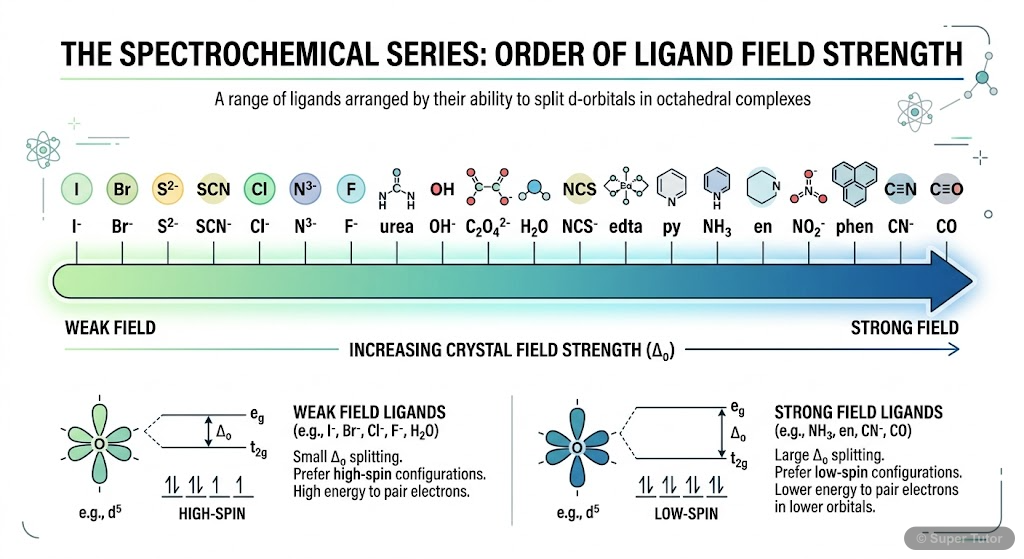
Super Tutor has 22+ illustrations like this for Coordination Compounds alone — flashcards, concept maps, and step-by-step visuals.
See them allOverview
Coordination compounds represent one of the most fascinating areas of inorganic chemistry, forming the backbone of modern industrial processes and biological systems. These compounds, where central metal atoms are surrounded by ligands in specific geometric arrangements, are essential components in
Key Concepts
Alfred Werner proposed that metals exhibit
Alfred Werner proposed that metals exhibit two types of valences: Primary valence (ionizable, satisfied by negative ions) and Secondary valence (non-i
Coordination Entity
Coordination Entity: Central metal atom/ion bonded to fixed number of ligands (e.g., [Co(NH₃)₆]³⁺). Central atom/ion: The metal atom receiving electro
Formula writing
Formula writing: Central atom first, ligands alphabetically, entire coordination entity in square brackets. Naming: Ligands named alphabetically befor
Two main types
Two main types: Stereoisomerism (same bonds, different spatial arrangements) includes geometric (cis-trans in square planar/octahedral) and optical is
Metal uses hybrid orbitals (sp³
Metal uses hybrid orbitals (sp³, dsp², d²sp³, sp³d²) to bond with ligands. Inner orbital complexes (d²sp³) use inner d orbitals, often low spin. Outer
Learning Objectives
- Understand Werner's theory and its postulates regarding primary and secondary valences
- Master the terminology: coordination entity, central atom/ion, ligand, coordination number, coordination sphere
- Learn IUPAC nomenclature rules for coordination compounds
- Identify and classify different types of isomerism in coordination compounds
- Apply Valence Bond Theory to explain bonding, geometry, and magnetic properties
Frequently Asked Questions
What are the important topics in Coordination Compounds for CBSE Class 12 Chemistry?
How to score full marks in Coordination Compounds — CBSE Class 12 Chemistry?
Sources & Official References
- NCERT Official — ncert.nic.in
- CBSE Academic — cbseacademic.nic.in
- CBSE Official — cbse.gov.in
- National Education Policy 2020 — education.gov.in
Content is aligned to the official syllabus. Refer to the board website for the latest curriculum.
More resources for Coordination Compounds
Important Questions
Practice with board exam-style questions
Syllabus
What topics to cover
Revision Notes
Key points for last-minute revision
Study Plan
Step-by-step plan to ace this chapter
Flashcards
Quick-fire cards for active recall
Formula Sheet
All formulas in one place
Practice Quiz
Test yourself with a quick quiz
Concept Maps
See how topics connect visually
For serious students
Get the full Coordination Compounds chapter — for free.
Quizzes, flashcards, AI doubt-solver and a step-by-step study plan for CBSE Class 12 Chemistry.