Coordination Compounds
CBSE · Class 12 · Chemistry
Quick revision notes for Coordination Compounds — CBSE Class 12 Chemistry. Key concepts, formulas, and definitions for last-minute revision.
Interactive on Super Tutor
Studying Coordination Compounds? Get the full interactive chapter.
Quizzes, flashcards, AI doubt-solver and a step-by-step study plan — built for revision notes and more.
1,000+ Class 12 students started this chapter today
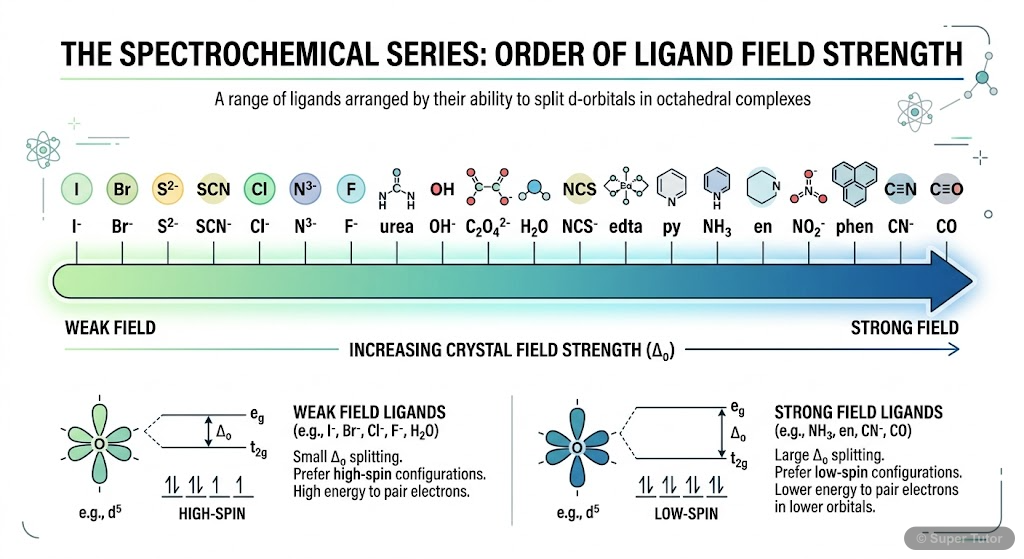
Super Tutor has 22+ illustrations like this for Coordination Compounds alone — flashcards, concept maps, and step-by-step visuals.
See them allKey Topics to Revise
Werner's Theory and Basic Concepts
- Alfred Werner proposed primary valence (oxidation state) and secondary valence (coordination number)
- Primary valences are ionizable and satisfied by anions, secondary valences are non-ionizable
- Coordination entities have definite geometry: octahedral (CN=6), tetrahedral (CN=4), square planar (CN=4)
Ligand Types and Denticity
- Unidentate ligands: Cl⁻, NH₃, H₂O, CN⁻ (one donor atom)
- Bidentate ligands: en (ethylenediamine), ox²⁻ (oxalate) (two donor atoms)
- Polydentate ligands: EDTA⁴⁻ (hexadentate - 6 donor atoms)
IUPAC Nomenclature Rules
- Cation named first, then anion (regardless of which contains complex)
- Within coordination sphere: ligands named alphabetically before metal
- Anionic ligands end in -o (chlorido, cyano, oxalato)
Isomerism in Coordination Compounds
- Structural Isomerism: Different bonding patterns - linkage, coordination, ionization, solvate
- Stereoisomerism: Same bonds, different spatial arrangements - geometrical and optical
- Geometrical isomerism: cis-trans in square planar/octahedral, fac-mer in octahedral
Get complete notes with diagrams and examples
Full NotesKey Concepts
Frequently Asked Questions
What are the important topics in Coordination Compounds for CBSE Class 12 Chemistry?
How to score full marks in Coordination Compounds — CBSE Class 12 Chemistry?
Sources & Official References
- NCERT Official — ncert.nic.in
- CBSE Academic — cbseacademic.nic.in
- CBSE Official — cbse.gov.in
- National Education Policy 2020 — education.gov.in
Content is aligned to the official syllabus. Refer to the board website for the latest curriculum.
More resources for Coordination Compounds
Important Questions
Practice with board exam-style questions
Syllabus
What topics to cover
Study Plan
Step-by-step plan to ace this chapter
Flashcards
Quick-fire cards for active recall
Formula Sheet
All formulas in one place
Chapter Summary
Understand the chapter at a glance
Practice Quiz
Test yourself with a quick quiz
Concept Maps
See how topics connect visually
For serious students
Get the full Coordination Compounds chapter — for free.
Quizzes, flashcards, AI doubt-solver and a step-by-step study plan for CBSE Class 12 Chemistry.