Solutions
CBSE · Class 12 · Chemistry
Quick revision notes for Solutions — CBSE Class 12 Chemistry. Key concepts, formulas, and definitions for last-minute revision.
Interactive on Super Tutor
Studying Solutions? Get the full interactive chapter.
Quizzes, flashcards, AI doubt-solver and a step-by-step study plan — built for revision notes and more.
1,000+ Class 12 students started this chapter today
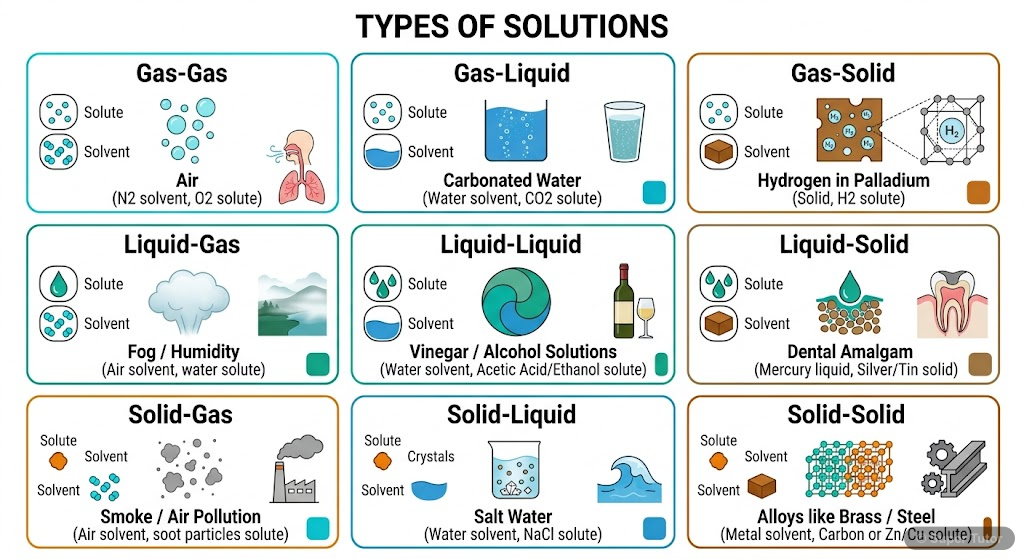
Super Tutor has 18+ illustrations like this for Solutions alone — flashcards, concept maps, and step-by-step visuals.
See them allKey Topics to Revise
Types of Solutions and Basic Concepts
- Solution = Solute + Solvent (homogeneous mixture with uniform properties throughout)
- Solvent: Component present in largest quantity, determines physical state of solution
- Solute: Component(s) present in smaller quantities
Concentration Units and Calculations
- Six major concentration units: Mass %, Volume %, Mass/Volume %, ppm, Mole fraction, Molality
- Mass percentage most common for solid-liquid solutions
- Volume percentage used for liquid-liquid solutions
Solubility and Henry's Law
- Solubility depends on nature of solute-solvent, temperature, and pressure
- For solids in liquids: Generally increases with temperature (endothermic dissolution)
- Pressure has negligible effect on solid-liquid solubility
Raoult's Law and Vapor Pressure
- Vapor pressure of solution < vapor pressure of pure solvent (for non-volatile solute)
- Raoult's Law: Partial vapor pressure ∝ mole fraction
- For volatile liquid solutions: p_total = p₁⁰x₁ + p₂⁰x₂
Get complete notes with diagrams and examples
Full NotesKey Concepts
Frequently Asked Questions
What are the important topics in Solutions for CBSE Class 12 Chemistry?
How to score full marks in Solutions — CBSE Class 12 Chemistry?
Sources & Official References
- NCERT Official — ncert.nic.in
- CBSE Academic — cbseacademic.nic.in
- CBSE Official — cbse.gov.in
- National Education Policy 2020 — education.gov.in
Content is aligned to the official syllabus. Refer to the board website for the latest curriculum.
More resources for Solutions
Important Questions
Practice with board exam-style questions
Syllabus
What topics to cover
Study Plan
Step-by-step plan to ace this chapter
Flashcards
Quick-fire cards for active recall
Formula Sheet
All formulas in one place
Chapter Summary
Understand the chapter at a glance
Practice Quiz
Test yourself with a quick quiz
Concept Maps
See how topics connect visually
For serious students
Get the full Solutions chapter — for free.
Quizzes, flashcards, AI doubt-solver and a step-by-step study plan for CBSE Class 12 Chemistry.