Application of Derivatives
CBSE · Class 12 · Mathematics
Flashcards for Application of Derivatives — CBSE Class 12 Mathematics. Quick Q&A cards covering key concepts, definitions, and formulas.
Interactive on Super Tutor
Studying Application of Derivatives? Get the full interactive chapter.
Quizzes, flashcards, AI doubt-solver and a step-by-step study plan — built for flashcards and more.
1,000+ Class 12 students started this chapter today
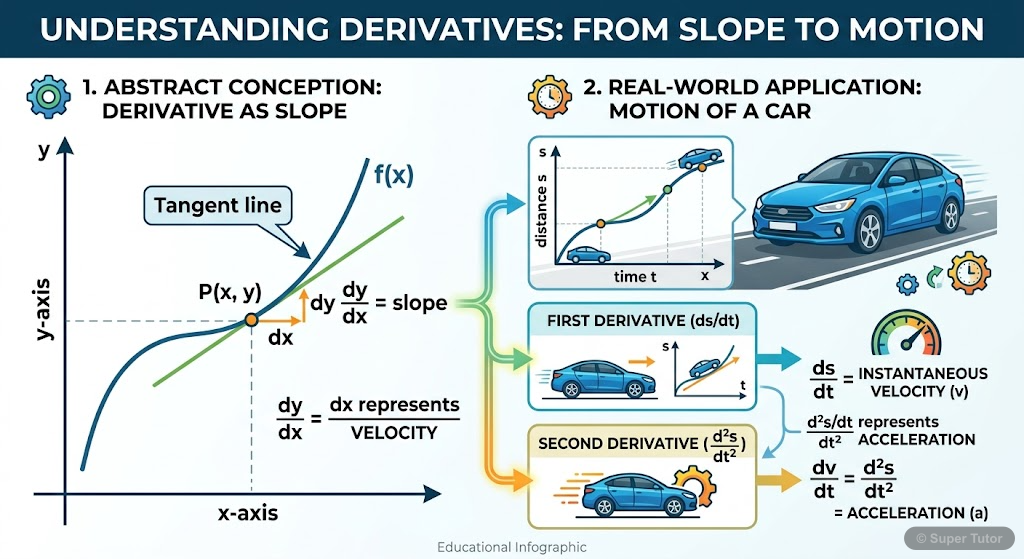
Super Tutor has 9+ illustrations like this for Application of Derivatives alone — flashcards, concept maps, and step-by-step visuals.
See them allWhat does dy/dx represent in the context of rate of change?
Answer
dy/dx represents the rate of change of quantity y with respect to quantity x. If y = f(x), then dy/dx (or f'(x)) gives how fast y changes when x changes. At a specific point x₀, dy/dx|x=x₀ represents …
If x = f(t) and y = g(t), how do you find dy/dx using the chain rule?
Answer
Using the chain rule: dy/dx = (dy/dt)/(dx/dt), provided dx/dt ≠ 0. This formula helps find the rate of change of y with respect to x when both variables are functions of a third variable t.
Define an increasing function on an interval I.
Answer
A function f is increasing on interval I if for any two points x₁ < x₂ in I, we have f(x₁) < f(x₂). In other words, as x increases, f(x) also increases. Mathematically: x₁ < x₂ ⟹ f(x₁) < f(x₂) for all…
Define a decreasing function on an interval I.
Answer
A function f is decreasing on interval I if for any two points x₁ < x₂ in I, we have f(x₁) > f(x₂). In other words, as x increases, f(x) decreases. Mathematically: x₁ < x₂ ⟹ f(x₁) > f(x₂) for all x₁, …
How do you use derivatives to determine if a function is increasing or decreasing?
Answer
For a differentiable function f on interval I: • If f'(x) > 0 for all x ∈ I, then f is increasing on I • If f'(x) < 0 for all x ∈ I, then f is decreasing on I • If f'(x) = 0 for all x ∈ I, then f is c…
What is a critical point of a function?
Answer
A point c in the domain of function f is called a critical point if either: 1. f'(c) = 0, or 2. f is not differentiable at c Critical points are important because local maxima and minima can only occu…
Define local maximum and local minimum of a function.
Answer
Local Maximum: Point c is a local maximum if there exists h > 0 such that f(c) ≥ f(x) for all x in (c-h, c+h), x ≠ c. Local Minimum: Point c is a local minimum if there exists h > 0 such that f(c) ≤ …
State the First Derivative Test for finding local extrema.
Answer
For a continuous function f at critical point c: • If f'(x) changes from positive to negative as x passes through c, then c is a local maximum • If f'(x) changes from negative to positive as x passes …
+14 more flashcards available
Practice AllFrequently Asked Questions
What are the important topics in Application of Derivatives for CBSE Class 12 Mathematics?
How to score full marks in Application of Derivatives — CBSE Class 12 Mathematics?
How many flashcards are available for Application of Derivatives?
Sources & Official References
- NCERT Official — ncert.nic.in
- CBSE Academic — cbseacademic.nic.in
- CBSE Official — cbse.gov.in
- National Education Policy 2020 — education.gov.in
Content is aligned to the official syllabus. Refer to the board website for the latest curriculum.
More resources for Application of Derivatives
Important Questions
Practice with board exam-style questions
Syllabus
What topics to cover
Revision Notes
Key points for last-minute revision
Study Plan
Step-by-step plan to ace this chapter
Formula Sheet
All formulas in one place
Chapter Summary
Understand the chapter at a glance
Practice Quiz
Test yourself with a quick quiz
Concept Maps
See how topics connect visually
For serious students
Get the full Application of Derivatives chapter — for free.
Quizzes, flashcards, AI doubt-solver and a step-by-step study plan for CBSE Class 12 Mathematics.